8. The Investigation Begins: Reconstructing a Catastrophic Failure
The National Transportation Safety Board took responsibility for investigating the accident. Its task was not simply to identify the part that broke. Investigators had to determine why it failed, what systems were affected, how the aircraft responded, what the crew could see, and whether organizational or regulatory failures contributed.
The investigation involved examining the wreckage, reviewing maintenance records, studying flight recorder data, interviewing witnesses, analyzing the aircraft's design, and conducting engineering tests.
The left engine and pylon assembly became a central focus. Investigators examined the structural components that connected the engine to the wing and looked for evidence of overload, fatigue, cracking, and damage.
The aircraft's hydraulic and electrical systems were also examined. Investigators needed to understand how the engine separation affected the slats and warning systems, and how those changes altered the airplane's ability to generate lift.
Flight recorder information helped reconstruct the aircraft's speed, altitude, attitude, and control inputs. Witness accounts and photographs provided additional evidence about the sequence of events outside the aircraft.
The investigation also expanded beyond the specific aircraft. The NTSB examined maintenance practices, FAA oversight, communications between the airline and manufacturer, and earlier incidents involving damage to engine pylon structures.
This broader approach was essential. A single failed component may be the immediate trigger of an accident, but aviation disasters often arise from several layers of weakness. The physical failure, the maintenance method, the inspection process, the reporting system, and the design all need to be understood together.
The NTSB's final report was adopted on December 21, 1979. It concluded that maintenance-induced damage led to the failure of the pylon structure and the separation of the left engine and pylon assembly. The report also identified additional contributing factors involving design vulnerability, oversight, communication, and operational procedures.
The findings showed that Flight 191 was not simply an isolated mechanical failure. It was a case in which weaknesses across several parts of the aviation safety system aligned at the worst possible moment.
9. The Maintenance Procedure at the Center of the Disaster
One of the most consequential discoveries was that the engine pylon had been damaged during maintenance before the accident flight. The issue involved the way the engine and pylon assembly had been removed and reinstalled.
Aircraft engines require periodic maintenance. They may need to be removed for inspection, repair, replacement, or other work. Because the engine is heavy and attached to the wing through a complex structural assembly, the removal and installation process must follow carefully controlled procedures.
The NTSB found that American Airlines had used a procedure involving a forklift to support and move the engine and pylon assembly. The procedure differed from the manufacturer's recommended method, which involved separating the engine from the pylon before removing the pylon from the wing.
The concern was not simply that a forklift had been used. The problem was how the assembly was supported and moved during the process. If the engine and pylon are not properly aligned or supported, substantial loads can be transferred through structural points that are not intended to withstand them in that manner.
The investigation determined that improper maintenance procedures caused damage to the pylon structure. The damage included cracking and structural weakening that eventually led to failure under the loads experienced during takeoff.
This finding was especially significant because the aircraft had appeared serviceable before departure. The structural damage was not obvious to the passengers or crew. It was hidden within a critical attachment structure, where it could worsen over time and remain undetected until the aircraft was subjected to the forces of takeoff.
The accident demonstrated that maintenance safety depends on more than whether a task is completed. It depends on whether the task is performed using approved methods, suitable equipment, correct alignment, and adequate inspection.
A procedure that seems faster or more convenient can introduce risks if it changes how loads are applied to an aircraft structure. In commercial aviation, even small deviations can have serious consequences when they involve components that carry major structural forces.
10. Why the Damage Was Not Detected Before the Flight
A natural question follows: if the pylon had been damaged during maintenance, why was the aircraft allowed to fly?
The answer involves the difficulty of detecting damage inside a complex aircraft structure and the limitations of the inspection and reporting systems in place at the time.
The pylon structure contained attachment points and internal surfaces that were not necessarily easy to inspect through a routine visual check. Damage could develop in areas that were hidden or difficult to access. If an inspection procedure did not require the relevant area to be examined in a way that revealed the damage, a weakened component could remain in service.
The NTSB also examined the broader maintenance and oversight environment. The investigation found deficiencies in the FAA's surveillance and reporting systems that failed to detect and prevent the use of improper maintenance procedures.
This did not mean that every maintenance worker or inspector had ignored an obvious warning. The issue was systemic: procedures, supervision, reporting, and communication had not adequately identified and controlled a dangerous practice.
Aircraft maintenance is built around layers of protection. Manufacturers publish instructions, airlines develop maintenance programs, technicians perform the work, inspectors verify critical tasks, and regulators oversee compliance. Each layer is intended to catch problems before an aircraft returns to service.
Flight 191 showed how those layers can fail together. A damaging procedure was used, the resulting structural damage was not identified before the accident, and information about previous damage incidents had not been effectively shared across the relevant organizations.
The lesson was not that maintenance should be treated with suspicion. It was that maintenance must be treated as a safety-critical operation equal in importance to flight operations. A plane can be designed with sophisticated systems and flown by experienced pilots, but those protections cannot compensate for hidden structural damage that enters service undetected.
11. The Design Vulnerabilities Identified by Investigators
The NTSB did not place the entire explanation on the maintenance procedure alone. The board also identified vulnerabilities in the aircraft's design.
One issue involved the pylon attachment points. Their design made them vulnerable to damage from the improper maintenance method. A robust safety system should consider not only the loads an aircraft experiences in normal operation but also the possibility that components may be mishandled during maintenance.
The investigation also identified vulnerability in the leading-edge slat system. When hydraulic pressure was lost, the slats on the affected section of the left wing were able to retract under aerodynamic loads. That created the asymmetric wing configuration that contributed directly to the stall and loss of control.
The design issue was not simply that the aircraft had hydraulic systems. Hydraulic systems are common in large aircraft and perform essential functions. The concern was that the particular failure sequence allowed the loss of hydraulic pressure to produce an unintended change in the wing's high-lift configuration during a critical phase of flight.
The NTSB's findings highlighted how design choices can interact. The pylon attachment structure was vulnerable to maintenance damage; the hydraulic lines were exposed to damage when the assembly separated; and the slat system could move into a hazardous configuration after pressure was lost.
A single design feature may be acceptable when considered on its own. But safety engineering requires looking at how components behave when several failures occur together. The Flight 191 investigation emphasized the importance of evaluating those combined failure scenarios.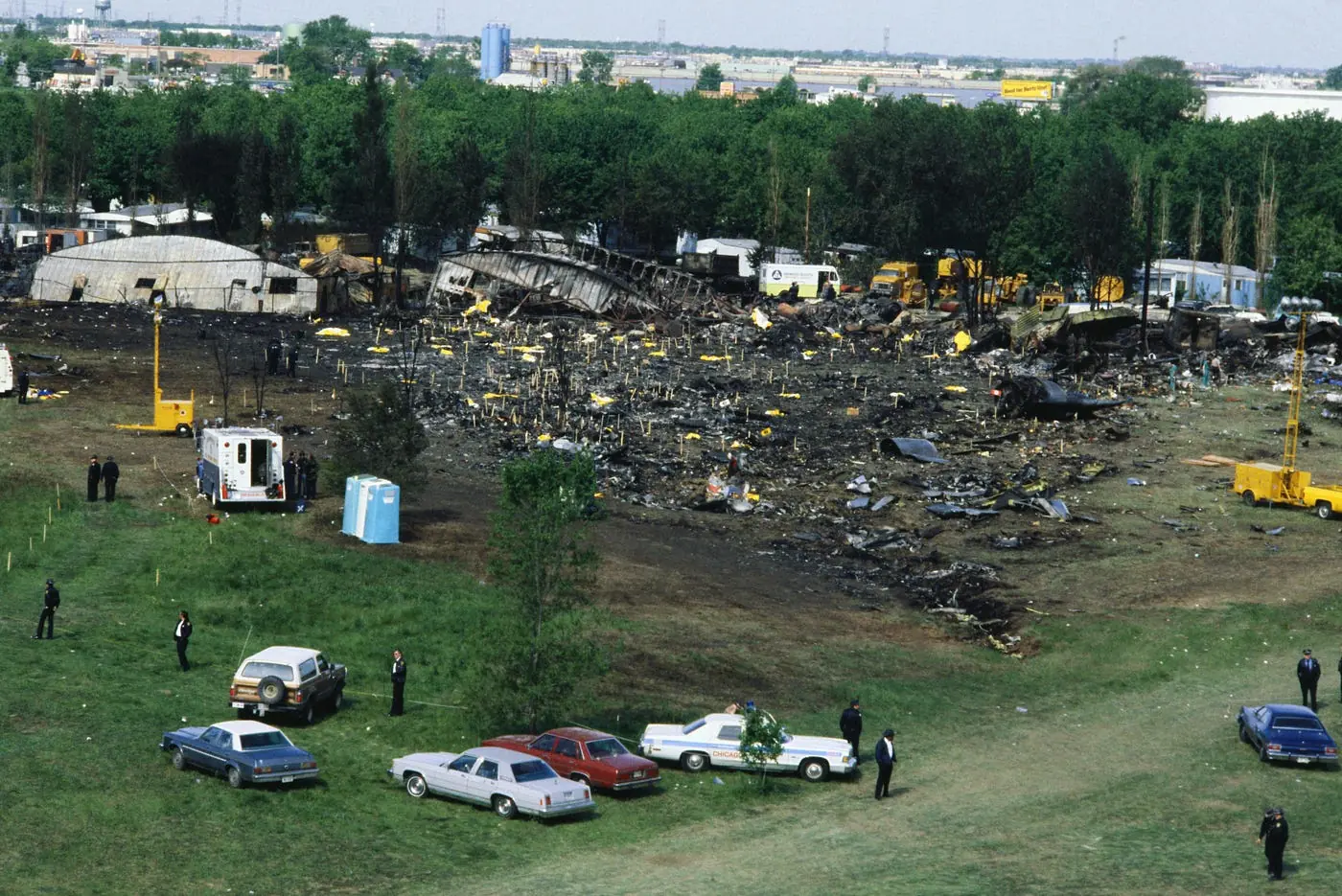
12. The Crew's Response and the Limits of Emergency Procedures
The pilots of Flight 191 were trained professionals operating under the procedures available to them. The investigation examined the flight crew's actions in detail and found that the aircraft was being flown in accordance with American Airlines' engine-failure procedures.
The crew's initial interpretation was that the aircraft had suffered an engine failure. That was a reasonable response to the information available in the cockpit. The left engine was no longer operating normally, and the aircraft was experiencing a major emergency during takeoff.
The airline's engine-out procedure directed the crew to climb at a specified speed. The procedure was designed to provide a safe climb following the loss of an engine under the assumptions used in the aircraft's performance calculations.
But Flight 191 was not in the normal configuration assumed by that procedure. The left wing's slats had retracted, raising its stall speed. The aircraft therefore could not safely follow the same speed guidance that would ordinarily apply after a conventional engine failure.
The FAA's historical account explains that American Airlines modified its procedures after the accident. The revised guidance addressed the speed to be maintained following an engine failure at different points in the takeoff sequence and instructed crews not to follow flight director pitch commands that could lead them toward an unsafe speed in the relevant scenario.