Man Stretches His Arm — Doctors Explain What Actually Happened
A simple stretch suddenly turns into a frightening moment: a sharp pain shoots through a man's upper arm, and within minutes, an unusual bulge appears near his elbow. The photograph looks alarming, but the explanation may surprise you. Doctors recognize this type of change as a possible tendon injury—and the strange-looking arm is only half the story.
At first glance, the images accompanying this story seem to show two unrelated medical mysteries. In the upper photographs, an older man is sitting on a sofa with one arm extended. His biceps appears unusually misshapen, with a prominent lump closer to the elbow than many people would expect. The lower photograph shows fingers that have become deeply wrinkled and pale, resembling skin that has been soaked in water for a long time.
Both images can provoke concern. Is the man's muscle tearing? Has something happened to his nerves or circulation? Are the fingers showing a sign of illness? And could the two conditions be connected?
The most likely explanation for the arm's unusual shape is a condition known as a biceps tendon rupture, which can cause a visible change commonly called a Popeye deformity. The lower photograph, meanwhile, appears to show water-related wrinkling of the fingers—a separate physiological response that is not evidence of the same injury.
These distinctions matter because dramatic photographs can encourage people to jump to conclusions. A visible bulge does not, by itself, confirm exactly which tendon has torn, and wrinkled fingers do not automatically indicate dehydration or a circulation disorder. A medical examination is needed to establish what is happening in an individual case.
The first question is how an ordinary movement such as stretching could be followed by such a striking change in the arm. The answer begins with the anatomy of the biceps—and with a small but important structure that most people rarely think about: the tendon.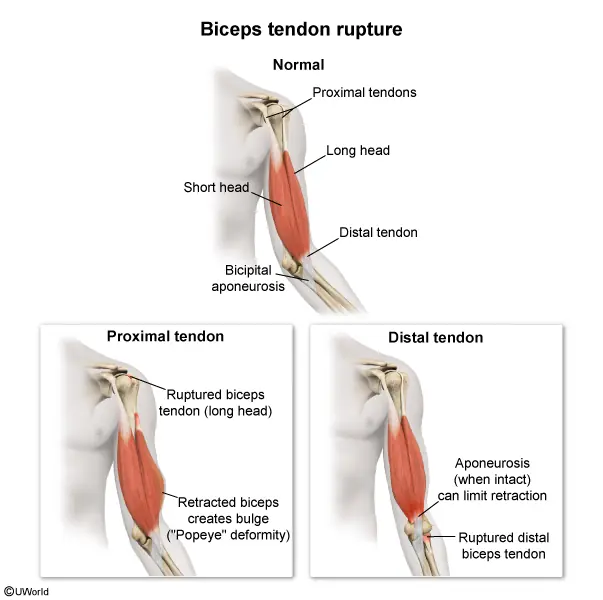
Chapter 1: The Sudden Change That Made the Man's Arm Look Different
Stretching is usually considered a harmless part of everyday movement. People stretch after waking up, after sitting for long periods, before exercise, or simply because their shoulders and arms feel stiff.
Most stretches do not cause injuries. However, a sudden movement can expose a weakness that has developed gradually, particularly in a tendon that has already experienced years of wear.
In the story accompanying the photograph, the man reportedly felt a sharp pain while stretching his arm. A visible bulge then appeared near the elbow, making the arm look dramatically different.
That description is consistent with one possible type of biceps tendon injury, but it is important not to assume that the photograph alone proves the exact diagnosis. Several injuries can produce pain, swelling, bruising, or changes in the shape of the upper arm.
A distal biceps tendon rupture, for example, occurs near the elbow and can affect the ability to bend the elbow and rotate the forearm. A proximal biceps tendon rupture occurs near the shoulder and may cause the muscle belly to bunch lower down the upper arm, producing the familiar Popeye appearance.
The location of the visible bulge, the pattern of pain, the person's strength, and the results of a physical examination help doctors distinguish between these injuries.
Why a tendon injury can change the shape of a muscle
A muscle does not attach directly to a bone in the same way that two pieces of wood might be joined together.
Instead, strong connective tissues called tendons connect muscles to bones. When a muscle contracts, it pulls through its tendon, allowing a joint to move.
The biceps muscle is located at the front of the upper arm. It plays an important role in bending the elbow and rotating the forearm so that the palm can face upward.
The muscle has two upper attachment points near the shoulder, which is why it is called the biceps—meaning two heads. It also has a tendon that attaches near the elbow.
If one of these tendons tears, the normal connection between the muscle and its attachment point is disrupted. Depending on where the injury occurs, the muscle may retract or bunch into a different position.
That change can create a visible lump or altered contour.
Why the bulge can look so dramatic
When a tendon tears, the muscle may no longer be held in its usual position.
With certain proximal biceps injuries, the muscle can move downward toward the elbow, creating a rounded bulge in the upper arm. This is why the appearance is often compared to the exaggerated upper arm of the cartoon character Popeye.
The shape can look dramatic even when the person is still able to move the arm.
However, a striking appearance does not necessarily mean that the entire biceps muscle has been destroyed. The extent of the injury depends on which tendon is affected and whether other structures have also been damaged.
Can a stretch really cause a tendon rupture?
A gentle stretch in a healthy tendon would not ordinarily be expected to cause a rupture.
But a tendon may become weakened by age-related changes, repetitive loading, previous injury, or certain medical conditions. If the tissue is already vulnerable, a sudden force can be enough to cause a tear.
The movement that immediately precedes an injury is not always the whole explanation. Sometimes, the underlying weakness has been developing for years.
This is why a person may report that an injury happened during an apparently ordinary activity.
Chapter 2: What Is a Biceps Tendon Rupture?
A biceps tendon rupture happens when one of the tendons connecting the biceps muscle to the shoulder or forearm tears partially or completely.
The injury can occur at either end of the muscle, and the difference is medically important. The location affects the symptoms, the visible shape of the arm, the amount of strength that may be lost, and the treatment doctors recommend.
The biceps has two tendons near the shoulder:
-
The long-head tendon, which travels through the shoulder region and attaches near the top of the shoulder socket.
-
The short-head tendon, which attaches to a different area of the shoulder blade.
At the lower end, the biceps connects to the radius, one of the two bones in the forearm, through the distal biceps tendon.
These attachments allow the muscle to perform its main jobs: bending the elbow and rotating the forearm so the palm can face upward.
Proximal rupture: the injury near the shoulder
A proximal biceps tendon rupture occurs near the shoulder.
The long-head tendon is particularly vulnerable to wear because of its position and the repeated movements it experiences. It passes through a narrow region near the shoulder joint, where friction and other shoulder problems may contribute to gradual degeneration.
When this tendon tears, the muscle may retract downward. The result can be a rounded bulge in the lower portion of the upper arm.
This is the classic Popeye deformity.
Some people experience a sudden sharp pain or a snapping sensation when the tendon tears. Others notice bruising, cramping, or weakness when using the arm.
Interestingly, a person with an isolated rupture of the long-head tendon may retain a considerable amount of everyday arm function because the short-head tendon remains attached.
That does not mean the injury should be ignored. A doctor should still assess the shoulder, particularly because proximal biceps problems can occur alongside rotator cuff injuries or other shoulder conditions.
Distal rupture: the injury near the elbow
A distal biceps tendon rupture occurs near the elbow, where the tendon attaches to the forearm bone.
This injury is less common than a proximal rupture, but it can have a more noticeable effect on strength.
The distal tendon is important for turning the palm upward, a movement known as supination. It also contributes to elbow flexion.
When it tears completely, the muscle may pull upward toward the shoulder, and a gap may become noticeable near the front of the elbow.
People may experience:
-
Sudden pain near the elbow.
-
A popping or snapping sensation.
-
Swelling and bruising around the elbow and forearm.
-
Weakness when bending the elbow.
-
Difficulty rotating the forearm to turn the palm upward.
-
A visible change in the contour of the biceps.
A complete distal rupture often deserves prompt assessment because surgical repair may be considered, particularly in people who need to regain substantial arm strength.
Why the two injuries should not be confused
Both injuries involve the biceps tendon, but they do not produce identical problems.