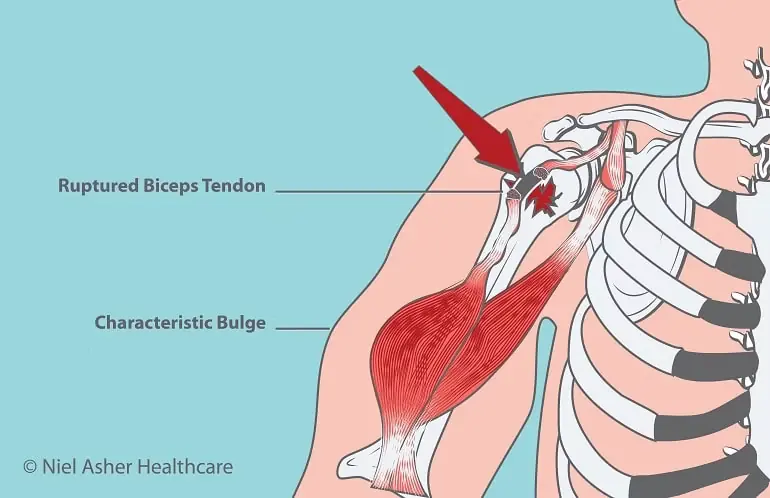
A proximal rupture may create a prominent bulge lower in the upper arm while leaving much of the person's daily elbow function intact.
A distal rupture can cause more significant weakness in forearm rotation and elbow flexion. It may also create a different pattern of deformity, including a gap near the elbow.
The phrase “Popeye deformity” is most commonly associated with a proximal long-head biceps rupture. However, the exact appearance of an individual arm cannot reliably identify the injury location without an examination.
This is particularly important when interpreting the supplied photograph. The image shows an unusual arm contour, but it does not provide enough clinical information to determine which tendon was injured.
Can a tendon tear without the entire muscle tearing?
Yes.
A tendon rupture does not necessarily mean that the muscle itself has been cut or destroyed.
The muscle fibers may remain intact but lose part or all of their normal attachment. When that happens, the muscle can retract, producing a change in shape.
A partial tear is different from a complete rupture. In a partial tear, some tendon fibers remain connected, and the person may still have pain and weakness without the full deformity associated with a complete rupture.
The distinction matters because treatment decisions depend on the severity of the tear, the location, the person's symptoms, and their physical needs.
Chapter 3: Why Can a Simple Stretch Trigger an Injury?
The idea that a man could injure his arm while stretching sounds surprising. Many people associate tendon ruptures with weightlifting, sports, or accidents—not with an ordinary movement performed at home.
But the condition of the tendon before the movement is often just as important as the movement itself.
Tendons change as people get older
Tendons are strong, but they are not indestructible.
Over time, repeated loading and normal biological aging can alter their structure. The tissue may become less resilient, and small areas of degeneration can develop.
These changes do not always cause symptoms.
A person may continue gardening, carrying groceries, exercising, and performing everyday tasks without realizing that a tendon has become vulnerable.
Eventually, a sudden force may exceed what the weakened tissue can tolerate.
Repetitive use can contribute to wear
Many people use their arms repeatedly throughout the day.
Lifting objects, carrying bags, pulling equipment, playing sports, and performing repetitive overhead movements can place stress on the biceps tendon.
Athletes who perform frequent throwing, swimming, or racquet sports may experience repeated shoulder loading.
Workers who regularly lift or carry heavy objects may also place substantial demands on their arm muscles and tendons.
Repetitive activity does not mean a rupture is inevitable. Most people who perform these movements do not experience a tendon tear.
The concern is greater when repeated stress occurs alongside pre-existing tendon degeneration or other risk factors.
A sudden movement can expose an existing weakness
Imagine a person whose tendon has gradually weakened over several years.
He may feel completely normal while performing routine activities. Then, during a movement that requires the biceps to resist a sudden load, the tendon may tear.
The event can feel unexpected because the person did not know the tissue was vulnerable.
This is why an injury can appear to happen during a movement that seems ordinary.
The stretch may be the immediate event, but it may not be the only factor involved.
The role of force
Tendons are especially vulnerable when a muscle is contracting while being forced to lengthen.
This is called eccentric loading.
For example, imagine someone holding a heavy object with the elbow bent. If the object suddenly pulls the arm downward, the biceps must work to control the movement while lengthening.
That combination can place substantial stress on the tendon.
A similar mechanism can occur during sports, weightlifting, or an unexpected movement while carrying something heavy.
Not every rupture follows this exact pattern, but it helps explain why sudden loading can be dangerous for a weakened tendon.
Does stretching weaken tendons?
Normal stretching does not generally weaken healthy tendons.
Gentle mobility exercises can help maintain comfortable movement and flexibility. Problems are more likely when a person forces a joint beyond a comfortable range, uses excessive resistance, or continues through sudden pain.
Stretching should not involve violent pulling, bouncing, or attempts to force a joint into an extreme position.
People who have a history of shoulder or elbow injuries should follow individualized advice from a qualified clinician or physical therapist.
Why older adults should pay attention to sudden arm changes
Age alone does not mean a tendon will rupture.
However, tendon degeneration becomes more common as people get older. A person may therefore experience an injury during an activity that would not have caused a problem when they were younger.
Sudden pain, bruising, swelling, weakness, or a new change in muscle shape should be evaluated rather than dismissed as an ordinary effect of aging.
The important lesson is not to avoid movement. It is to recognize that new symptoms deserve attention.
Chapter 4: The Warning Signs Doctors Look For
A biceps tendon rupture can produce several symptoms, but not everyone experiences the same combination.
Some people notice a loud pop. Others feel sudden pain without hearing anything. A visible bulge may develop immediately or become easier to see after swelling and bruising change.
Doctors look at the entire pattern rather than relying on one photograph or one symptom.
A sudden pop or snapping sensation
Some people describe hearing or feeling a pop when the tendon tears.
The sensation may occur during lifting, pulling, catching a falling object, or another movement that places sudden stress on the arm.
However, the absence of a pop does not rule out a tendon injury.
Sudden pain in the shoulder or elbow
The location of the pain can provide useful clues.
A proximal tear may cause pain near the front of the shoulder or upper arm. A distal tear may produce pain near the front of the elbow.
The pain can be sharp at first and may later become less intense.
A reduction in pain does not necessarily mean the tendon has healed.
Bruising and swelling
Bruising may appear around the shoulder, upper arm, elbow, or forearm, depending on the injury.
The discoloration can spread over time as blood from the injured tissue moves through the surrounding area.
Swelling may also make the arm look larger or less symmetrical.
If bruising is extensive, rapidly increasing, or accompanied by severe pain or other concerning symptoms, urgent medical assessment is appropriate.
A visible change in muscle shape
The Popeye deformity is one of the most recognizable signs of a proximal biceps tendon rupture.
The muscle may appear to have moved downward, producing a rounded bulge.
The affected arm may look different from the opposite arm, especially when the person bends the elbow or tightens the biceps.
But not every bulge is a tendon rupture. Swelling, muscle injury, and other conditions can also alter the appearance of the arm.
Weakness when bending the elbow
The biceps helps bend the elbow.
If the tendon is injured, a person may notice difficulty lifting objects, carrying a bag, or performing movements that require elbow flexion.
The degree of weakness depends on the injury location and whether other structures remain intact.
Weakness when turning the palm upward
This movement is especially important when doctors assess a possible distal biceps tendon rupture.
Supination allows a person to turn the palm from facing downward to facing upward.
It is used in everyday activities such as turning a key, using a screwdriver, holding a bowl, or carrying an object with the palm facing upward.
A distal rupture can significantly weaken this movement.
Cramping during activity
Some people experience cramping in the biceps when they use the arm.
This may happen because the muscle is no longer functioning with its normal tendon attachment.
The symptoms may be more noticeable during strenuous activity than during rest.
When symptoms should be treated urgently
A sudden arm injury should not be self-diagnosed from an online photograph.
Seek prompt medical assessment if there is a sudden pop followed by pain, bruising, swelling, a visible deformity, or loss of strength.
Urgent evaluation is particularly important if the arm becomes numb, cold, unusually pale or blue, severely swollen, or difficult to move. These symptoms can suggest problems beyond an isolated tendon injury and may require emergency attention.
If there is severe pain after an accident, an obvious deformity, or concern about a fracture or circulation problem, do not wait for symptoms to settle.