The crew's training and emergency preparation were also examined. A passenger ferry should have clear evacuation procedures, properly maintained safety equipment, and staff who know how to guide passengers under extreme conditions.
The presence of lifeboats and life jackets is not enough if passengers are not told how and when to use them.
An emergency plan must work in practice, not simply exist in a manual.
The disaster also exposed the importance of leadership under pressure. When a vessel is in danger, hesitation can cost lives. Passengers need instructions that are timely, understandable, and consistent with the actual conditions.
The Sewol's crew failed to provide the kind of evacuation response that passengers needed.
For many South Koreans, this became one of the most painful symbols of the tragedy: the people who had been entrusted with protecting the passengers did not fulfill that responsibility.
Chapter 9: Families Waiting for News
After the ferry sank, the tragedy entered a different and deeply painful stage.
Families gathered at locations where they hoped to receive reliable information. Some traveled to hospitals or ports. Others waited for announcements from authorities, watching television reports and checking their phones repeatedly.
At first, many relatives believed that their children might still be found alive.
The uncertainty was unbearable.
A missing-person notice is not the same as a death confirmation. Families were left waiting, hoping that the next update would bring news of survival. Some contacted classmates, teachers, and friends, trying to discover whether their loved ones had been seen.
The authorities faced the enormous task of identifying survivors and recovering those who had not escaped.
But information was confusing, and early reports about the number of people rescued were inaccurate. The changing figures made it difficult for families to understand what was happening.
In a disaster involving hundreds of passengers, accurate communication should be treated as an essential part of emergency response. Families need clear information, even when the answer is that officials do not yet know what has happened.
Uncertainty can create additional suffering when people receive conflicting reports.
The families also had to face the reality that many passengers had remained inside the vessel. Each passing hour reduced the hope that more survivors would be found.
The recovery operation continued for months.
Divers and rescue teams worked in difficult underwater conditions to search the wreck and recover victims. The work was physically demanding and emotionally exhausting. It involved risks for the people carrying out the operation, who were trying to reach spaces inside a damaged ship beneath the sea.
The recovery effort became a painful reminder that the disaster had not ended when the ferry disappeared.
For families, the search was not simply an operation conducted by professionals. It was the only remaining possibility of bringing their loved ones home.
The recovery of the victims allowed many families to hold funerals and begin the process of mourning. But five bodies were never recovered, leaving some families without the final certainty they had desperately wanted.
The missing victims became part of the lasting wound of the Sewol disaster.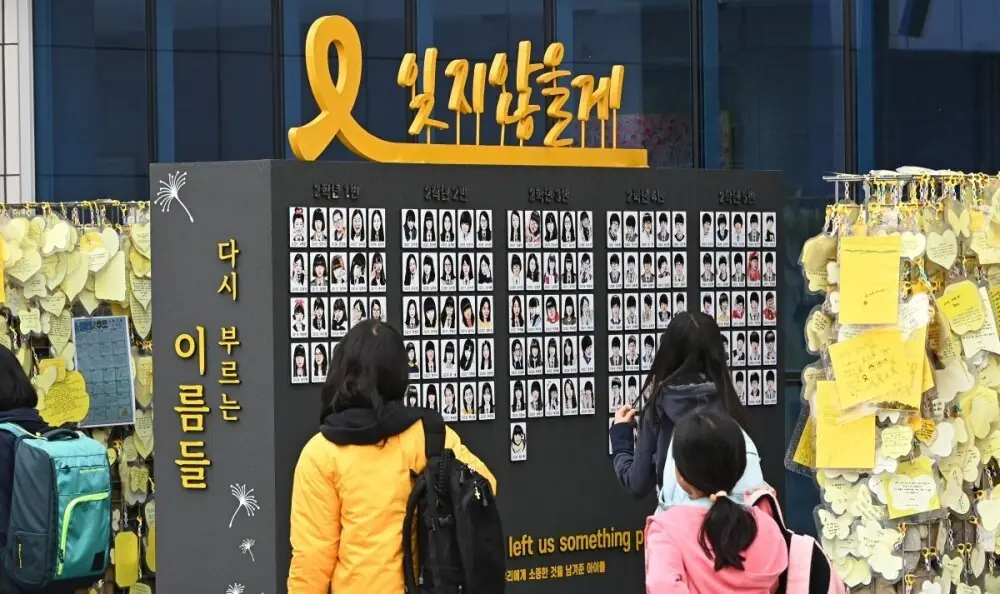
Chapter 10: A Nation in Mourning
The scale of the tragedy shocked South Korea.
Television coverage showed the capsized ferry, rescue vessels, families waiting for news, and officials attempting to explain what had happened. The images became part of the country's collective memory.
The loss of so many students had a particularly powerful effect.
Schools are places where parents entrust children to teachers and administrators. A school trip is supposed to be an opportunity for learning and growth, not a situation in which students face a life-threatening emergency.
The fact that so many of the victims came from one school made the loss deeply personal for communities across the country.
Classmates who had not joined the trip returned to classrooms where familiar faces were missing. Teachers and school staff faced grief and questions about the safety of educational excursions. Parents throughout South Korea began thinking about what they would do if their own children were involved in a similar journey.
The yellow ribbon became a widely recognized symbol of remembrance and solidarity.
People tied yellow ribbons to bags, fences, trees, and public spaces. The ribbons represented a promise not to forget the victims and a demand that the tragedy lead to meaningful changes.
Memorial services were held. Photographs of the students appeared at remembrance sites. Families and supporters gathered to honor those who had died.
The public response was not limited to grief.
Many citizens demanded accountability. They wanted to know why the ferry had been allowed to sail in an unsafe condition, why passengers had not been evacuated promptly, and why the rescue response had failed to save more people.
The disaster became a national debate about public safety and government responsibility.
It also raised questions about how a modern society should respond when institutions fail to protect people who depend on them.
For the families, remembrance was inseparable from the demand for answers.
They did not want the students to be remembered only as numbers in a tragic statistic. They wanted their names, personalities, and hopes to remain part of the national story.
Chapter 11: The Political and Social Consequences
The Sewol disaster had consequences far beyond maritime transportation.
The response by government agencies came under intense criticism. Questions were raised about the coordination of emergency services, the flow of information, and the ability of officials to respond effectively to a large-scale disaster.
The public also questioned whether existing regulations were being enforced properly.
South Korea had developed into a highly modern and technologically advanced country. Its citizens expected public institutions to operate with professionalism and efficiency. The Sewol tragedy exposed a painful gap between those expectations and what happened during the emergency.
The disaster became an important issue during the administration of President Park Geun-hye.
Her government's handling of the response attracted widespread criticism, and the tragedy became part of a broader public debate about leadership, accountability, and the state's duty to protect its citizens.
The controversy did not end with the sinking itself.
Investigations and public inquiries continued. Questions about the rescue operation, communication systems, and the handling of evidence remained part of the national discussion.
The disaster also contributed to wider political tensions that eventually became part of the circumstances surrounding Park's impeachment in 2017. The Sewol response was one of several issues discussed in the constitutional proceedings, although the legal questions involved were more specific than the broader public anger.
For many citizens, the tragedy became a symbol of what can happen when institutions fail to take responsibility.
It changed the way people discussed safety. It made the public more aware of the need for transparent investigations and clear accountability after disasters.
It also created a lasting debate about how governments should communicate during emergencies.
A government cannot always prevent every accident. But it has a responsibility to prepare, respond quickly, provide reliable information, and learn from failures.
The Sewol disaster became a powerful reminder that public trust depends not only on promises but on actions when people's lives are at risk.
Chapter 12: The Long Search for Accountability
The sinking of the Sewol led to multiple investigations, court proceedings, and public efforts to establish what had gone wrong.
Investigators examined the vessel's modifications, cargo records, ballast, navigation, and the actions of the crew. They also examined the response by maritime authorities and the way information had been handled during the emergency.
The findings identified serious failures at different stages.
The ship's operator had allowed dangerous loading practices. The vessel's stability had been compromised. The navigation and emergency response were inadequate. The authorities' initial rescue efforts were widely criticized.