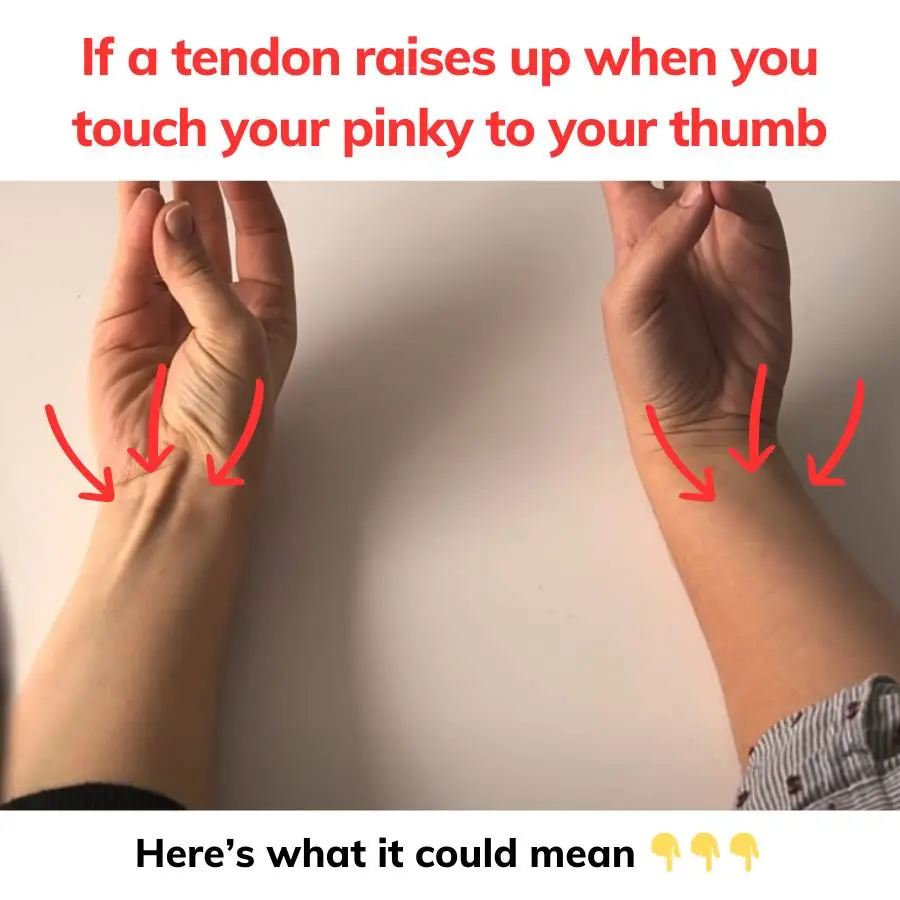
A tendon raises up when you touch your pinky to your thumb

This physiological response doesn’t serve a significant purpose in our present lives. But apart from reminding us that we should have brought a coat, we can still observe modern mammals taking to this biological instinct. For example, when facing chilly weather. You might have seen a pigeon puff up on a cold winter day, pushing out its feathers to keep warm. If that isn’t proof of evolution, then what is?
Additionally, when an animal feels threatened, such as when you surprise your cat, you’ll notice their fur will puff out. This defense mechanism is an ancient adaptation aimed at deceiving potential attackers by creating an illusion of a bigger size.
But there is one trait that undeniably shows proof of evolution
One truly remarkable evidence of evolution lies within our arms, specifically within our tendons. A tendon has been evolutionarily phased out in almost 10-15% of the human population, suggesting that we humans are far from reaching the end of evolution.
This tendon is associated with an ancient muscle known as the palmaris longus, which was predominantly used by arboreal primates such as lemurs and monkeys to aid in their movement from branch to branch. As humans and ground-dwelling apes like gorillas no longer rely on this muscle or tendon, both species have gradually been losing this internal function.
Nonetheless, evolution operates at its own pace – slowly, so nearly 90% of humans still retain this vestigial trait passed down from our primate ancestors. To check if you possess this tendon, place your forearm on a table with your palm facing upwards. Touch your pinky finger to your thumb and slightly lift your hand off the surface. If you observe a raised band in the middle of your wrist, you have the tendon connected to the still-existing palmaris longus.
If you do not see this tendon, congratulations, you are showing an evolutionary change!
The presence or absence of this tendon does indeed offer a fascinating connection to our ancestral lineage, with those possessing it carrying a tangible link to our evolutionary past. Likewise, individuals without this tendon represent tangible evidence of ongoing human evolution.
The ways in which our bodies retain traces of our evolutionary history never cease to amaze us. It’s remarkable to consider how our physical features, even those which seem insignificant or obsolete, can reveal profound insights into our evolutionary journey.
News in the same category


Add a Few Drops of Oil to an Onion: A Simple Home Trick That Repels Mosquitoes and Improves Sleep

Revealed: The 10 Most Toxic Foods in the World — Some Are Shockingly Familiar

3 Effective Ways to Prevent Snakes From Entering Your Home

A Simple, Safe Way to Repel Rats Using Only Rice

The reason dogs always behave this way is because

The Vegetable Once Reserved for Emperors — Now Found in Everyday Gardens

The Overlooked Plant Said to Support Health in Many Ways

The World’s Rarest and Most Expensive Plant — Found Only in Vietnam

The World’s Best Fish — Shockingly Cheap and Found Everywhere

Why do many flight attendants bring a banana with them on flights?

How long should frozen meat last before it should be discarded?

Here are some possible reasons you might be getting these bruises

Drinking Polyscias fruticosa Leaf Tea Daily: A Simple Habit Linked to Notable Health Benefits

Now I know these 4 relics should never be kept

With just a few simple tips passed down by seasoned fishermen

When buying oranges, should you choose ones with a big or small “navel”? Here are 4 tips to pick super-sweet oranges

The Cultural Meaning of Ankle Bracelets You May Not Know

Doctors Explain What Happens When You Eat Bananas Every Single Day

The Tiny Seat Belt Button You’ve Probably Never Noticed — Here’s What It’s For
News Post

A 52-Year-Old Woman Di.ed from a Stro.ke: Middle-Aged People, Stop Doing These 7 Things

Doctors’ Warning After a Tragic De.ath: Don’t Drink These 4 Types of Water Before Sleeping Even If You’re Thirsty

Discover Love in the Little Things: Everyday Connections

Say Goodbye to Swelling

Proven Health Benefits of Walnuts, How Many to Eat, and More (Science Based)

Doctors reveal that eating APPLES causes...

Four Can.cers Discovered After a Sore Thr.oat: A Man Was Shocked to Learn That Despite Regular Exercise, Three Habits Led to His Illness

Little Black Bugs in the Bathroom? Here’s What They Are & How to Get Rid of Them for Good

Adrenal fatigue: what it is and 17 all-natural ways to fix it fast

Important News for Everyone Who Loves a Daytime Nap

Grapefruit Is Healthy and Generally Safe, but These 4 Groups Should Avoid It

10 Stroke Warning Signs You May Notice 1 Month Before It Happens

Do your legs cramp up at night? Learn the common reasons and the best ways to prevent it.

Here’s What Really Happens When You Sleep with Socks On

Meatball Zucchini Pasta (Italian-Style)

7 Ways How To Deal With A Cheating Husband

If Your Kidneys Are in Danger, the Body Will Show these 10 Signs

When bitten by a snake, you should do these things first

Two Fruits That Cancer Cells “Love”: Why Experts Advise Limiting Them
