After more than two decades of working in pest control, Nick Castro thought he had seen just about everything. As the owner of Nick’s Extreme Pest Control in California, he had dealt with unusual infestations, unexpected animal behavior, and plenty of surprises hidden inside homes.
But one particular call left even an experienced professional genuinely stunned.
The problem initially sounded relatively straightforward: a homeowner was dealing with damage caused by a woodpecker. The bird had been repeatedly drilling holes into the home's exterior siding.
Woodpeckers are known for pecking into wood and other surfaces, sometimes creating cavities that can later be used for nesting or storing food. In this case, however, the bird appeared to have found a rather unusual storage system.
It was using the house.
And what it was storing inside the walls was about to become an enormous problem.
It Started With a Few Holes in the Siding
When Castro arrived at the property, the homeowner had already noticed something unusual.
A local woodpecker had been creating holes in the exterior of the house.
At first, the damage may not have seemed particularly alarming. A bird making holes in siding is certainly inconvenient, but it isn't necessarily something that would make you expect a massive discovery inside the walls.
The woodpecker, however, had a purpose.
She had been collecting acorns and placing them into the holes she had created.
This behavior may seem strange when you first hear about it, but woodpeckers can store food in protected locations. Some species are known to create or use cavities where they can stash food for later.
The problem was that these particular cavities weren't simply small holes in an isolated tree.
They connected to the hollow spaces inside the home's walls.
And gravity was doing the rest.
The Acorns Were Falling Into the Walls
Castro knew that when he opened the wall, he would probably find some acorns.
What he didn't expect was the sheer volume.
He cut into the wall expecting to remove a relatively modest amount of stored food.
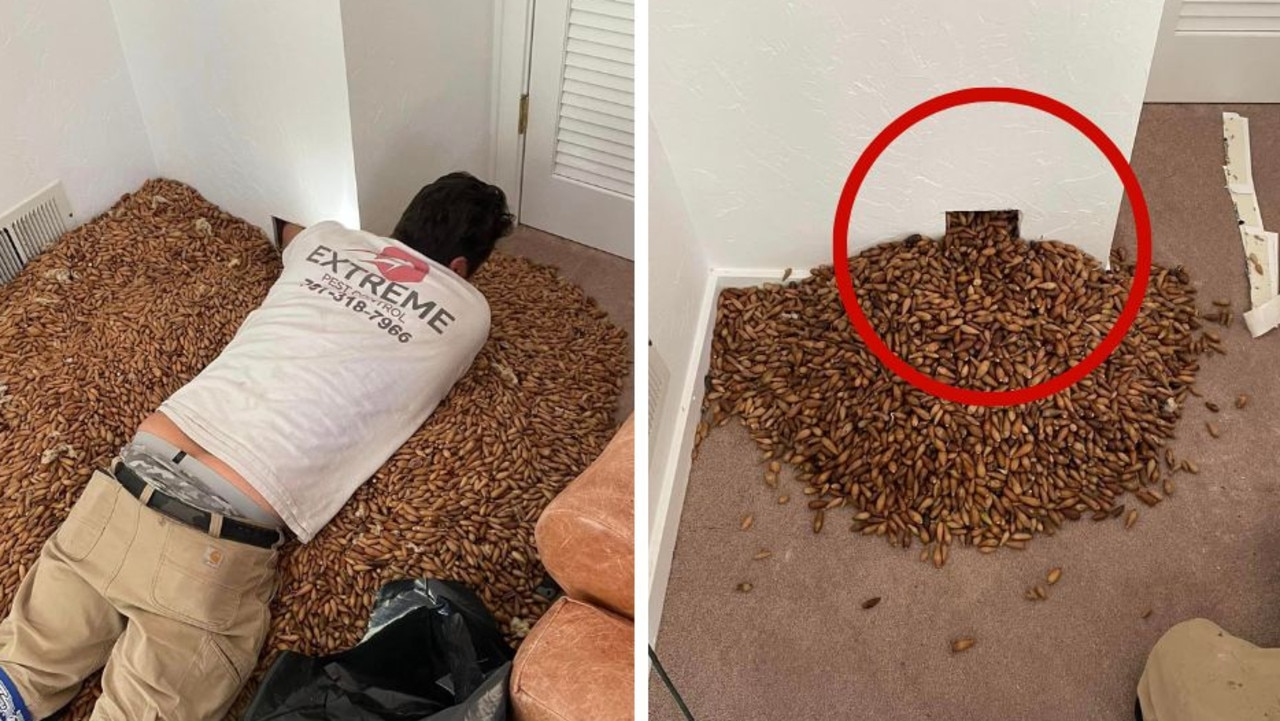
Instead, acorns began pouring out.
At first, it was a steady stream.
Then more and more started falling.
The discovery quickly went from curious to completely unbelievable.
It wasn't a small collection hidden inside the wall.
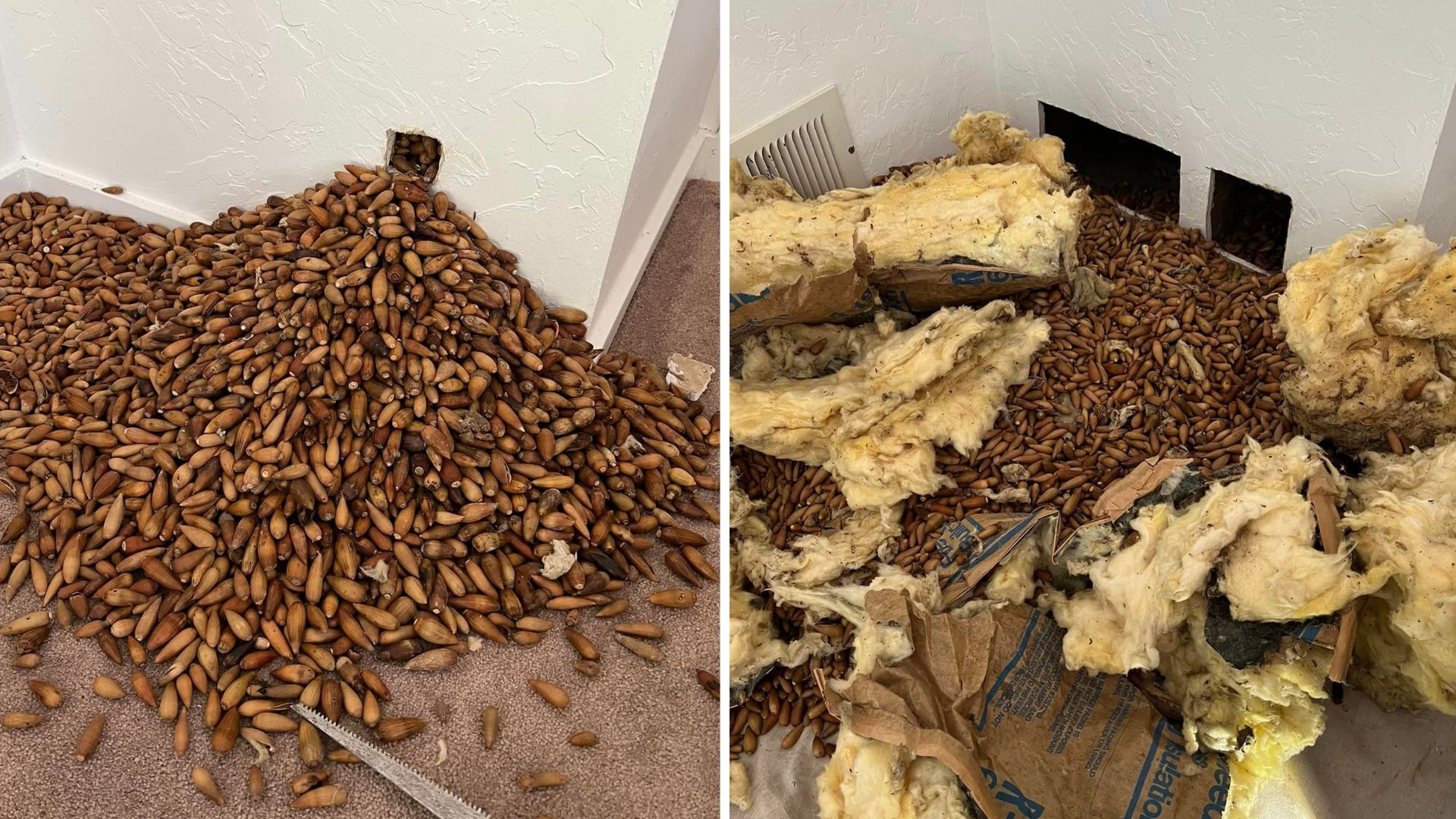
There were apparently hundreds upon hundreds of acorns packed into the home's cavities.
According to Castro, the acorns continued coming out nonstop.
The amount already visible was impressive, but it turned out that the biggest surprise was still waiting farther inside the structure.
The Acorns Reached Nearly to the Attic
The initial assumption was that the acorns had accumulated only partway up the wall.
That would already have been unusual.
But after Castro opened additional areas, the scale of the stash became clear.
The acorns had been accumulating throughout the wall cavities and had apparently reached all the way up toward the attic.
What looked from the outside like a bird simply making a few holes had actually become a remarkably large food-storage operation.
The woodpecker had been working repeatedly, bringing acorn after acorn back to the house.
Over time, those individual trips had added up.
And the result was astonishing.
Nearly 700 Pounds of Acorns
When everything was finally removed, the total was estimated at approximately 700 pounds of acorns.
That's an incredible amount of food for one bird to have accumulated.
The stash was large enough to fill eight large trash bags.
Imagine opening a wall expecting to find a handful of acorns and instead watching them continue pouring out until you've filled bag after bag.
For Castro, who had spent more than 20 years working in pest control, it was something he had never encountered before.
The sheer quantity was what made the situation so memorable.
One small bird had essentially transformed the hollow spaces inside a house into a giant pantry.

How Did So Many Acorns Get There?
The explanation is actually much simpler than the discovery itself.
The woodpecker had been collecting acorns and placing them into openings in the home's exterior.
Normally, a cavity used to store food would presumably hold the food in place.
But the house's wall cavities created a different situation.
Instead of remaining neatly stored near the entrance, many of the acorns fell downward into the empty spaces inside the wall.
The woodpecker could continue returning to the same area without necessarily realizing that her carefully collected food was disappearing deeper into the structure.
One acorn became dozens.
Dozens became hundreds.
And eventually, hundreds became hundreds of pounds.
The Bird Was Working Hard—But Her Effort Was Going to Waste
There's something almost heartbreaking about the story when you look at it from the bird's perspective.
The woodpecker had clearly been busy.
She had found a source of food, transported the acorns, and repeatedly returned to store them.
From her perspective, she was building up a valuable reserve.
But because the acorns were falling into inaccessible areas of the house, the stash wasn't necessarily serving its intended purpose.
Her hard work was effectively disappearing into the walls.
Every trip represented effort.
Every acorn represented another piece of food she had collected.
Yet the food was accumulating somewhere she couldn't easily retrieve it.
An Unusual Pest-Control Job
For Castro, this wasn't simply about removing a large amount of material from a wall.
The situation also involved an animal that wasn't intentionally trying to damage the homeowner's property.
The woodpecker was simply behaving according to its instincts.
That distinction mattered.
Rather than harming the bird, the pest-control team followed a humane approach.
The goal wasn't to punish or eliminate the animal.
It was to prevent the house from continuing to be used as an enormous acorn storage facility.
The Solution Was Surprisingly Simple
Once the acorns had been removed, the next step was to prevent the woodpecker from continuing to use the same openings.
The existing holes in the exterior siding were patched.
The homeowner also planned to add new vinyl siding, which would make the previous storage locations less accessible.
This approach addressed the source of the problem without harming the bird.
Instead of trying to capture or eliminate the woodpecker, the team simply made the house less suitable for storing acorns.
Ideally, the bird would then find another location that was better suited to her natural behavior.
A Reminder That Wildlife Can Adapt to Human Structures
The story is also a fascinating example of how wildlife can interact with human environments.
Animals don't necessarily understand the difference between a natural tree cavity and a hollow space inside a building.
If a location provides shelter, protection, or a convenient place to store food, an animal may take advantage of it.
From the woodpecker's perspective, the house offered something useful:
a series of openings and cavities that could be used for food storage.
The homeowners, of course, saw the situation differently.
What was convenient for the bird was potentially damaging to the building.
This kind of conflict is common wherever human structures overlap with wildlife habitat.
Why the Discovery Was So Hard to Believe
The most fascinating part of this story isn't simply that a woodpecker stored acorns.
It's the scale of what happened.
Seeing one or two acorns around a house wouldn't immediately raise suspicion.
Even finding a few dozen might not seem extraordinary.
But hundreds of pounds is an entirely different story.
The outside of the house didn't necessarily reveal what was happening inside.
That is what made the discovery so surprising.
The wall essentially hid a giant collection of food that had been accumulating over time.
Until Castro opened it, there was no obvious way to appreciate just how much had been stored inside.
Nature Can Be Much Stranger Than It Looks
Stories like this are a good reminder that ordinary-looking places can contain surprisingly unusual secrets.
A few holes in the siding might look like nothing more than minor property damage.
But behind those holes was an enormous food stash.
The situation also shows how animal behavior can produce unexpected consequences when wildlife finds new opportunities in human-built environments.
The woodpecker wasn't trying to create a bizarre mystery.
She was simply following her instincts.
She found a place where she could store food and kept returning to it.
The extraordinary part was what happened as those individual efforts accumulated over time.
What Homeowners Can Learn From the Story
If you notice repeated holes appearing in your home's siding, roofline, fascia, or other exterior surfaces, it's worth investigating rather than simply repairing them over and over.
Wildlife may be using those openings for:
-
Food storage
-
Nesting
-
Shelter
-
Access to wall cavities
-
Protection from weather
A recurring pattern can be a sign that an animal has discovered something useful about the structure.
Repairing the visible damage without addressing the reason it keeps happening may only lead to more damage later.
If wildlife is involved, humane exclusion and professional guidance can help resolve the problem without unnecessarily harming the animal.
One Woodpecker, Hundreds of Pounds of Acorns
What began as a routine pest-control call turned into one of the strangest discoveries of Castro's career.
A woodpecker had been using holes in a California home's siding to store acorns.
The homeowner likely expected some minor cleanup.
Instead, approximately 700 pounds of acorns eventually came out of the walls—enough to fill around eight large trash bags.
The discovery was astonishing not because the bird had done something malicious, but because she had apparently been working so efficiently that her hidden pantry had grown to an almost unbelievable size.
And perhaps the most fitting ending is that the bird was allowed to remain unharmed.
The holes were patched, new siding helped make the house less attractive as a storage site, and the woodpecker could hopefully move on to a more suitable location.
Sometimes the strangest things hiding inside a house aren't caused by pests invading the home—they're caused by wildlife deciding that the home is the perfect place to build a pantry.