But hundreds of pounds is an entirely different story.
The outside of the house didn't necessarily reveal what was happening inside.
That is what made the discovery so surprising.
The wall essentially hid a giant collection of food that had been accumulating over time.
Until Castro opened it, there was no obvious way to appreciate just how much had been stored inside.
Nature Can Be Much Stranger Than It Looks
Stories like this are a good reminder that ordinary-looking places can contain surprisingly unusual secrets.
A few holes in the siding might look like nothing more than minor property damage.
But behind those holes was an enormous food stash.
The situation also shows how animal behavior can produce unexpected consequences when wildlife finds new opportunities in human-built environments.
The woodpecker wasn't trying to create a bizarre mystery.
She was simply following her instincts.
She found a place where she could store food and kept returning to it.
The extraordinary part was what happened as those individual efforts accumulated over time.
What Homeowners Can Learn From the Story
If you notice repeated holes appearing in your home's siding, roofline, fascia, or other exterior surfaces, it's worth investigating rather than simply repairing them over and over.
Wildlife may be using those openings for:
-
Food storage
-
Nesting
-
Shelter
-
Access to wall cavities
-
Protection from weather
A recurring pattern can be a sign that an animal has discovered something useful about the structure.
Repairing the visible damage without addressing the reason it keeps happening may only lead to more damage later.
If wildlife is involved, humane exclusion and professional guidance can help resolve the problem without unnecessarily harming the animal.
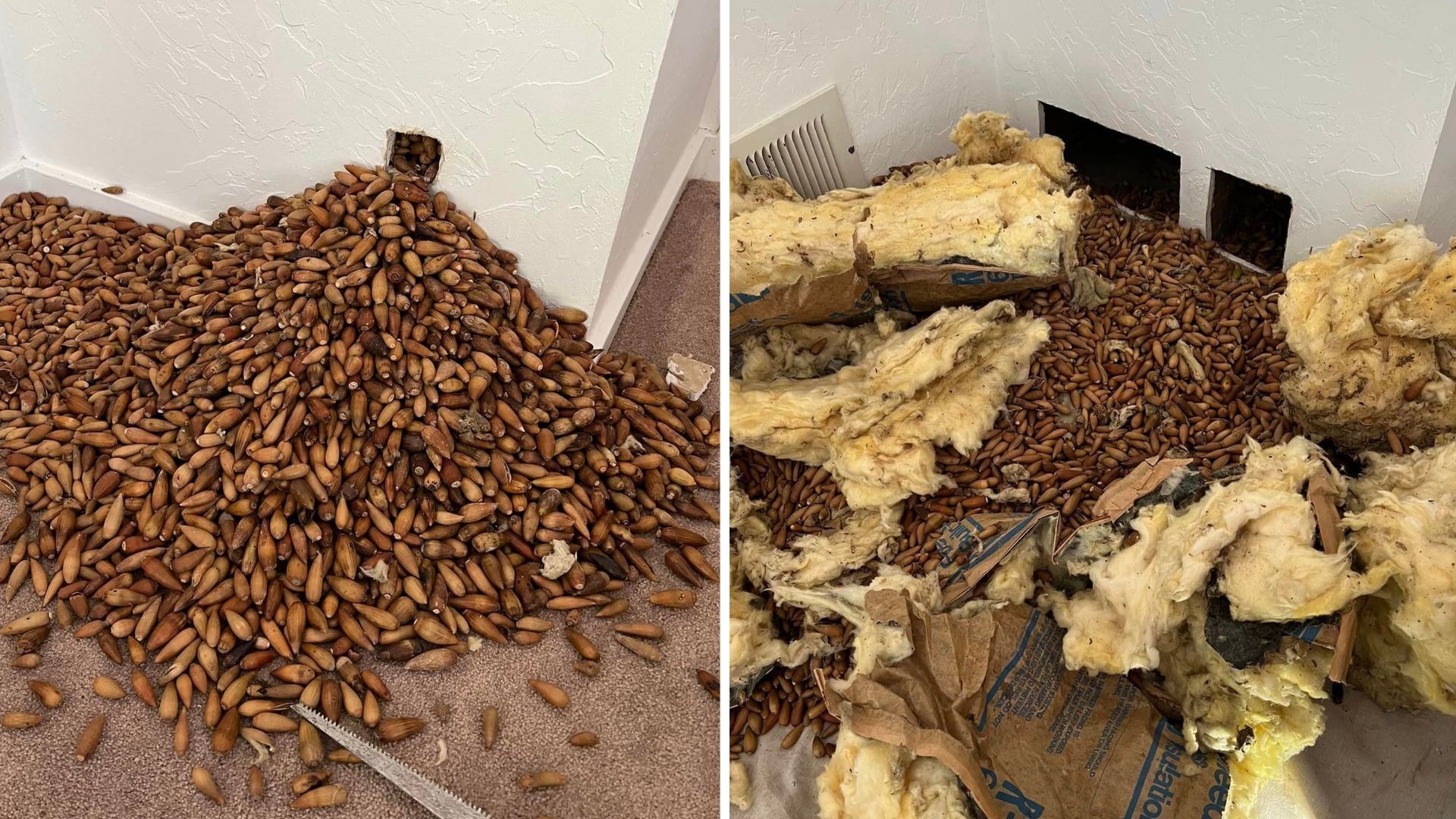
One Woodpecker, Hundreds of Pounds of Acorns
What began as a routine pest-control call turned into one of the strangest discoveries of Castro's career.
A woodpecker had been using holes in a California home's siding to store acorns.
The homeowner likely expected some minor cleanup.
Instead, approximately 700 pounds of acorns eventually came out of the walls—enough to fill around eight large trash bags.
The discovery was astonishing not because the bird had done something malicious, but because she had apparently been working so efficiently that her hidden pantry had grown to an almost unbelievable size.
And perhaps the most fitting ending is that the bird was allowed to remain unharmed.
The holes were patched, new siding helped make the house less attractive as a storage site, and the woodpecker could hopefully move on to a more suitable location.
Sometimes the strangest things hiding inside a house aren't caused by pests invading the home - they're caused by wildlife deciding that the home is the perfect place to build a pantry.
One Woodpecker, Hundreds of Pounds of Acorns—and What Happened After the Walls Were Opened
What began as an ordinary complaint about damage to a home's exterior had already turned into one of the strangest pest-control jobs Nick Castro had encountered in more than two decades.
The homeowner had noticed holes appearing in the siding.
A woodpecker was responsible.
That part was easy enough to understand.
What nobody expected was what happened when the wall was opened.
Acorns began pouring out.
Not a few.
Not a bucketful.
Not even several boxes.
They kept coming.
According to the account, the hidden stash eventually amounted to approximately 700 pounds of acorns, filling roughly eight large trash bags.
The discovery was astonishing.
But once the immediate shock wore off, another set of questions remained.
Why had the woodpecker chosen the house?
How long had the acorns been accumulating?
Could the same thing happen again?
And what would happen to the bird once its enormous hidden pantry was suddenly gone?
Those questions turned what initially seemed like a bizarre pest-control story into something much more interesting—a story about wildlife, instinct, human homes, and the unexpected ways animals adapt to the environments people build around them.
The Morning After the Acorns Were Removed
The first priority was simple.
The wall needed to be cleared.
Hundreds of pounds of acorns inside a wall cavity were not something a homeowner could simply ignore.
The acorns occupied space that was never designed to function as a pantry.
They could add significant weight.
They could potentially attract insects or rodents.
And because the wall had been opened during the inspection, leaving the material behind would have defeated the purpose of the work.
So the cleanup continued.
Bag after bag was filled.
At one point, the quantity seemed almost comical.
The homeowner reportedly stood nearby watching the piles grow, apparently struggling to comprehend that all of it had come from the walls.
One bag became two.
Then three.
Then four.
Eventually, eight large trash bags were filled.
The total was estimated at around 700 pounds.
It was the kind of discovery that makes everyone in the room stop and say the same thing:
"How did all of that get in there?"
The answer was simple.
One acorn at a time.
The Mystery Wasn't Really the Acorns
Once the physical evidence had been removed, the most interesting part of the story became the behavior behind it.
A woodpecker had apparently discovered that the house offered convenient cavities.
The bird wasn't thinking about siding.
She wasn't thinking about property damage.
And she certainly wasn't thinking about the inconvenience she would cause a pest-control company years later.
She was looking for somewhere to put food.
That distinction is important.
Wild animals don't understand human property boundaries in the same way people do.
A bird sees a hole.
A person sees damaged siding.
A bird sees a cavity.
A homeowner sees a wall.
The same structure can have completely different meanings depending on who—or what—is looking at it.
For the woodpecker, the house had apparently become a remarkably useful storage facility.
The House Had Become a Hidden Pantry
Imagine walking past your house every morning and seeing nothing unusual.
You might notice a few holes.
You might hear tapping.
You might occasionally see a bird flying away from the siding.
But you would have no idea that the empty spaces behind the exterior were gradually filling with food.
That was perhaps the strangest aspect of the entire incident.
The acorns were hidden.
They were not sitting in piles on the floor.
They weren't stacked visibly against the walls.
They were inside cavities where the homeowner couldn't see them.
That allowed the collection to grow quietly.
One trip by the bird didn't create a dramatic problem.
Neither did the next.
Or the one after that.
But repeated behavior over a long period of time can produce surprisingly large results.
The woodpecker didn't need to carry hundreds of pounds at once.
She only needed to carry one acorn at a time.
The accumulation happened gradually.
One Trip at a Time
It's easy to imagine the bird returning to the house again and again.
She finds an acorn.
She carries it to the structure.
She lands near one of the holes.
She places the acorn inside.
Then she flies away.
Perhaps she returns minutes later.
Perhaps hours later.
Perhaps she uses several different openings.
From the bird's perspective, the process is completely ordinary.
There is nothing particularly strange about storing food.
What made the situation unusual was the location.
The house provided an enormous amount of concealed space.