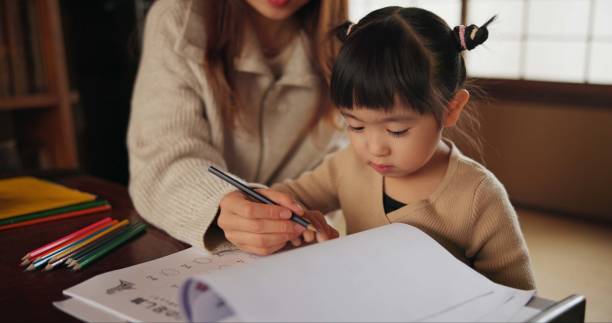
“Who is she, sweetheart?” I asked.
Mia shrugged with a natural, relaxed tone children use when talking about something they don’t find unusual. “She lives upstairs.”
“We don’t have upstairs,” I reminded her with a smile. Our home was a single-story cottage—no second floor, no attic. The roof structure was shallow, leaving no crawlspace large enough for anyone to fit. It simply wasn’t possible for someone to “live upstairs.”
Mia just kept coloring. “She talks softly,” she added, as if she were describing a friendly neighbor.
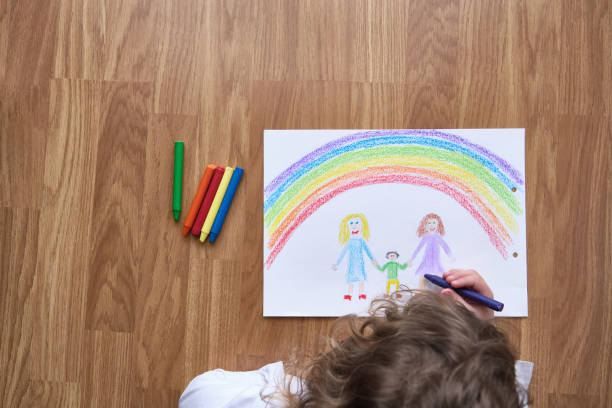
I laughed it off, placing the drawing on the refrigerator. But over the next week, more drawings came home. Every single one showed the same woman. And every picture placed her in the same position—floating above the ceiling, sometimes sitting near the beams, sometimes looking down at us with an expression that wasn’t frightening but strangely thoughtful. Like she had been there a long time, watching over something she cared about.
By the seventh drawing, my uneasiness grew. The details were too consistent: the same dress, the same hairstyle, the same kind smile. Children don’t usually repeat specific features unless they come from somewhere real to them.
So one night while Mia slept, I quietly examined the ceilings for any sign of water stain, light leak, anything that might be triggering her imagination. There was nothing. Our house was perfectly normal, quiet, predictable.
But curiosity has a way of settling in, even when logic insists it shouldn’t. I found myself lying awake, staring at the ceiling as if I expected it to speak.
The next morning, as I packed Mia’s lunch, she approached me holding another drawing—this one more detailed than all the others.
“She says this is you,” Mia explained, tapping the small figure of a young woman standing at the bottom of the picture. “She remembers you.”
I felt a chill I couldn’t explain. The little woman in the drawing wore a hairstyle I used to have in college, something I hadn’t shown Mia. Something not even saved in most photos anymore.
“How do you know that?” I asked gently.
“She told me when I was playing,” Mia said.
“Where were you playing?”
“Upstairs.”
I knelt to her level. “Sweetheart, show me where ‘upstairs’ is.”
She walked to the hallway, pointed at the ceiling, and smiled as if inviting me to look. “She stays right there. She watches us so we’re not lonely.”
I tried to keep my voice steady. “What’s her name?”
“She doesn’t say. She says you already know.”
That answer lodged itself in my mind for the rest of the day. I didn’t know anyone who matched Mia’s drawings. No relative, no friend of the family, no former neighbor.
But something stirred inside me—a memory I didn’t fully understand. My mother used to mention a friend who visited often when I was little, someone kind, someone who helped her through a difficult year. But I was too young to remember anything clearly, and my mother rarely spoke about that period. Whenever I asked, she always said, “It was a complicated time.” And that was the end of it.
That night, I brought out a flashlight and climbed onto a chair beneath the hallway ceiling. If there was any kind of access panel, I wanted to find it. After running my hands along the edges of the plaster, I felt a faint outline—a square panel painted to match the ceiling. So faint I had never noticed it before.
My heart beat faster. I pressed gently. Nothing moved. But when I fetched a thin screwdriver and pried carefully, the panel lifted slightly. Dust sprinkled down. I coughed, holding the flashlight steady as I pushed the panel aside.
The space above wasn’t an attic—not really. It was more of a shallow storage cavity built decades ago when the house was first constructed. Barely tall enough for anyone to sit upright. But something was definitely up there.
A small tin box.
My breathing changed as I reached up, standing on tiptoe to pull it down. It was old—its hinges rusted, its surface scratched. I climbed off the chair and sat on the floor, the box heavy in my hands.
Inside were items carefully wrapped in tissue.
Old photographs.
A necklace.
And a stack of letters bound together with a faded ribbon.
My hands shook as I unfolded the top photograph. It showed a young woman holding a baby—me. The woman wasn’t my mother. Yet she looked deeply affectionate, as if she had cared for me once in a way that left a lasting memory.
And she looked exactly like the woman in Mia’s drawings.
“No…” I whispered, though I didn’t know what I was denying.
The next photo showed the same woman sitting beside my mother at a kitchen table, both smiling warmly. My mother looked tired but grateful. Behind them, on the wall, was the wallpaper we had in our childhood home—the home we left when I was five.
I turned to the letters next. The handwriting was elegant and familiar in a way I couldn’t place. The first letter began simply:
“To Sarah, when she’s old enough to understand.”
My breath caught. The letter was meant for me.
The writer explained that she had been my mother’s closest friend during a year when our family went through many challenges. She helped care for me when my mother was overwhelmed. She never attempted to take my mother’s place—but she formed a bond with me during that time. A bond so strong that when she moved away, she left behind these letters and photos, hoping I would find them someday.
But why hide them in the ceiling?
The next letter revealed the answer. My mother had been struggling emotionally during that period and relied heavily on this friend. When things improved, she worried that knowing the depth of this woman’s involvement might confuse me or weaken our mother-daughter closeness. So she stored the memories away—literally—promising to share them when I was older, but never finding the right moment.
The final letter said something that made my eyes sting:
“I hope you never feel alone, Sarah. If you ever do, I hope you remember that once you were loved by more hearts than you knew.”
I sat there for a long time, absorbing the truth. The woman in the drawings wasn’t a ghostly figure or an imaginary friend. She was a real person from my past—a person I had forgotten, but whose presence had been meaningful enough that even my daughter sensed something about her through old photographs she must have glimpsed while the box remained hidden above us.
The next morning, I asked Mia gently, “Sweetheart, when you saw that woman, did she look like this?” I showed her the photo.
Mia studied it with surprising seriousness. “Yes. She smiles a little more in real life.”
I swallowed. “Did she ever say anything else to you?”
“She just said she’s happy we’re okay,” Mia replied, turning back to her breakfast.
Something in my chest loosened. Whatever presence Mia felt wasn’t frightening. It wasn’t harmful. Children often blend memory, imagination, and glimpses of real images into something that feels vivid to them.
Later that day, I called my mother. When she heard my voice, she sighed before I even spoke. “You found the box.”
I sat on the couch, holding one of the letters. “Why didn’t you tell me about her?”
My mother’s voice softened with something like regret. “I wanted to. But the years passed, and then you grew up, and I wasn’t sure if opening the past would help you or just confuse you.”
“She meant something to us,” I said.
“She did,” my mother whispered. “She helped me during a hard time. She cared for you like you were her own. She brought peace into our home when everything felt overwhelming.”
“Did she leave because something happened?”
“No. She left because her work took her abroad. She wanted to keep in touch, but I thought it would be easier for you if I simplified your world. I didn’t want you to feel torn between two mother figures.”
I looked at another picture—a candid shot of the woman brushing my hair while I giggled. The tenderness in her expression was undeniable.
“Mom,” I said softly, “Mia has been drawing her.”
There was a long silence on the line.
“She was very gentle,” my mother said quietly. “Children remember gentleness, even when adults forget.”
After the call, I placed the letters back in their box, but I didn’t put it back in the ceiling. Some stories shouldn’t be hidden indefinitely. Some connections, even ones we forget, continue through the generations in ways we don’t fully understand.
That evening, I found Mia drawing again—this time a picture of our family: me, her, her father… and the woman. But in this drawing, the woman wasn’t floating above the ceiling. She stood beside us, smiling.
“Why is she down here now?” I asked.
Mia shrugged as if it were obvious. “Because you found her. She doesn’t need to stay upstairs anymore.”
I kissed the top of her head, feeling a mix of awe and gratitude. Somehow, my daughter had sensed a part of my past before I rediscovered it myself. Maybe memories don’t disappear. Maybe they wait quietly until someone is ready to receive them.
And maybe, in her own way, the woman from my childhood had always stayed close. Not in the attic. Not in shadows.
Just in the space where love lingers quietly—until someone opens the box.