What Is This Strange Wooden Chair With a Built-In Table? The Forgotten Household Treasure That Once Had a Special Place in American Homes
The unusual wooden chair in the headline may look like something pulled from an old-fashioned living room, but its strange design once served a surprisingly practical purpose. Before smartphones, text messages, and wireless devices transformed the way people communicated, making a telephone call at home was often an activity that required a little preparation.
Families needed a place to sit, a telephone within easy reach, and somewhere to keep the information they might need during a conversation. That everyday habit gave rise to a distinctive piece of furniture that many younger Americans have never seen.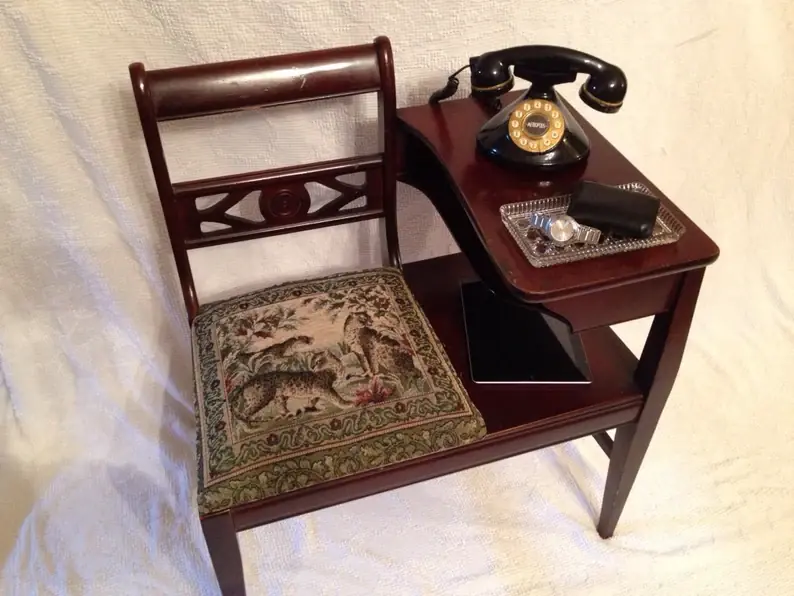
Known as a telephone chair or telephone table chair, this vintage household item combined a comfortable seat with a built-in writing surface. Some designs included drawers, shelves, or compartments for storing telephone directories, address books, pencils, and handwritten messages.
But why did American homes need an entire piece of furniture just for making phone calls? And what made these chairs so popular that they eventually became nostalgic collectibles?
The answer begins in a time when a telephone call was not something people made while walking around the house. It was an activity that often brought family members to one particular corner of the home.
The screenshot's main photograph appears to show a close-up of a fruit rather than the wooden telephone chair described in the headline and article text. To keep the article accurate, I’m following the headline and the supplied description of the furniture. The related photographs at the end show actual vintage telephone chairs and tables.
The historical background is supported by accounts of telephone furniture, including the IKEA Museum's history of telephone tables and a feature on the American “gossip bench.”
IKEA Museum+2
Chapter 1: The Forgotten Furniture That Once Made Perfect Sense
Imagine walking into an American home during the middle of the twentieth century.
The living room might contain a comfortable sofa, a polished wooden coffee table, a television cabinet, and a telephone positioned in a convenient corner. In the hallway, there might be a small table holding a lamp, a bowl for keys, and a thick telephone directory.
But in some homes, the telephone had a dedicated place of its own.
Instead of placing the telephone on an ordinary table and pulling up a separate chair, families could use a specially designed piece of furniture that combined both items into one compact arrangement.
The chair usually had a wooden frame, a seat positioned beside a raised tabletop, and sometimes a small storage compartment underneath. The telephone rested on the table, while the person making the call sat comfortably nearby.
At first glance, the design may seem unnecessarily complicated. Why would anyone need a chair with a table permanently attached?
The answer becomes much clearer when we consider how different telephone technology was from the devices people use today.
A telephone was not something that could easily be carried from room to room. It was often connected to a fixed location, and the telephone itself could be large, heavy, and inconvenient to move.
The furniture was designed around that reality.
It brought the telephone, the person using it, and the materials needed for the conversation together in one place.
What might look like an unusual antique today was once a practical solution to an everyday household problem.
Chapter 2: What Was the Strange Wooden Chair Actually Called?
The furniture described in the headline is commonly known as a telephone chair, telephone table chair, or telephone table with a seat.
Another popular name is the gossip bench.
The term “gossip bench” became associated with furniture that allowed someone to sit beside a telephone for an extended conversation. It was especially familiar in American homes during the middle decades of the twentieth century.
The exact design varied considerably.
Some examples looked like ordinary wooden chairs with a small tabletop attached to one side. Others were built more like compact benches, with the seat and table forming a single continuous structure.
Certain models had a simple wooden seat, while others included upholstered cushions.
Some featured a raised backrest, decorative wooden carvings, or turned legs. More modern examples used cleaner lines and simpler shapes.
The tabletop was usually positioned at a convenient height for placing a telephone and writing notes.