Some models have a simple shelf, while others include a drawer or enclosed space.
Upholstery can also influence the appearance of the chair.
Original fabric may help preserve the furniture's historical character, although it may show wear after decades of use.
Collectors may also look for manufacturer labels, stamps, or other identifying marks.
These details can sometimes help establish the furniture's origin or approximate age.
Because telephone chairs were produced in many styles, identifying a particular example may require comparing its design with similar pieces.
Chapter 15: Could the Telephone Chair Have a Modern Purpose?
Although the original telephone chair is no longer essential, its basic design still has potential uses.
A small table attached to a chair can be convenient in many situations.
It could provide a place for reading, writing, or using a tablet.
A storage compartment might hold books, notebooks, charging cables, or other small items.
Some people might use a vintage telephone chair as a compact desk in a small apartment.
Others may place it in a reading corner or use it as an accent piece.
The furniture's original purpose may have disappeared, but its combination of seating and storage remains practical.
This is one reason vintage furniture can continue to appeal to modern homeowners.
A design created for an old technology may still be useful in a different context.
Chapter 16: The Nostalgia Behind the Gossip Bench
For people who remember the telephone chair, the furniture may evoke more than a particular room or household object.
It can bring back memories of family conversations, childhood homes, and a time when communication followed a different rhythm.
A telephone call might involve looking up a number, sitting down, and speaking for several minutes.
There was often a sense of preparation.
People could write down information as they talked.
They might arrange a visit, share news, or discuss an important family matter.
The telephone chair became part of those routines.
Its presence in a home could be so familiar that family members barely noticed it.
Years later, seeing a similar chair in an antique shop may bring those memories back.
That emotional connection helps explain why seemingly ordinary furniture can become meaningful to collectors.
The chair is not simply a wooden object.
It is a reminder of how people once communicated.
Chapter 17: A Small Piece of Furniture That Tells a Bigger Story
The telephone chair offers an interesting example of how everyday design reflects the technology and habits of its time.
It was created to solve a practical problem.
The telephone needed a stable location.
The user needed a comfortable seat.
The directory and writing materials needed to remain nearby.
The chair combined those functions into one piece of furniture.
Its design made sense in a home where telephone calls were often stationary and required a little preparation.
As technology changed, the furniture became less necessary.
But the chair still tells us something about the way people organized their homes.
It shows how a new technology can influence the design of ordinary household objects.
It also demonstrates how furniture can become part of a family's daily routine.
The telephone chair may seem unusual today, but it was once a sensible response to a familiar need.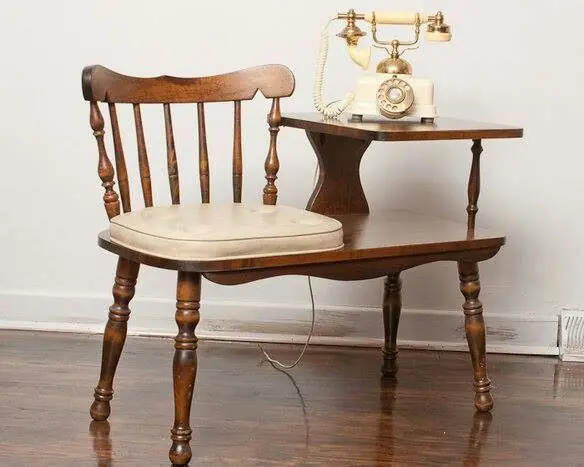
Chapter 18: The Forgotten Household Treasure
The strange wooden chair with a built-in table was not simply an eccentric antique.
It was a telephone chair, often called a gossip bench, designed to make household telephone calls more comfortable and organized.
The attached tabletop held the telephone.
The seat allowed someone to sit during a conversation.
The compartment underneath could store directories, address books, and writing materials.
For many American households, the furniture provided a convenient place to make calls and keep important information close at hand.
Its popularity reflected a time when telephones were fixed in place and communication often required a dedicated corner of the home.
As telephones became smaller, cordless, and eventually mobile, the need for this specialized furniture faded.
Today, the telephone chair survives as a vintage collectible and a reminder of a different era.
Its unusual design may puzzle younger generations, but its original purpose was straightforward.
It brought together everything a person needed for a telephone conversation in one compact piece of furniture.
And that is what makes the forgotten telephone chair so fascinating: it was not designed to be strange. It was designed to make everyday life a little easier.