“Sign the inheritance transfer—nine point eight million dollars—to your sister,” Dad said, sliding a folder across the oak table as casually as if he were passing the salt.
He didn’t raise his voice. He never needed to. The living room had gone so quiet that the clock above the fireplace seemed louder than usual, tapping out each second like a countdown no one dared to interrupt.
The folder stopped just short of my hands, hovering in a space that felt like a boundary even cardboard could recognize. My name was already printed beneath a blank line, waiting. And the number sat there in bold, confident lettering—decided long ago, without me.
$9,800,000.
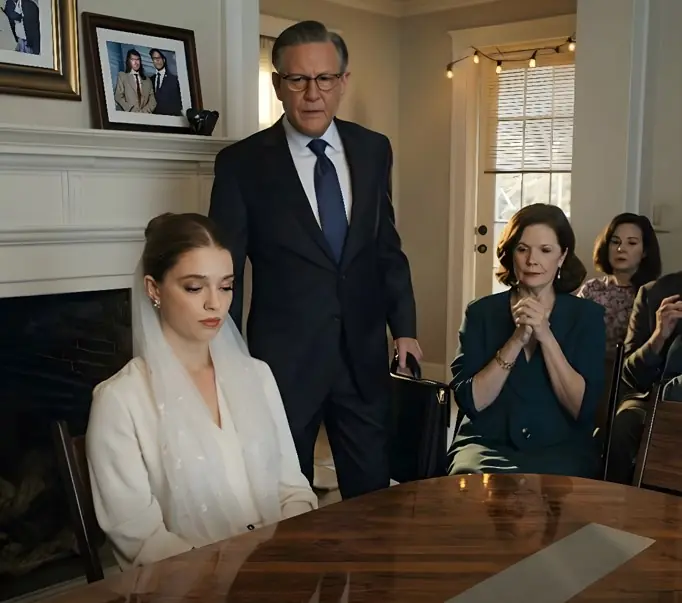
The house didn’t smell like home. It smelled staged: sharp lemon cleaner that pinched the throat, the heavy sweetness of roast chicken lingering in the air, warm vents blowing as if the room had been “preheated” for an audience. Along the walls, folding chairs had been lined up—too many—packed with people who suddenly made the space feel designed to outvote me.
- A folder placed like an order, not a request
- A room arranged like a meeting, not a family gathering
- Silence so thick it turned every breath into a decision
Karen sat near the center in cream pants and a pale blue blouse, hands neatly folded in her lap. She wore a calm, polished smile—the kind people wear when they already know how the story ends.
Behind her chair, her husband stood with one hand resting on the backrest, a quiet claim of support that also felt like ownership.
I stared at the documents, then looked up at my father. His face held that familiar expression he used when he believed he was being “reasonable.” It wasn’t warmth. It was certainty.
“I’m not signing,” I said.
The words landed hard. Not loud—just final. The room reacted like a restaurant after a dropped plate: a startled hush, a few small sounds people made without meaning to. Someone swallowed. Someone coughed. A chair creaked and then went still, as if even the furniture realized it had moved at the wrong moment.
Karen’s smile flickered for the briefest instant before snapping back into place.
Sometimes the loudest rebellion in a controlling room is a calm “no.”
My mother stood up so quickly her chair scraped the floor with a harsh metallic screech. Her perfume—sweet, floral, too strong—hit me like a warning. Before I could say another word, she struck me.
It wasn’t drawn out or dramatic; it was swift and sharp, the kind of gesture meant to end a conversation. My cheek burned, and I tasted something metallic, like I’d bitten my lip.
“You don’t have a choice!” she shouted, her voice climbing higher. “Do you understand? No choice!”
No one stepped in. A few faces showed surprise, but surprise is not the same as help. The room held its breath and forgot how to exhale.
I kept my palm flat on the table. I didn’t touch my face. I refused to give her what she wanted—reaction.
In my family, reactions were fuel. If I cried, I was “too dramatic.” If I raised my voice, I was “unstable.” Whatever I did, they would shape it into proof that I couldn’t be trusted.
- If I showed emotion, it would be used against me
- If I defended myself, it would become the story
- If I stayed still, they had less to twist
So I stayed still. Stillness was the one thing they couldn’t easily distort.
Then Mr. Caldwell—the family lawyer—rose from his seat with deliberate care and adjusted his glasses. He wore a suit that looked too perfect for a Sunday, and the briefcase at his feet sat like a period at the end of a sentence.
His gaze moved from my mother’s raised hand, to my cheek, to the folder on the table—like he was seeing the document for what it truly was, not what it had been presented as.
“Ma’am,” he began carefully, “you do realize who actually—”
Dad cut him off before the sentence could find its shape.
He slammed his palm on the table hard enough to make the good dishes tremble.
“And what is that supposed to mean?” he snapped. “What exactly are you implying?”
Every head turned. Every breath stalled.
And through it all, the clock kept ticking, steady and indifferent—marking time in a room where the truth was pressing against the walls, waiting for someone brave enough to let it out.
Conclusion: What began as a demand for a signature became something larger: a moment where control, money, and family expectations collided. In that tense silence, it was clear the real issue wasn’t the inheritance—it was the secret the lawyer almost revealed, and the fear of what would happen if it finally came into the open.