The first thing I noticed wasn’t the sirens, or the bright ambulance lights, or the concerned faces leaning in and out of my view.
It was my heartbeat—loud, heavy, and relentless—pounding so hard it swallowed every other sound. Not as a figure of speech, but as a physical wall of noise, like I’d been pushed underwater while the rest of the world stayed safely above the surface.
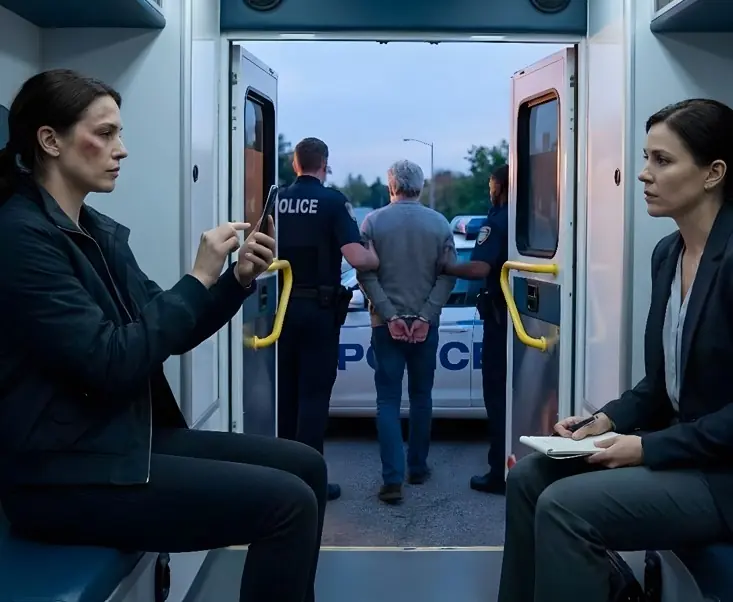
My phone trembled in my hand so violently I could barely hold it steady. A warm line of blood slid from the corner of my mouth and dotted my blouse, darkening the pale fabric into sticky stains. I sat on the narrow bench inside the ambulance, legs hanging awkwardly, hands shaking in my lap like they belonged to someone else.
A paramedic held an ice pack against the swelling on my cheek and mentioned stitches. I nodded, but the words didn’t fully land. Everything felt distant, muffled, unreal.
Seeing Him Outside the Ambulance

Through the open ambulance doors, I spotted my father.
William Brennan—fifty-eight, broad-shouldered, the kind of man strangers once described as “steady” and “reliable,” as if those traits automatically meant “safe.”
Police guided him toward a cruiser with his hands restrained behind him. Even from where I sat, I could see the fury twisting his face as he shouted. I couldn’t make out the words over the ringing in my ears, but I recognized the intensity.
- My body hurt in places I couldn’t fully name yet.
- My mind kept trying to replay what had just happened.
- And the worst part was realizing it had happened at all.
My Mother’s Reaction Hurt in a Different Way
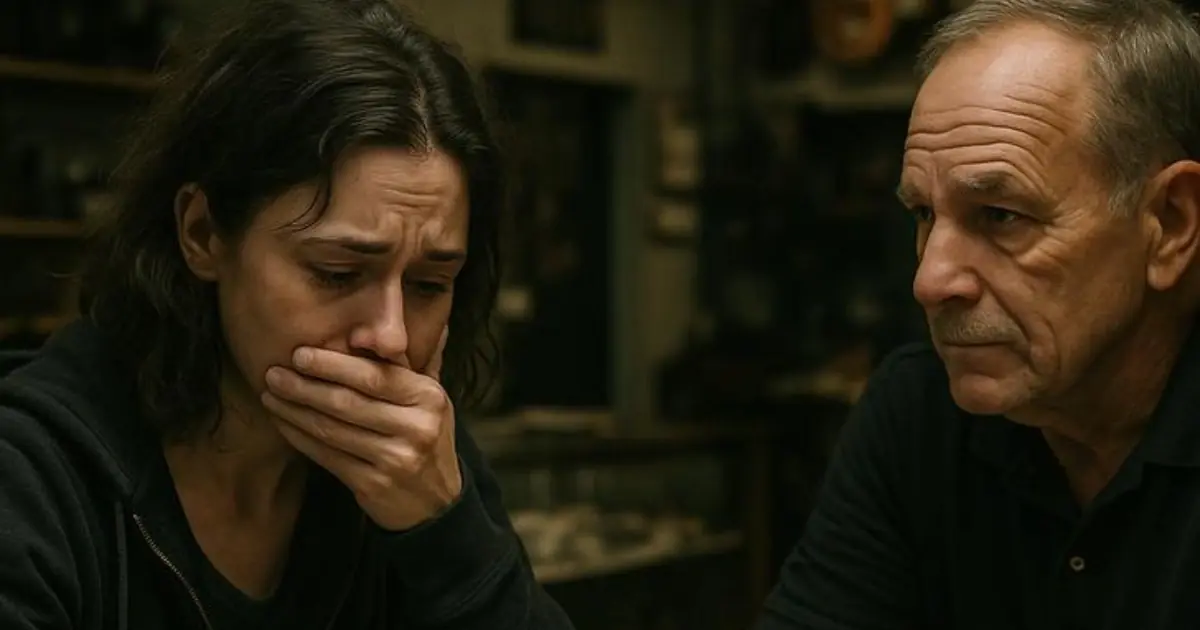
Standing near him was my mother.
She wasn’t crying. She wasn’t stunned. She wasn’t asking if I was okay.
She looked angry—focused and sharp—and her anger wasn’t aimed at what had been done. It was aimed at me.
She kept pointing in my direction, gesturing as if she could persuade the police that I was the real issue. As if my injuries were an inconvenience. As if I had somehow caused the scene simply by existing in it.
In that moment, I understood something I’d avoided admitting for years: sometimes people don’t defend what’s right—they defend what’s familiar.
The Detective Asked for the Truth
“Miss,” someone said calmly from inside the ambulance.
A woman in plain clothes stepped closer, a badge clipped at her waist. Detective Morris. She looked like she had no interest in drama—only facts. Hair pulled back, steady eyes, posture firm. She sat across from me with the composed focus of someone about to conduct an interview in a quiet office, not in the aftermath of a family disaster.
“I need to ask you a few questions while it’s still fresh,” she said gently. “Can you tell me what happened?”
I tried to take a deeper breath, but pain flared across my ribs—like sand ground into a bruise.
“My brother,” I managed, and my voice cracked. “Trevor called this morning. He said he needed somewhere to stay. I told him no.”
Detective Morris wrote it down. “Why did you refuse?”
“My place is a one-bedroom,” I said. “There isn’t room. And…” I swallowed carefully; the corner of my lip stung as it split again. “He’s twenty-eight. He never keeps a job for long.”
How a Boundary Turned Into a Confrontation
The detective’s pen didn’t stop. “Your father came here because of that?”
“He texted me around noon,” I said. “He said we ‘needed to talk.’ I didn’t answer.”
She glanced up. “And he showed up after work?”
I nodded. “Around five. I work downtown at Morrison and Associates. The garage has cameras.”
“What did he say when he approached you?”
My wrist throbbed as I adjusted the ice pack. “He told me I was selfish. He said family helps family. That Trevor ‘needed’ me and I was abandoning him.”
- He made it sound like my apartment wasn’t mine.
- Like my peace was a luxury I didn’t deserve.
- Like saying “no” was the same as betrayal.
Detective Morris’s voice stayed steady. “And what did you say back?”
I stared at my trembling fingers. The shaking wouldn’t stop, no matter how hard I tried to control it.
“I told him Trevor keeps getting evicted because he doesn’t pay rent,” I said. “I told him I worked hard for my home, and I wasn’t going to sacrifice it.”
The detective’s eyes softened, but her tone remained professional. “And that’s when your father became physical with you?”
I didn’t answer right away. Not because I didn’t know—but because saying it out loud made it real in a new way.
Finally, I nodded.
Conclusion: Choosing Safety Over Silence
Even now, what stays with me most isn’t only the pain or the chaos—it’s the clarity. I set a reasonable boundary, and the people who should have protected it treated it like a personal attack. That day taught me an unforgettable lesson: “family” should never be used as a weapon, and love shouldn’t come with threats. Moving forward, my priority is simple—safety, stability, and a life that doesn’t require me to shrink just to keep someone else comfortable