My Stepmother Sat in the Front Row When No One Else Did
For five years, I lived my life as a series of carefully constructed boundaries. In my world, love was a finite resource—a pie with only so many slices—and I was determined that not a single crumb would go to the wrong person. When my father married Clara, I was twelve. I remember standing at their wedding in a pale blue dress, feeling like a secret agent behind enemy lines. I had convinced myself that every smile I gave Clara was a direct insult to my mother, who lived three towns away and spent her weekends trying to rebuild a life that had once felt so solid.
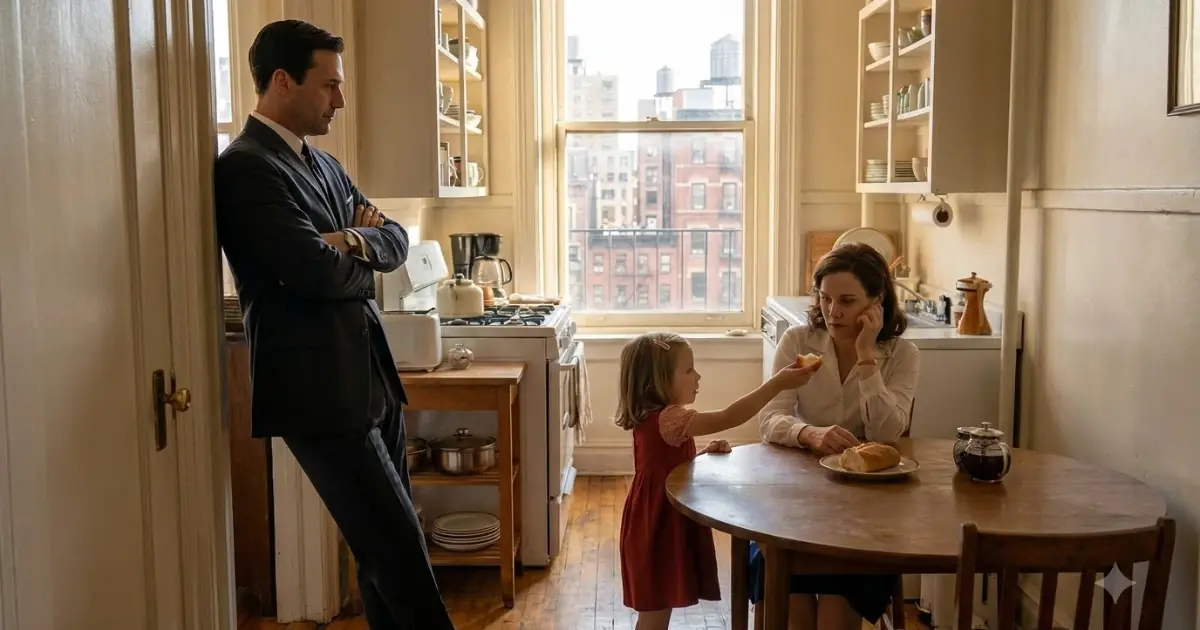
Clara was a landscape architect—a woman of patience, sun-kissed skin, and an incredible ability to listen to the silence. She never tried to "parent" me in the traditional sense. She didn't scold me for messy rooms or demand that I call her anything other than her name. Instead, she existed in the periphery of my life like a gentle light. She left books she thought I’d like on the coffee table. She made sure there was always a batch of blueberry muffins on the mornings I had swim meets.
But I was a master of the polite distance. I would say "thank you" for the muffins, but I wouldn't tell her how the race went. I would take the books, but I’d never mention that the one about the girl in the lighthouse made me cry. To me, sharing my inner world with Clara was an act of treason. I believed that if I let her see my struggles or my triumphs, I was officially erasing my "original" family.
"How was the debate prep, Maya?" she’d ask on a Tuesday evening, her voice steady and kind.
"It was fine," I’d reply, staring at my laptop. "Just research."
I wouldn't tell her that I was terrified of the upcoming Regional Finals, or that I had stayed up until two in the morning perfecting my opening statement on environmental policy. Those were things I saved for my mom’s Sunday phone calls—calls where I’d downplay the stress so my mom wouldn't worry, but where I’d at least feel the comfort of a "blood" connection.
The loyalty conflict was a heavy, invisible weight I carried all the way to the state-level forensics competition in early March. This was the big one. I had worked for four years to reach the state finals in Original Oratory. My dad had promised to be there, and my mom had booked a hotel room months in advance to ensure she wouldn't miss a single word of my ten-minute speech. This was supposed to be the moment my "real" parents stood in the back of the auditorium and saw what I had become.
Then, the universe decided to test my boundaries.
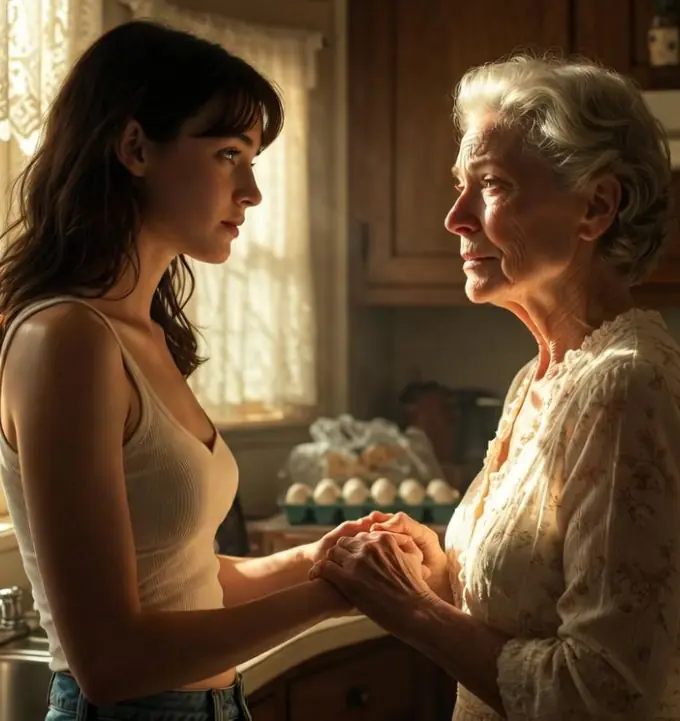
Two days before the competition, a massive late-season ice storm paralyzed the tri-state area. My mom’s town was hit the hardest; her car was iced into the driveway, and the local authorities had issued a strict "no travel" order. She called me on Thursday night, her voice thick with tears.
"Maya, honey, I’m so heartbroken. The roads are sheets of glass. I tried to get out, but I almost slid into the neighbor’s fence just getting to the end of the drive. I can't get there, sweetie. I am so, so sorry."
"It’s okay, Mom," I said, trying to keep my own voice from trembling. "Safety first. I know you’re with me in spirit."
But the blow didn't stop there. My dad, who had been on a business trip in Atlanta, found himself stranded at the airport as flight after flight was canceled due to the weather moving north. He called me from Terminal B, the sound of gate announcements echoing behind him.
"Maya, I’m trying everything. I’m on the standby list for a flight into the city three hours away, but it doesn't look good. I might not make the morning session."
I hung up the phone and sat on the edge of my bed in my dad and Clara’s house. The house was quiet. Clara was downstairs, probably sketching a garden plan or reading. I felt a hollow ache in my chest. I had spent four years preparing for this ten-minute moment, and now, it looked like I would be speaking to a room full of strangers and judges, with no one in the "Maya" camp to witness it.
The morning of the competition was gray and frigid. Clara was in the kitchen, packing a thermos of tea. "The roads are cleared here, Maya," she said softly. "I’ll drive you to the high school. We should leave in twenty minutes to make sure you have time to warm up your voice."
"Thanks," I said, my voice flat. I felt a sting of resentment. It felt like a consolation prize. She was the one who was available because she didn't have to travel, but she wasn't the one I had envisioned in that back row.
The competition was a blur of nervous energy. I sat in the holding room with thirty other students, all of us adjusting our blazers and whispering our lines. When my turn finally came, I walked onto the stage of the massive high school auditorium. The lights were bright, making the audience a sea of shadowy figures. I looked for the familiar silhouette of my dad’s tall frame or my mom’s enthusiastic wave. There was nothing. Just the scratch of pens on judges' clipboards and the soft cough of a spectator in the third row.
I took a breath and began. "History isn't just a collection of dates; it’s a collection of people who refused to be quiet..."
I poured everything into it. The frustration of the week, the disappointment of the empty seats, the four years of work. I spoke about resilience, about building bridges when the world feels divided. As I reached my conclusion, my eyes adjusted to the dim light of the auditorium.
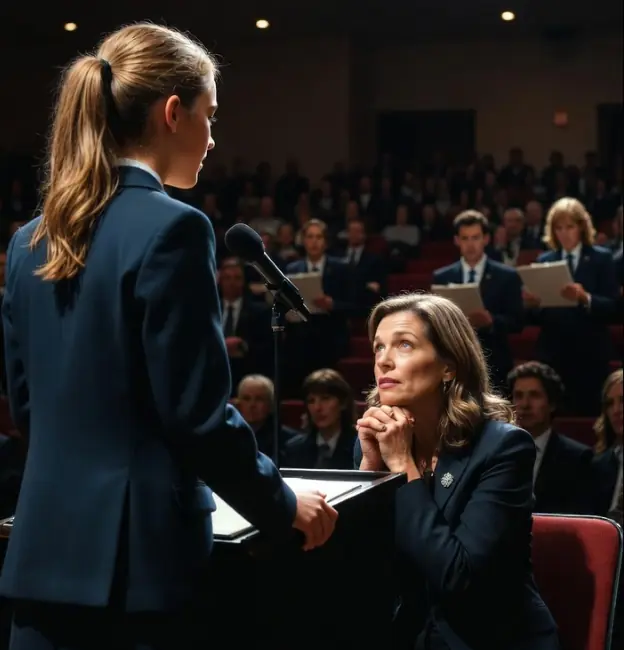
There, right in the front row—a seat usually reserved for the most dedicated supporters—was Clara.
She wasn't waving. She wasn't taking photos with a flash. She was simply sitting there, leaning forward, her hands clasped under her chin. She was wearing a small silver brooch I had seen on her dresser—a tiny thing I never knew she wore for luck. Even from the stage, I could see the intensity of her focus. She wasn't just "there" because she was the driver; she was there as a witness.
When I finished, the applause was polite and standard for a high school event. I walked off the stage, my heart hammering against my ribs. I found a quiet hallway near the gymnasium and leaned against the lockers, finally letting a few tears of adrenaline escape.
A few minutes later, I heard the soft click of heels on the linoleum. Clara appeared at the end of the hall. She didn't rush over and try to force a "mother-daughter" hug. She didn't tell me I was the best one there. She just walked up, handed me a bottle of water, and said, "The part where you spoke about the bridge-builders—the way your voice dropped just a half-octave to show the gravity of it? That was the moment you won the room, Maya. It was powerful."
I looked at her, really looked at her, for the first time in years. I realized that while I had been busy guarding the "slices of the pie," Clara had been busy just being a person who showed up. She didn't want my mom’s slice. She didn't want to replace my dad’s support. She had brought her own chair to the table, and she had sat in it quietly, waiting for me to notice.
"You stayed for the whole thing?" I asked, my voice small.
"I wouldn't have been anywhere else," she replied. "I know how hard you worked on that opening statement. I heard you through the door on Tuesday night. You finally got the rhythm right."
The hollow ache in my chest began to fill with something warm and unfamiliar. It wasn't the same love I had for my mom, and it wasn't the same bond I had with my dad. It was something new—a sturdy, respectful connection built on the simple fact of her presence.
"Clara?" I said as we walked toward the car.
"Yes, Maya?"
"Thank you. For being here. And for the tea this morning. It really helped my throat."
She smiled, a small, genuine expression that didn't ask for anything in return. "You’re very welcome. Now, let’s get home and call your parents. I think they’re going to want to hear every detail."
That evening, as I sat on the phone with my mom, I found myself doing something I never thought I’d do. I didn't just tell her about the speech. I told her about Clara. "She was there, Mom. She sat in the front row and noticed the half-octave thing. She really listened."
And for the first time, my mother didn't sound hurt or threatened. She sounded relieved. "I’m so glad, Maya. I’m so glad you weren't alone."
I realized then that family isn't a zero-sum game. Loving Clara didn't mean I loved my mother less; it just meant I had more people in my corner. The "original" family wasn't being erased; the story was just getting a longer cast list. We are the Miller-Baxters, and we are still navigating the ice storms and the boundaries. But the distance isn't so cold anymore. I still have my room, and my mom still has her weekends, but there is a bridge now—a silver ribbon of a bridge—that leads to the kitchen where Clara is probably baking something that smells like home.