The silent dinner that finally brought my father-in-law and me closer
In the hierarchy of the Miller family, my father-in-law, Frank, was the undisputed summit. A retired master electrician with a grip like a vice and a gaze that could seemingly measure the levelness of a shelf from fifty paces, Frank was a man of few words and even fewer smiles. To him, communication was a tool used for efficiency, not for "vibe-checking" or "sharing feelings."
I, however, am a middle school guidance counselor. My entire professional life is built on open dialogue, empathy, and the occasional breakthrough over a shared box of tissues. When I married his daughter, Sarah, I knew I was entering a world where my ability to discuss "emotional intelligence" held about as much value as a chocolate teapot.
For five years, our relationship was defined by the "Frank Silence." It wasn’t a hostile silence, but it was heavy. It was the kind of quiet that made me feel like I was perpetually auditioning for a role I hadn't quite memorized. At family dinners, I would lob conversational softballs—questions about his vintage truck, the weather, the local high school football scores—and Frank would catch them with a one-word answer and a slow chew of his steak.
"He’s just an old-school guy, Mike," Sarah would say on the drive home, as I sat dejectedly in the passenger seat. "He likes you. He just doesn't think talk is necessary if there’s nothing broken that needs fixing."
"I feel like I’m a ghost in his house, Sarah," I’d reply. "I feel like he’s waiting for me to do something 'counselor-y' so he can roll his eyes. I just want to know if he thinks I’m good enough for you."
The tension reached a peak on a rainy Thursday in November. Sarah and her mother had gone out to a late-afternoon bridal shower for a cousin, leaving me and Frank to "fend for ourselves" with a pre-made lasagna. The plan was for me to drop by, heat up the dinner, and wait for the women to return. It was supposed to be a ninety-minute exercise in polite nodding.

Then, the sky turned a bruised purple, and the Oregon rain transformed into a localized monsoon.
We were sitting at the kitchen table, the only sound being the rhythmic clink of forks and the torrential downpour against the window. I had just tried to start a conversation about the new community center, and Frank had responded with his signature "Mhm."
Then, the world went black.
A crack of thunder shook the house, followed by the high-pitched whine of a transformer blowing out down the street. The hum of the refrigerator died. The stove clock vanished. We were plunged into a darkness so absolute I couldn't even see the lasagna on my plate.
"Transformer’s gone," Frank’s voice rumbled in the dark, surprisingly calm.
"I’ll get my phone flashlight," I said, fumbling in my pocket.
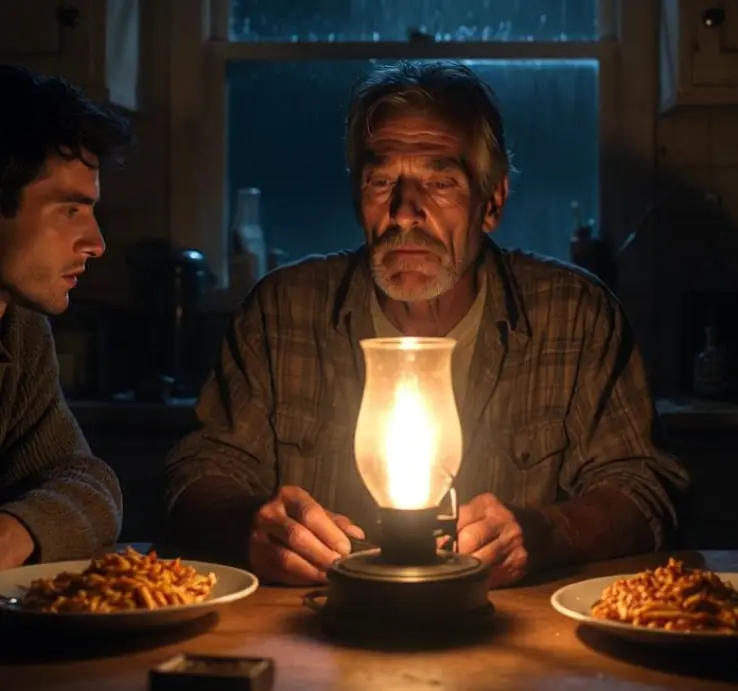
"Don't bother. Batteries are low on those things," Frank said. I heard the scrape of his chair and the familiar heavy tread of his boots moving toward the utility closet. A moment later, a match struck, and the warm, flickering glow of an old hurricane lamp filled the room.
He set the lamp in the middle of the table. The light cast long, dramatic shadows across his weathered face. He looked like a character from a frontier novel, and I felt more like a misplaced city kid than ever.
"Lines are down on the main road," Frank said, sitting back down. "Sarah and her mom won't be back for a few hours. Road’s blocked by the creek."
So, there we were. No TV, no internet, no way out, and nothing to do but sit across from the man who treated my voice like background noise. The silence returned, but this time, it was amplified by the flickering shadows.
"So," I said, my voice cracking slightly. "I guess this is what they call 'unplugged.'"
Frank didn't respond. He just stared at the lamp. I felt a surge of frustration. Five years of being "the invisible son-in-law" finally boiled over.
"Frank, do you actually dislike me, or am I just that boring?"
The question hung in the air, sharper than anything I’d ever said to him. Frank looked up, his eyes catching the lamplight. He looked genuinely surprised.
"What are you talking about, Mike?"
"Every time we’re together, it’s like I’m talking to a wall," I said, the words tumbling out. "I try to be a part of this family. I try to show you that I love Sarah and that I’m a hard worker. But you just... you don't say anything. I feel like I’m constantly failing a test I don't have the study guide for."
Frank leaned back, the wooden chair creaking under his weight. He took a long, slow breath. "You think I’m testing you?"
"Aren't you? You’re the guy who fixes everything. I’m the guy who talks about feelings. I assumed you thought I was... I don't know, soft."
Frank was silent for a long time. I thought I’d finally crossed the line. But then, he let out a short, dry chuckle.
"Soft? Mike, I spent forty years on job sites with men who shouted all day and did nothing. I watched guys puff out their chests and talk a big game while the wiring was a mess behind the walls."
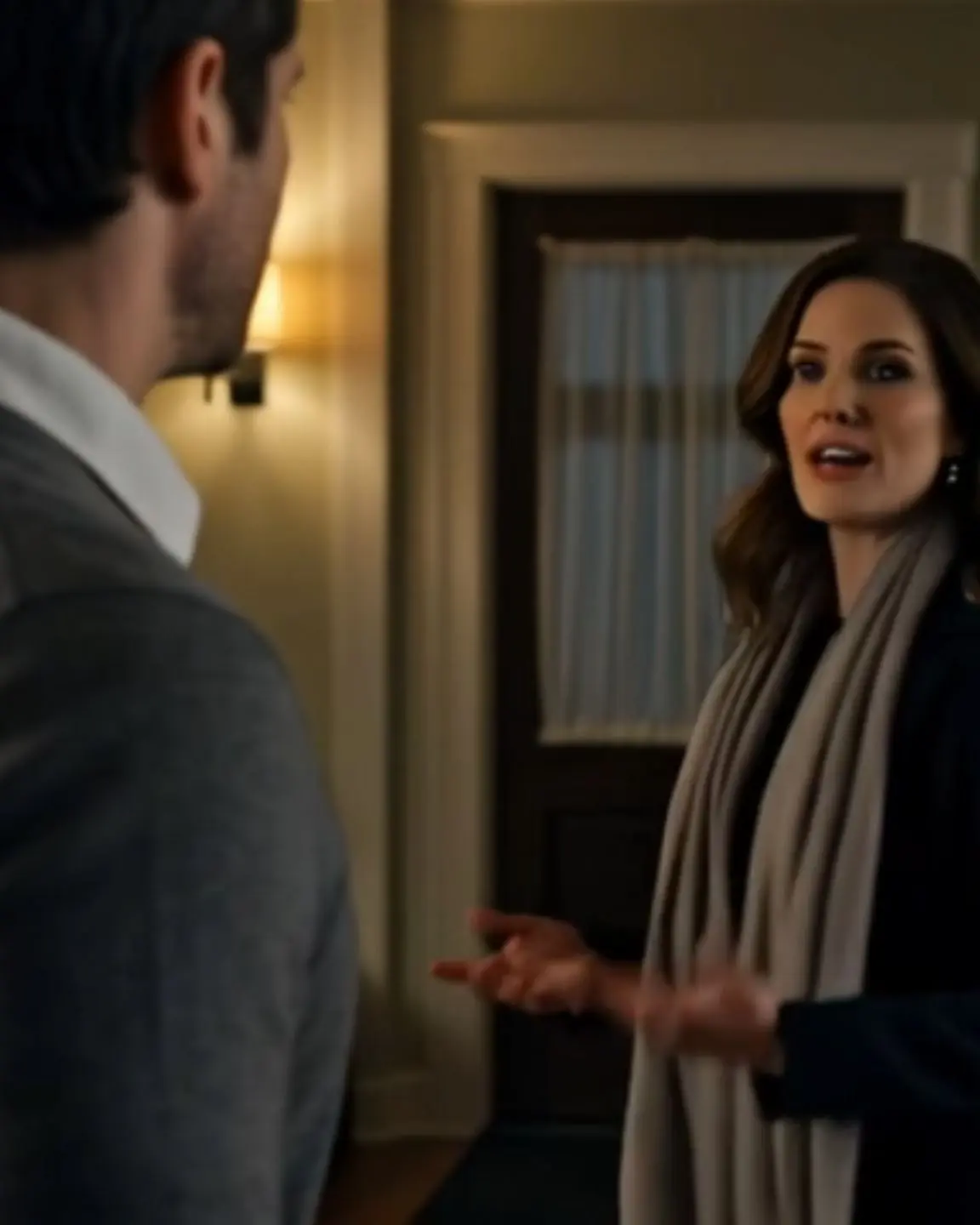
He leaned forward, his hands folded on the table. "When Sarah brought you home, I watched you. I didn't listen to what you were saying—I watched what you were doing. I saw the way you look at her when she’s not looking at you. I saw the way you handled it when her car broke down and you didn't lose your temper. I saw you sit with my wife for three hours talking about her garden when you clearly didn't know a petunia from a potato."
He paused, a rare, thoughtful expression on his face. "I don't talk much because I like to listen. And what I heard over the last five years was a man who stayed. You’re steady, Mike. You’re like a good circuit. You don't make a lot of noise, but the power’s always on."
I felt the tension in my shoulders dissolve, replaced by a warmth that had nothing to do with the hurricane lamp. "I thought the silence meant you were disappointed."
"The silence means I’m comfortable," Frank said. "I don't talk to people I don't like. If I didn't like you, I’d have found a reason to be in the garage every time you visited."
He reached out and nudged the plate of cold lasagna toward me. "Now, eat. It’s better cold than not at all."

The rest of the evening was a revelation. With the pressure to "perform" gone, the conversation actually began to flow. Without the distraction of the TV, Frank started telling me about the "Great Blackout of '96," and I told him about the time a squirrel got loose in the school counseling office. We laughed—really laughed—for the first time. I realized that Frank’s "silence" wasn't a wall; it was a sanctuary. He didn't need me to be an electrician; he just needed me to be someone he could sit in the dark with.
By the time the headlights of Sarah’s car splashed against the kitchen window, the power had flickered back on. The stove clock beeped, the refrigerator hummed to life, and the "real world" rushed back in.
Sarah and her mom came through the door, shaking out their umbrellas and talking at a mile a minute.
"Oh, you poor things!" Sarah cried, rushing over to me. "Locked in the dark with no TV! Was it awful? Did you guys just sit there in total silence?"
I looked at Frank. He caught my eye and gave me a small, almost imperceptible wink—the first one I’d ever received.
"Actually," Frank said, standing up and stretching his back, "we were busy. Mike was helping me understand the 'emotional intelligence' of a blown transformer."
I grinned. "It was a very productive session, Sarah. Frank’s making great progress."
The "Frank Silence" didn't disappear after that night, but it changed. It was no longer a weight; it was a shared understanding. Now, when we sit on the porch or at the dinner table, the quiet is comfortable. I don't feel the need to lob conversational softballs anymore. Sometimes, we just sit there, watching the rain or the sunset, knowing that the "circuit" is closed and the power is on.
I’ve learned that being "good enough" isn't about the words you speak; it’s about the steadiness of your presence. And Frank learned that even a guidance counselor knows how to keep the light burning when the power goes out.
We are the Millers, and we’re a work in progress. But in our house, the silence is finally full.