Think You’re Good at Puzzles? Try Solving This Fun Fruit Challenge
Think You’re Good at Puzzles? Try Solving This Fun Fruit Challenge
⏱️ 1 min read 12/08/2026 14:42
Have you ever noticed that you automatically sit with your legs in a particular position?
Some people keep both feet together and their knees straight ahead. Others instinctively cross one leg over the other, tuck their legs underneath them, or sit with their knees apart.
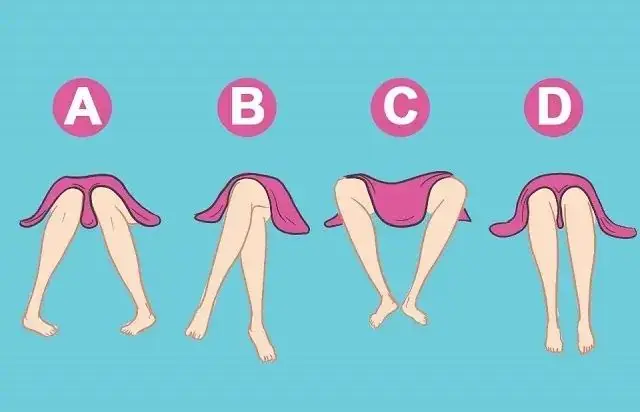
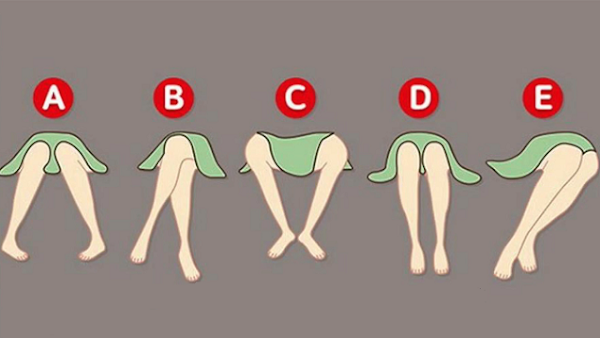
The image above shows five common sitting positions, labeled A through E, with the headline: “What Your Leg Position While Sitting Says About You.”
It may be fun to imagine that a sitting position reveals your personality, but there is no reliable scientific evidence that the way you cross or position your legs can accurately determine whether you are confident, shy, dominant, relaxed, or introverted.
What your sitting position can tell you more reliably is something about your comfort, habits, mobility, posture, and how your body responds to prolonged sitting.
Let's take a closer look at each position.
There isn't one "correct" sitting position that everyone should maintain all day.
People naturally change their posture based on:
Comfort
Chair height
Desk setup
Clothing
Hip mobility
Muscle flexibility
Previous injuries
Habit
Fatigue
Activity level
The body is constantly making small adjustments to maintain balance.
That's why someone might sit differently while working at a desk compared with relaxing at home.
The bigger concern isn't usually which position you prefer, but whether you remain in the same position for too long.
In position A, the person's knees are close together and the feet are positioned relatively symmetrically in front of the body.
This is a relatively neutral-looking seated posture.
This position may simply feel stable and comfortable.
Keeping both legs facing forward can reduce the amount of rotation required at the hips and knees compared with some crossed-leg positions.
It may also be easier to maintain symmetry between the left and right sides of the body.
But it would be a mistake to conclude that someone who sits this way is automatically:
More disciplined
More reserved
More polite
More organized
Less confident
Those personality conclusions are popular online, but they aren't reliable psychological assessments.
If the person's feet are supported and their knees are roughly aligned with the hips, this can be a comfortable position for many people.
However, even a relatively neutral posture can become uncomfortable if maintained for hours without movement.
Position B shows one leg crossing over the other.
This is one of the most common sitting positions worldwide.
People often cross their legs because it feels comfortable or because it provides a sense of stability.
For most healthy people, briefly crossing your legs is not inherently harmful.
However, remaining in one crossed-leg position for a long time can contribute to temporary discomfort, particularly if the posture places uneven pressure on the hips, knees, or lower back.
You may notice:
Tingling
Numbness
A "pins and needles" sensation
Hip discomfort
Leg stiffness
Usually, changing position and moving around resolves these sensations.
You've probably heard that crossing your legs is dangerous because it "cuts off circulation."
That's an exaggeration.
Crossing your legs can temporarily affect blood flow or compress nerves depending on the position, but occasional leg crossing is not generally considered a major health risk for most people.
The bigger issue is prolonged immobility.
If you're sitting for several hours, regularly changing positions and getting up to walk is more important than obsessing over whether your legs are crossed.
Position C shows both legs facing forward with the feet positioned relatively evenly on the floor.
From an ergonomic standpoint, this can be a useful starting position when sitting at a desk.
Ideally:
Both feet are supported
Knees are comfortably bent
Hips are supported by the chair
Shoulders remain relaxed
The back is supported when appropriate
But even this posture doesn't need to be held rigidly.
A common misconception is that there is one perfect posture that must be maintained throughout the entire day.
There isn't.
The human body isn't designed to remain completely still for hours.
Even a theoretically excellent posture can become uncomfortable when maintained indefinitely.
Instead, think:
Good posture + regular movement + position changes.
Position D shows the legs crossing lower down, around the ankles or lower legs.
This can feel comfortable because it creates a stable base while allowing the upper body to remain relatively relaxed.
People may adopt this position unconsciously while:
Working
Waiting
Talking
Watching television
Reading
Again, there is no scientific basis for saying this position reveals a specific personality type.
Someone sitting this way may simply have found a comfortable position.
Potentially, especially if you maintain an asymmetrical position for a long time.
When one leg is positioned differently from the other, the pelvis and lower body may rotate slightly.
This isn't necessarily harmful.
The important thing is to change positions regularly rather than maintaining the same asymmetry throughout a long sitting session.
Position E shows a more open seated posture, with the knees separated and the legs positioned asymmetrically.
This is another common way people relax in a chair.
The amount of space between the knees naturally varies between individuals because of:
Hip anatomy
Femur length
Chair design
Clothing
Flexibility
Personal comfort
You may see social-media posts claiming that people who sit with their legs apart are more confident, dominant, or outgoing.
That interpretation should be taken with a huge grain of salt.
Body language can sometimes provide contextual information during social interaction, but one isolated leg position isn't enough to determine someone's personality.
Someone may simply be comfortable.

The most interesting lesson from this image isn't that your legs reveal your personality.
It's that your body constantly searches for comfortable positions.
You may switch between:
Legs crossed
Legs uncrossed
Feet forward
One foot tucked backward
Knees together
Knees apart
These changes are normal.
In fact, regularly changing positions can be preferable to remaining completely rigid.
The bigger health concern isn't necessarily whether you sit with your legs crossed.
It's how much time you spend sitting overall.
Long periods of sedentary behavior are associated with several health concerns, particularly when combined with insufficient physical activity.
Extended sitting can contribute to:
Muscle stiffness
Back discomfort
Hip tightness
Reduced movement
Poor posture habits
Reduced daily energy expenditure
For people who work at a desk, the solution isn't necessarily to find one "perfect" sitting posture.
Instead, build movement into the day.
When you sit for a long time, the muscles responsible for maintaining posture remain relatively inactive compared with standing or walking.
Your hips and knees remain flexed.
Your body may gradually become more relaxed, causing you to:
Slouch
Lean to one side
Slide forward in the chair
Cross your legs
Tuck one foot underneath you
These positions may feel comfortable temporarily.
But after enough time, stiffness or discomfort can develop.
That's your body's signal that it's time to move.
There isn't one perfect position that works for everyone.
However, a good seated setup generally includes:
Ideally, your feet should have stable support rather than dangling.
Your knees should be positioned comfortably rather than being forced tightly together or excessively apart.
Sit far enough back in the chair that your pelvis is supported.
Avoid constantly lifting or rounding your shoulders.
If you're working at a computer, position the screen so you don't need to constantly bend your neck downward.
This might be the most important point.
Don't treat posture like a statue.
Move.
Imagine sitting in one position for eight hours.
Even if that position were theoretically perfect, your muscles and joints would still benefit from movement.
Try periodically:
Standing up
Walking around
Stretching
Straightening your legs
Moving your ankles
Changing your hip position
Adjusting your chair
Even short movement breaks can make prolonged sitting more manageable.
Occasional numbness or tingling after sitting awkwardly is common.
It can happen when a position temporarily compresses a nerve or affects local blood flow.
For example, sitting with one leg tucked underneath you can put pressure on nerves.
Usually, the sensation improves after you change position and move around.
However, persistent or recurrent numbness deserves medical attention, especially if it occurs without an obvious positional trigger.
Leg swelling isn't something that should automatically be blamed on sitting posture.
Mild swelling after prolonged sitting or standing can occur because fluid accumulates in the lower limbs.
But persistent or significant swelling can have many causes, including:
Venous problems
Heart conditions
Kidney conditions
Liver conditions
Certain medications
Pregnancy
Other medical conditions
If swelling is persistent, severe, or unexplained, consult a healthcare professional.
If one leg suddenly becomes swollen, painful, warm, or red, seek prompt medical evaluation because a blood clot is one possible cause.
Sitting posture can influence back comfort, but back pain is rarely caused by one specific leg position alone.
Back discomfort may involve:
Muscle fatigue
Poor workstation setup
Previous injury
Weakness
Limited mobility
Prolonged sitting
Stress
Sleep factors
Other medical conditions
If you repeatedly experience back pain while sitting, consider adjusting your workstation and increasing movement throughout the day.
Persistent or severe pain should be evaluated by a healthcare professional.
This is another popular myth.
There is no good evidence that simply crossing your legs causes varicose veins.
Varicose veins are influenced by factors such as:
Genetics
Age
Pregnancy
Hormonal factors
Prolonged standing
Venous valve problems
If you already have circulation problems or discomfort, frequently changing positions and staying physically active can be helpful, but crossing your legs isn't the sole cause of varicose veins.
While your leg position can't reliably reveal your personality, it may tell you something about your routine.
For example:
Someone who frequently sits with one leg tucked underneath may have developed that habit because the position feels comfortable.
Someone who constantly crosses their legs may simply prefer that posture.
Someone who changes positions frequently may be responding naturally to discomfort.
These are observations about behavior and comfort, not personality diagnoses.
Why are articles about sitting positions so popular?
Because people love simple personality tests.
It's entertaining to look at five illustrations and think:
"That's exactly how I sit!"
Then the article tells you that your position means you're confident, shy, independent, emotional, intelligent, or mysterious.
The problem is that these claims often rely on generalized descriptions that can apply to almost anyone.
This is sometimes called the Barnum effect: people tend to perceive vague, broadly applicable descriptions as uniquely accurate about themselves.
So it's fine to treat these personality interpretations as entertainment.
Just don't treat them as psychological science.
If you spend much of your day sitting, try these simple adjustments.
Don't wait until your back hurts.
Stand up and move periodically throughout the day.
Crossing your legs isn't necessarily a problem.
Crossing them in exactly the same way for hours isn't ideal.
Switch sides or uncross them periodically.
A footrest can help if your feet don't comfortably reach the floor.
Your chair should allow you to sit comfortably without excessive pressure behind the knees.
If you constantly reach across your desk, you may develop unnecessary twisting habits.
A few minutes of walking can break up long periods of sitting.
If you've been sitting for a long time, take 60–90 seconds to reset.
Place both feet comfortably on the floor.
Sit back and allow your hips to be supported.
Relax your shoulders.
Take a few comfortable breaths.
Move your ankles and gently straighten your legs.
Stand up and walk around.
Then return to whatever sitting position feels comfortable.
The goal isn't perfection.
It's movement and variation.
Your sitting position itself usually isn't a medical problem.
But symptoms associated with sitting deserve attention if they are:
Persistent
Severe
Getting worse
Recurrent
Associated with weakness
Associated with significant numbness
Accompanied by unexplained swelling
Affecting your ability to walk or perform normal activities
Seek urgent medical attention for sudden weakness, sudden loss of sensation, severe unexplained leg swelling, or other sudden neurological or cardiovascular symptoms.

The five positions shown in the image A, B, C, D, and E - are all variations of normal sitting behavior.
Your preferred leg position may reflect comfort, habit, mobility, chair design, or how your body naturally balances itself. It cannot reliably tell whether you're introverted, confident, shy, dominant, or any other particular personality type.
From a health perspective, the bigger issue is not whether you cross your legs or keep them apart.
It's how long you remain sitting and whether you move regularly.
So, if you recognize yourself in one of these five positions, don't stress about what it supposedly "says" about your personality.
Instead, ask a more useful question:
“Have I been sitting in the same position for too long?”
If the answer is yes, stand up, walk around, stretch gently, and let your body move.
Because when it comes to healthy sitting, there isn't one perfect position - there is a better habit: don't stay still for too long.
Think You’re Good at Puzzles? Try Solving This Fun Fruit Challenge
Choose One Nut: Are You More Easygoing or Highly Driven?
This Simple Math Problem Is Surprisingly Easy to Get Wrong
Think You Can Get It Right on the First Try? Give It a Shot!
A Mind-Bending Math Puzzle That Will Challenge Your Critical Thinking
Your Sleeping Position Might Be More Interesting Than You Think
Choose Your Favorite Shoe and See What It Might Reveal About Your Character
Can Your Feet Reveal Hidden Aspects of Your Character? A Look at the Popular Foot Personality Theory
Put Your Brain to the Test: What Number Belongs in the Empty Spot?
Pick One Raw Food: Your Choice Could Reveal Surprising Things About Your Personality
When You Change Your Perspective, New Solutions Often Come Into Focus
This Math Challenge Looks Easy, But Most People Get Different Answers
Which Couple Seems Most Happy? Your Answer May Reflect Your View of Relationships
Pick a Sapphire Ring and Uncover the Trait That Defines You Most
Put Your IQ to the Test with This Tricky Flower Math Challenge
What Does Your Favorite Nail Shape Say About Your Hidden Personality?
This Puzzle Seems Simple at First - But It Tricks Almost Everyone
Only the Most Observant People Can Find Every Dog Here!
The way you sit could secretly say a lot about who you are
9 Subtle Symptoms of Kidney Can.cer That Can Be Easy to Overlook
Think These Pizza Bubbles Mean Something's Wrong? Think Again
Don't Ignore These Early Signs of Meningitis
This Simple Shower Test Is Going Viral—What's Your Result?
Trying to Control Blood Sugar? Start With These Everyday Foods
A simple breakfast change helped improve energy levels, reduce hunger, and support healthier eating habits throughout the day.
Don't Ignore These 10 Possible Signs of Narrowed Arteries and Reduced Bl00d Flow...
Young Man in His 20s D.i.es of C.anc.er After Ignoring Two Nighttime Symptoms
Your Body May Warn You Before a Heart Attack—7 Signs That Can Appear Weeks Earlier
The hidden mistake many people make when handling eggs at home.
Discover why a quick rinse isn't enough and how to wash them safely!
What Do These Raised Spots Mean? The Answer May Surprise You
You May Be Missing Out on These Useful Vehicle Functions
A Wet Pillow Every Morning? Don't Ignore This Common Sleep Sign
The Silent Damage Certain Foods May Cause Over Time
Before You Eat Food From the Fridge, Check This List First