Snakes inspire fear, fascination, and misunderstanding in equal measure. One of the most common questions people ask - especially in rural
areas or when traveling - is how to tell whether a snake is dangerous. While many people say “poisonous,” the correct term for snakes is
venomous, because they inject venom rather than being poisonous to touch or eat.
Understanding the difference between venomous and non-venomous snakes can be useful, but it is also important to recognize a critical
truth: there is no single rule that works everywhere, and misidentification can be dangerous. This article explains the most commonly cited
differences, their limitations, and the safest approach to snake encounters.
First, an Important Safety Note
Before learning any identifying features, remember this:
-
Never attempt to handle, provoke, or ki.ll a snake
-
Many non-venomous snakes can bite defensively
-
Many venomous snakes do not match “textbook” descriptions
The safest assumption in the wild is that any unknown snake should be treated as potentially dangerous.
Venomous vs. Non-Venomous: What’s the Difference?
Venomous snakes possess specialized fangs connected to venom glands, allowing them to inject venom to subdue prey or defend
themselves. Non-venomous snakes lack these fangs and typically kill prey by constriction or swallowing it whole.
However, these internal differences are not always easy to see from a distance, which is why people rely on external traits - some of which are
unreliable.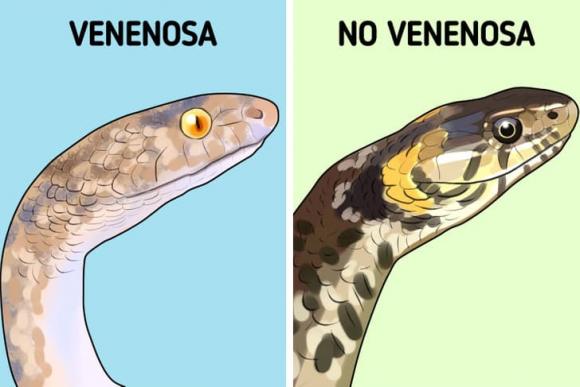
Common Physical Traits People Use (and Their Limits)
1. Head Shape
Popular belief:
Venomous snakes have triangular or arrow-shaped heads, while non-venomous snakes have rounded heads.
Reality:
-
Many non-venomous snakes flatten their heads when threatened, mimicking a triangular shape
-
Some venomous snakes have relatively narrow or rounded heads
This trait alone is not reliable.
2. Pupils (Eye Shape)
Popular belief:
Venomous snakes have vertical, slit-like pupils (like cats), while non-venomous snakes have round pupils.
Reality:
-
This can be helpful in some regions
-
However, many venomous species (such as coral snakes) have round pupils
-
Lighting conditions and distance can make pupils hard to see
Again, not a universal rule.
3. Presence of Fangs
Venomous snakes have hollow or grooved fangs used to inject venom.
Problem:
You would need to be dangerously close to see them.
This method should never be used in practice.
4. Color Patterns
Some snakes have distinctive color patterns that can be helpful in specific regions.
A well-known rhyme in North America is:
“Red on yellow, kill a fellow; red on black, friend of Jack.”
This refers to the difference between coral snakes (venomous) and some non-venomous mimics.
Limitations:
-
This rhyme works only in certain regions
-
Color variations exist
-
Many venomous snakes do not follow this pattern
Color alone is not globally reliable.
5. Tail and Rattles
-
Rattlesnakes are venomous and easy to identify by their rattle
-
However, not all venomous snakes have rattles
-
Some non-venomous snakes vibrate their tails to mimic rattlesnakes
Absence of a rattle does not mean a snake is harmless.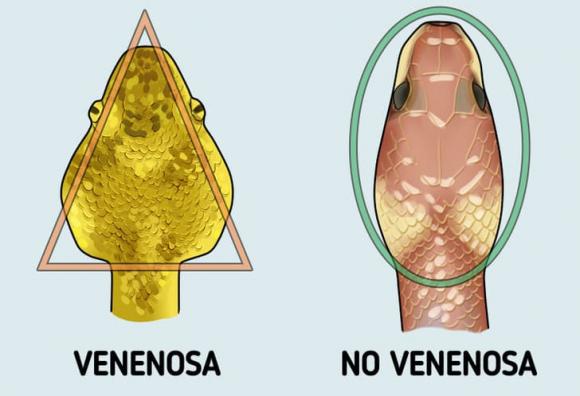
Behavioral Differences (Also Unreliable)
People sometimes say venomous snakes are more aggressive or hold their ground, while non-venomous snakes flee.
In reality:
-
Most snakes avoid humans
-
Venomous snakes may remain still as camouflage
-
Non-venomous snakes may act aggressively when cornered
Behavior varies widely and should not be used for identification.
Geographic Knowledge Matters More Than Appearance
The most reliable way to assess risk is knowing:
-
Which venomous species exist in the area
-
Their typical habitats
-
Their active times (day or night)
Local knowledge is far more accurate than general visual rules.
Why Misidentification Is Dangerous
Many snakebite injuries occur because people:
-
Tried to identify a snake up close
-
Assumed it was harmless
-
Attempted to move or kill it
Ironically, this puts people at greater risk than simply leaving the snake alone.
The Golden Rule of Snake Safety
Instead of trying to distinguish venomous from non-venomous snakes in the wild, follow this rule:
If you cannot identify a snake with absolute certainty from a safe distance, treat it as venomous and keep away.
This approach protects both humans and snakes.
What to Do If You Encounter a Snake
-
Stop and remain calm
-
Back away slowly
-
Give the snake space to escape
-
Do not throw objects or attempt to scare it
-
Keep children and pets away
Most snakes will leave if given the opportunity.
Final Thoughts
Learning about snake differences can be educational and fascinating, but visual identification is never foolproof. Nature does not follow simple rules, and snakes are masters of camouflage and mimicry.
The goal should not be to decide whether a snake is dangerous - but to avoid unnecessary interaction altogether. Respect, distance, and awareness are the most effective tools for staying safe.
In the wild, caution is not fear. It is wisdom..jpg)