It is easy to pass by a tree without truly seeing it.
Along suburban sidewalks, in schoolyards, and throughout quiet public parks, the American sweetgum stands tall and unassuming. In autumn, it bursts into brilliant shades of crimson, amber, and gold, lighting up entire streets with its fiery display. Most people notice it only then — and perhaps curse the spiky seed pods scattered across the ground.
Yet long before pavement covered the soil and landscaping prioritized aesthetics, this very tree was cherished as one of North America’s most respected natural healers.
Known scientifically as Liquidambar styraciflua, the American sweetgum once occupied a place of honor in Indigenous medicine, colonial herbal practice, and even European pharmacology. Its resin soothed wounds. Its bark eased fevers. Its leaves calmed inflamed skin. Its aroma carried the scent of protection and restoration.
Over time, that knowledge faded into the background of modern life. But today, science is beginning to rediscover what ancient healers understood intuitively: hidden within this familiar tree lies remarkable therapeutic potential.
A Tree of Strength, Beauty, and Resilience
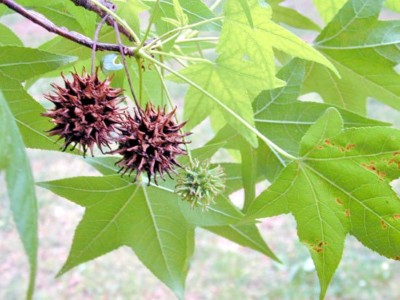
The American sweetgum is native to the southeastern United States and extends into Mexico and parts of Central America. In fertile soil and open light, it can grow more than 100 feet tall, forming a wide canopy of distinctive, star-shaped leaves.
These leaves are among its most striking features. In spring and summer, they glow a deep green. In autumn, they transform dramatically into shades of scarlet, orange, and gold — a final, radiant display before winter.
Then there are the seed pods — round, bristled spheres often dismissed as yard debris. But within these pods, along with the bark, flows a fragrant amber resin historically known as storax or liquid amber.
It is this resin that gave the tree its name: Liquidambar — “liquid amber.” And it is this resin that holds the key to the sweetgum’s healing legacy.
Indigenous Knowledge: Medicine Rooted in Relationship
Long before written pharmacology texts existed, Indigenous tribes across the southeastern regions of North America recognized the sweetgum as a powerful ally in healing.
For the Cherokee, Choctaw, and other Native nations, this tree was not merely a resource — it was part of a living relationship between land and people.
Nearly every part of the sweetgum was used with intention:
-
Resin was applied to wounds, cuts, and insect bites to prevent infection and speed tissue repair.
-
Bark infusions were brewed to relieve fevers, diarrhea, and respiratory distress.
-
Leaves were crushed into poultices to calm inflammation, rashes, and joint pain.
-
Resin was chewed, both to freshen the breath and to ease sore throats or chest congestion.
Healing was never separated from spiritual balance. The sweetgum symbolized endurance and protection — qualities reflected in its deep roots and adaptability to different environments.
This was not primitive medicine. It was sophisticated ecological knowledge passed down through generations.

From the Americas to European Apothecaries
When Spanish explorers encountered Indigenous healing practices in the early 1500s, they were quick to observe the use of sweetgum resin. Historical records suggest that Hernán Cortés sent samples back to Spain, describing the fragrant balm used to treat wounds and illness.
In Europe, the resin became known as liquid storax. Apothecaries valued it for its antiseptic and anti-inflammatory properties, prescribing it for:
-
Skin infections
-
Chest congestion
-
Ulcers
-
Digestive disorders
Its rich, balsamic scent also made it desirable in incense and perfumery. By the 18th and 19th centuries, American herbalists documented sweetgum extracts in medical texts as remedies for bronchitis, dysentery, and inflammatory conditions.
For centuries, this tree bridged continents — a quiet ambassador of botanical medicine.
The Chemistry Behind the Healing
What gave sweetgum its reputation was not superstition, but chemistry.
Modern analysis reveals that its resin contains a complex blend of biologically active compounds, including:
-
Cinnamic acid, known for antimicrobial and anti-inflammatory properties
-
Eugenol, an antiseptic compound also found in cloves
-
Coumarins, which may support circulation and muscle relaxation
-
Benzaldehyde, a mild disinfectant with aromatic benefits
These compounds work together, creating a synergistic effect that supports tissue protection, immune response, and inflammation control.
Ancient healers did not speak in terms of molecular structures — but they observed results.

Respiratory Support Through the Ages
One of sweetgum’s most valued traditional uses was for respiratory health.
When warmed or chewed, the resin releases aromatic oils that help open airways and loosen mucus. Steam inhalation with bark or resin was used during colds, influenza outbreaks, and bronchial infections — long before antibiotics existed.
Its gentle expectorant qualities made it a staple remedy in times when respiratory illness could mean life or death.
Even today, many plant-based remedies for congestion rely on similar aromatic compounds.
Modern Science Rediscovers a Forgotten Ally
For generations, sweetgum remained primarily a subject of historical interest. Then, in the early 2000s, researchers made an unexpected discovery.
During efforts to expand production of antiviral medications, scientists identified shikimic acid — a key precursor in the production of oseltamivir (Tamiflu) — within the seed pods of the American sweetgum.
Previously, most commercial shikimic acid was extracted from star anise. The sweetgum offered a potential alternative source.
Further laboratory studies revealed that extracts from sweetgum bark and resin exhibited activity against certain RNA viruses and demonstrated antioxidant properties that protect cells from oxidative stress.
The laboratory was confirming what tradition had long suggested: this tree holds potent biochemical resources.
A Gentle Return to Plant-Based Healing
As interest in herbal medicine and ecological sustainability grows, some are revisiting traditional uses of sweetgum with care and respect.
Modern applications may include:
-
Topical balms for minor skin irritation
-
Mild teas for respiratory or digestive discomfort
-
Steam inhalations for congestion relief
However, caution remains essential. Herbal remedies require knowledge, moderation, and proper guidance. Not all natural substances are automatically safe in all contexts.
Responsible use honors both tradition and science.
More Than Medicine: Ecological Significance
The American sweetgum’s importance extends beyond human health.
-
Its seeds feed birds and small mammals.
-
Its canopy supports pollinators and insects.
-
Its resin continues to be valued in natural perfumery.
It thrives in diverse soils, adapting to floods and drought alike — a living symbol of resilience.
In many ways, its story mirrors our own. What we once relied upon deeply, we sometimes forget in the rush toward modern convenience.
A Tree Waiting to Be Seen Again
The American sweetgum is not merely a backdrop to autumn photographs. It is a living archive of Indigenous knowledge, colonial medicine, and emerging scientific discovery.
Its story reminds us that powerful healing does not always come in manufactured packaging. Sometimes it grows quietly beside us — overlooked because it is familiar.
Perhaps the sweetgum’s greatest lesson is this: wisdom does not disappear. It waits.
In the bark of a tree.
In the scent of resin.
In traditions nearly forgotten.
Healing, like memory, is often rooted in the past — waiting patiently to be rediscovered.