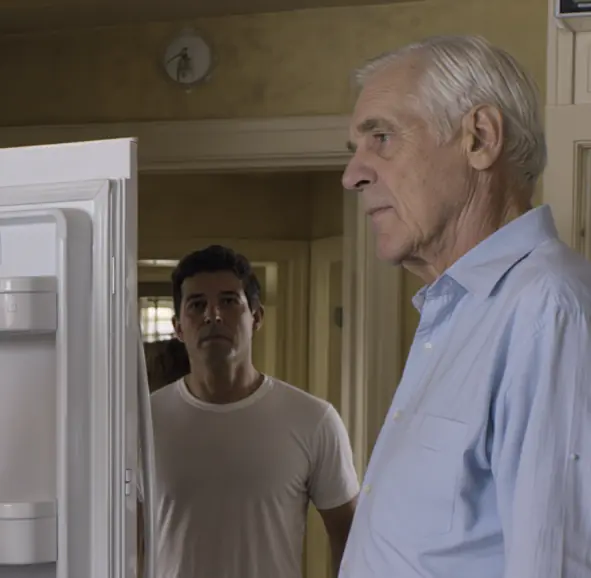
He opened the refrigerator door expecting the familiar soft glow, the neatly stacked leftovers, the sauces lined up the way he liked. Instead, the light flickered over shelves so bare they seemed to echo. A carton with only one egg rolling freely. A wilting bunch of spring onions. Half a bottle of water. Nothing else.
He stood frozen, hand still gripping the handle, a strange heaviness settling on his chest. It wasn’t like this before. The fridge had always been full—often cluttered, even messy—but full. A sign that life was moving, that someone cared enough to make meals that filled both stomach and home.
But today, the fridge looked like a quiet confession.
He closed it slowly.
In the silence of the small apartment, he felt something shift.
He went to the dining table, where a single plate sat unwashed from breakfast. Crumbs. A tea stain. A spoon placed hastily on top. It wasn’t messy enough to alarm him, but it wasn’t her way. She always cleaned as she went, humming softly as she wiped down the counters. Lately, she had stopped humming.
He hadn’t noticed when it disappeared.
He sat down, leaning forward, elbows on his knees. The morning sun filtered through the curtains she once ironed every week. Now they hung with faint wrinkles. Nothing dramatic—just the subtle marks of someone too tired to keep up.
He rubbed his face and exhaled.
He had been working late. Coming home long after dinner. Missing breakfasts. Missing conversations. Missing everything except complaints about bills, or the children’s grades, or the dishes not done. He didn’t remember the last time he asked her how she was.
He didn’t remember noticing her silence.
The door clicked open. She walked in with two grocery bags that looked heavier than she did. Her steps were slow, careful, exhausted.
He stood up at once. “Let me help.”
She blinked at him, surprised, as if the offer belonged to a stranger. She handed him one bag wordlessly. He took it, and for the first time in a long time, he actually looked at her.
Her face was pale, her eyes tired. Her shoulders slumped. She was there, but not really present—moving on muscle memory alone.
“What happened to the fridge?” he asked gently.
She didn’t answer at first. She just placed the bags on the counter and began unpacking a few essentials: bread, noodles, vegetables, a small bottle of milk. Everything was the cheapest version.
Only enough for two or three days.
When she finally spoke, her voice was thin. “I didn’t have time. And… I didn’t want to spend too much.”
He frowned. “Why not?”
She kept her eyes on the groceries. “You said last week that we should cut down expenses. I didn’t want you to be upset.”
He opened his mouth, but words failed him. He vaguely remembered the conversation—hurried, careless, spoken while he tied his shoes and rushed out the door. He hadn’t meant it like that. Or maybe he had, but he had said it without thinking of its weight on her.
Without thinking of her at all.
He watched her as she moved around the kitchen, not with the comfortable familiarity she used to have, but with the detached efficiency of someone completing chores for a house that no longer felt like a home.
Something inside him twisted.
He stepped closer. “Sit down for a moment.”
She shook her head. “There’s too much to do.”
He gently took the onion from her hand and placed it on the counter. “Please. Just for a minute.”
She hesitated but eventually sat at the table. Her posture was defensive, as if bracing herself for criticism she had grown accustomed to. That hurt him more than anything.
He sat across from her.
“When did things get this hard?” he asked quietly.
She looked away. “They’ve been hard. For a long time.”
The words hit him harder than he expected. He knew there had been tension, small arguments, long silences. But he hadn’t realized the depth of it.
“Why didn’t you tell me?” he whispered.
“I tried,” she said. “But you were always tired. Or annoyed. Or too busy. And after a while, I just… stopped trying.”
He swallowed. “I didn’t know.”
“I know you didn’t,” she said softly. “That’s why the fridge was empty.”
She wasn’t talking about groceries anymore.
He understood.
The empty fridge was the reflection of their life—emptied slowly, day by day, unnoticed until there was nothing left to reach for.
He leaned back and stared at the ceiling, ashamed. “I didn’t see it. I should have. I’m sorry.”
She didn’t say anything. Not forgiveness. Not anger. Just silence—a silence that carried more truth than any argument.
He looked at her again. “Tell me what you need.”
That startled her. “I don’t know.”
“Then tell me what hurts.”
A long pause. Her eyes grew glossy, not with dramatic tears, but with the quiet kind—the kind that had been held in for months.
“I hurt,” she whispered, “when I feel invisible.”
He closed his eyes briefly.
Invisible.
The word cut deeper than he expected.
He stood and opened the fridge again. The near-empty shelves stared back at him, as silent as she had been. He turned to her.
“I didn’t just miss groceries,” he said. “I missed you. And I didn’t even notice you slipping away.”
Her lips pressed together, trembling.
“I don’t want us to live like this,” he added. “Not with empty shelves and empty conversations.”
She looked up slowly. “What are you saying?”
“I’m saying I want to fix this. And not the way I try to fix things by throwing money or lectures at them. I want to be here. Really here.”
He took the grocery bags again and began unpacking them carefully—not rushing, not fumbling, but honoring the gesture itself. She watched him, unsure at first, as if trying to see whether this was temporary guilt or genuine understanding.
When he finished, he turned to her and spoke with unusual sincerity.
“Tonight, let me cook. And while I do, you tell me everything I’ve missed. Every little frustration. Every feeling. I’ll listen, even if it’s hard to hear.”
She stared at him for a long moment before finally nodding.
It was small. But it was a beginning.
As he washed the vegetables, she spoke quietly about the exhaustion, the loneliness, the countless moments when she felt like a shadow. She didn’t accuse—she simply explained.
He didn’t defend himself.
He listened.
For the first time in years, they shared a kitchen not as two people running separate lives but as a pair trying to rebuild a shared one.
When dinner was ready, they ate together. No phones. No rushing. No silence heavy with distance.
Just two people trying again.
Later that night, he opened the fridge once more—not to judge its contents but to remind himself of the moment that shook him awake.
The empty shelves had been a revelation.
A mirror.
A warning.
And a second chance.
He closed the door gently and turned off the lights before heading to the bedroom where she waited, no longer invisible.
He wasn’t a perfect man. But he was trying, finally trying, to be present.
And in that quiet effort, their home—once hollow, once fading—began to fill again.
Not with groceries.
But with attention.
With warmth.
With partnership.
With the kind of love that takes effort.
The kind that returns slowly, shelf by shelf, until the fridge—and the family—are full again.