Woman Paralyzed on One Side After Turning Over to Grab Her Phone at Night: Don’t Ignore These Warning Signs
Behind what seemed like a sudden, “out-of-the-blue” tragedy lies a health risk that many people overlook: cervical spine disease.
Even now, whenever she recalls that moment, Ms. Wang, 50, from Quanzhou City, Fujian Province (China), still feels shaken. What appeared to be an unexpected disaster was actually the result of a long-ignored health issue involving her cervical spine.
Ms. Wang had previously gone to the hospital because of persistent numbness in her hands and ongoing pain and stiffness. Tests revealed that she was suffering from severe cervical disc herniation. Doctors explained that imaging showed a large herniated disc, fully meeting the criteria for surgery, and strongly advised early surgical intervention. However, worried about surgical risks, Ms. Wang firmly chose conservative treatment instead.
No one expected that later that very night, while turning over in bed to reach for her phone, both of her arms would suddenly lose all sensation. Further examination showed that the strength of her major muscle groups had dropped to levels 0–1, and she was diagnosed with paralysis.
Doctors determined that during the movement, the herniated disc further compressed the spinal cord, triggering an acute condition. Fortunately, after emergency surgery and rehabilitation, her motor function has been gradually recovering.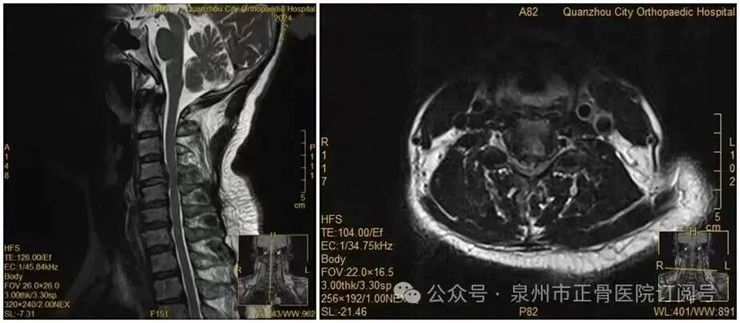
Cases like Ms. Wang’s are not rare.
A Dong, a third-year university student in Quanzhou, worked part-time at a restaurant during summer break. Every day, he spent more than four hours bending his head down while washing dishes and wiping tables. Back in his dorm, he would lie face down playing games and watching short videos for another two to three hours.
A few days before his condition worsened, A Dong began experiencing numbness and pain in his limbs, neck, and back. He had a CT scan, but no obvious abnormalities were found at the time. On July 30, his condition suddenly deteriorated—both legs became immobile and numb, forcing him to call emergency services.
Examinations revealed a large space-occupying lesion in the spinal canal from C4 to T1, severely compressing the spinal cord. From the chest downward, A Dong had completely lost sensation, and the muscle strength in his arms had also declined significantly. The hospital immediately activated an emergency “green channel” and performed surgery that same night to save his mobility.
During surgery, doctors discovered a large epidural hematoma compressing the spinal cord. They suspected the cause was a vascular malformation in the spinal canal; prolonged neck flexion likely caused a blood vessel to rupture, leading to bleeding and high-level paralysis.
Dr. Huang Jietong, Deputy Director of the Orthopedics and Trauma Department at Quanzhou First Hospital, explained that when the head is bent forward, the neck muscles bear forces three to five times the weight of the head. Once the muscles fatigue, the stress shifts directly to ligaments and blood vessels in the spinal canal. If there is a pre-existing vascular abnormality, rupture and spinal cord compression can occur in an instant.
After surgery, A Dong’s paralysis improved, and strength in his arms and legs gradually returned. Still, he couldn’t hold back tears:
“If it had been just a few hours later, I might never have been able to stand again for the rest of my life.”
These cases are far from uncommon
Doctors emphasize that the cervical spine is extremely important, and sudden paralysis caused by neck issues is not rare.
Cervical disc herniation is a common condition and should never be taken lightly. When symptoms such as neck pain, stiffness, or pain radiating down the arms appear, medical evaluation should be sought as early as possible.
Severe cervical disc herniation occurs when the nucleus pulposus breaks through the fibrous ring and compresses the spinal cord and nerve roots. Without timely intervention, spinal cord damage may become irreversible and even lead to permanent paralysis. Alarmingly, some patients have atypical symptoms, making the condition easy to miss or misdiagnose.
The World Health Organization has ranked this condition among the top 10 most difficult chronic diseases to treat worldwide, with an estimated prevalence of about 17.6%.
According to a report from the New York Spine Surgery and Rehabilitation Center, bending the head to look at a phone can place up to 60 pounds (about 27 kg) of pressure on the cervical spine—heavier than the weight of a 7-year-old child.
Office workers, accountants, typists, and people who use laptops or smartphones for long periods are at particularly high risk.
Don’t ignore warning signals from your neck
Experts recommend that protecting the cervical spine should start with daily habits: keep the neck warm, avoid prolonged head-down positions, take adequate breaks, maintain proper sleeping posture, and regularly exercise the neck and shoulders. Most importantly, if symptoms such as hand numbness, muscle weakness, or persistent neck pain appear, seek medical attention immediately—don’t wait until complications arise.
Because sometimes, a single moment of neglect is enough to change an entire lifetime.