My fingers tightened around the foil-covered pan.
“What do you mean?” I asked, my voice barely steady.
Eli swallowed, glancing down at the bouquet in his hands before looking back at me.
“She made me promise,” he said quietly. “She said you needed to see her kindness as something ordinary. Not… strategic.”
“Strategic?” I repeated.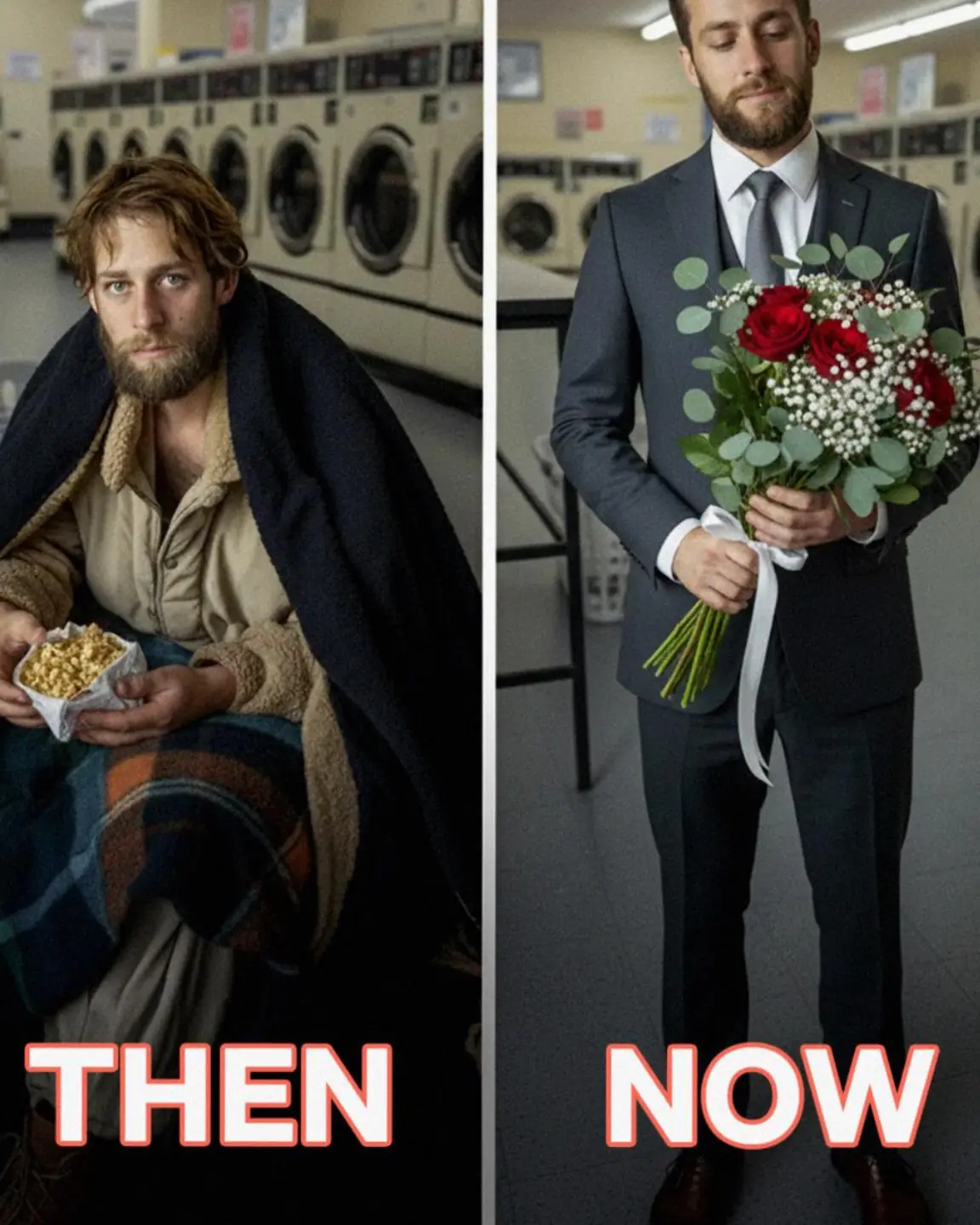
He nodded slowly.
“For years, she didn’t just bring me food.”
A long pause stretched between us. The hum of washing machines filled the laundromat, steady and indifferent.
“She helped me get my life back.”
I blinked.
“What are you talking about?”
Eli gestured toward the plastic chairs near the vending machines. We sat down, the bouquet resting carefully on his lap.
“The first winter she brought me gloves,” he began, “I hadn’t spoken to my sister in three years. I’d burned every bridge I had. Addiction does that.”
I didn’t move.
“She never asked me what I did wrong. She just asked what I needed.”
His jaw tightened.
“After that first Christmas, she came by every week. Sometimes with food. Sometimes with coffee. Sometimes just to talk.”
I felt something inside me begin to shift.
“She convinced me to go to a free clinic,” he continued. “Sat with me in the waiting room like it was the most normal thing in the world.”
The laundromat door opened and closed behind someone, letting in a gust of cold air. Neither of us looked.
“She helped me apply for an ID. Helped me fill out job applications. I kept messing up. I relapsed once.” His voice cracked slightly. “I thought she’d give up.”
“But she didn’t,” I whispered.
He shook his head.
“She said, ‘Healing isn’t linear, Eli. Dinner still stands.’”
My vision blurred.
“She paid for a short-term room at a boarding house,” he went on. “Told me it was from a ‘holiday fund.’ It wasn’t. It was her savings.”
I felt like the air had been knocked from my lungs.
“She… she never told me,” I said.
“She didn’t want you to know.”
“Why?”
Eli’s eyes softened.
“Because she didn’t want you to feel responsible for continuing it. She said kindness only counts when it’s freely chosen.”
The bouquet trembled slightly in his hands.
“She asked me to promise that if she didn’t make it… I’d show up one last Christmas. Not as someone she rescued. But as proof that it mattered.”
I stared at him.
“In a suit,” he added with a faint, shaky smile. “She was very specific about that.”
A laugh broke through my tears.
“She said, ‘Stand tall. Bring lilies. They’re her favorite.’”
I looked down at the white petals.
Lilies had filled our apartment every spring.
“I didn’t know if I could do it,” he admitted. “But I’ve been sober for eighteen months. I’ve got a job now. Maintenance supervisor at a hotel uptown.”
My heart swelled and shattered all at once.
“She wrote letters,” he continued carefully. “One for you. One for me.”
He reached into the inside pocket of his jacket and pulled out an envelope.
My name was written across it in my mother’s familiar looping handwriting.
I couldn’t breathe.
“She gave it to me in September,” Eli said. “When things got worse.”
I took it with shaking hands.
“She said you’d probably try to be strong through December. That you’d cook even if it hurt.”
A tear slid down my cheek.
“She knew you,” he said gently.
I opened the envelope.
The paper was thin and soft, like it had been folded and unfolded before.
My sweet girl,
If you’re reading this, then you did it. You made the dinner.
I closed my eyes briefly.
I didn’t tell you everything about Eli because I wanted you to learn what I did in your own way.
Kindness is not charity. It’s relationship.
It’s showing up again and again when it would be easier not to.
Eli did the hard work. I only held the door open.
And one day, someone will hold a door open for you when you can’t lift your own hands.
That’s how we survive each other.
Don’t let grief harden you. Let it widen you.
Dinner still stands.
I pressed the letter to my chest.
The laundromat, the hum, the cold tile floor beneath my boots—it all felt distant.
“She believed in me before I believed in myself,” Eli said quietly. “When she got sick, I tried to visit her.”
I looked up.
“She wouldn’t let me come empty-handed,” he added. “So I brought flowers then too. She said, ‘Next time, bring them to my daughter.’”
A sob escaped me.
He stood slowly.
“I know this is strange,” he said. “But she didn’t want you alone tonight.”
The pan of food sat untouched between us.
For years, I had thought my mother’s tradition was about generosity.
Now I understood.
It was about continuity.
I stood as well.
“Do you… want to come over?” I asked.
He blinked.
“I mean,” I said quickly, “dinner still stands.”
For a second, he couldn’t speak.
Then he nodded.
We walked out of the laundromat together, the cold December air biting at our cheeks.
At my apartment, the scent of ham and cornbread wrapped around us the moment we stepped inside.
Eli paused just inside the doorway.
“It smells the same,” he whispered.
I set the bouquet in a vase and placed it at the center of the table.
Then I did what my mom always did.
I made two plates.
We sat across from each other.
At first, we ate quietly.
Then he told me about the hotel job. About the first paycheck he framed instead of spending. About calling his sister and apologizing.
I told him about my work. About the hospital corridors that still haunted me. About how quiet the apartment felt without her humming in the kitchen.
The conversation wasn’t forced.
It wasn’t heavy.
It was steady.
Halfway through dinner, I realized something subtle but profound.
The ache in my chest had shifted.
Not gone.
But softened at the edges.
After we finished, Eli stood and cleared the plates without asking.
“She’d scold me if I didn’t help,” he said with a small smile.
I laughed.
“Yeah. She would.”
When he put on his coat to leave, he hesitated by the door.
“She changed my life,” he said. “I just wanted you to know it wasn’t small.”
“It wasn’t,” I replied.
He looked at me carefully.
“She’d be proud of you.”
“For what?”
“For coming tonight. Even when it hurt.”
The door closed behind him, and the apartment felt quiet again.
But not empty.
I walked back to the table and sat down.
The lilies caught the light from the Christmas tree.
For the first time since October, the music playing softly in the background didn’t feel false.
It felt… gentle.
My mom hadn’t just fed someone every Christmas.
She had planted something.
And tonight, I saw it bloom.
I realized grief doesn’t erase the good someone has done.
It multiplies it.
Because the people they touched carry it forward.
I picked up my phone and opened my contacts.
There was a local shelter downtown.
I hesitated only a second before calling.
“Hi,” I said when someone answered. “I was wondering if you’re accepting volunteers next week.”
Dinner still stood.
And now, I understood why.