The blended family vacation that almost ended in disaster
The blended family vacation that almost ended in disaster
Story 20/02/2026 21:50
The house on Sycamore Lane didn't just have a foundation of stone and mortar; it was built on decades of Sunday dinners, scraped knees, and the scent of my grandmother’s lavender sachets. When my grandparents passed away, they left the Victorian structure to the three of us: me, my younger brother Kevin, and our stepsister, Chloe. It was meant to be a final gift, but for the first few weeks, it felt more like a match dropped into a very old pile of dry kindling.
We gathered in the living room on a sweltering July afternoon, the air thick with dust motes and the heavy silence of things unsaid. The "merger" of our families had happened twenty years ago when my father married Chloe’s mother, but even after two decades, the seams still showed. Kevin and I were the "originals," and Chloe, despite her kindness, was often treated as a late addition to the narrative.
The conflict was as old as time: what to do with the house.
"It’s a gold mine," Kevin said, pacing the length of the Persian rug. He was a real estate developer in the city, and he saw the world in square footage and ROI. "The market is peaking. If we sell now, we can all clear our debts and have a fresh start. Keeping it is just sentimental hoarding."
I felt a sharp pang of hurt. "It’s not hoarding, Kevin. It’s our history. This is the only place where the whole family actually feels like a family. If we sell this, where do we go for Christmas? A hotel?"
"I agree with Kevin," Chloe said softly, though she didn't look at either of us. She was sitting on the edge of a velvet armchair, looking like she wanted to disappear. "My mom—our mom—needs the help with her medical bills. Selling would solve everything for her. I love this place, but we have to be practical."
I turned on her, my own insecurity rising to the surface. "It’s easy for you to say 'sell' because your childhood isn't written into these walls the way ours is. You didn't grow up here."
The words hung in the air, cold and unfair. Chloe flinched as if I’d struck her. The "step" in our relationship, which we had worked so hard to smooth over, suddenly felt like a jagged mountain range again. We spent the rest of the afternoon moving through the house like ghosts, avoiding eye contact and bickering over the smallest details—who got the silver, who was responsible for the lawn, and whose memories were "more valid."
The turning point didn't come from a grand speech or a legal breakthrough. It came from a box in the attic.
The three of us had spent two days sorting through the "keep" and "toss" piles. By the third evening, we were exhausted and grimy. Kevin was in the corner of the attic, grumbling about the heat, when he pulled out a heavy, cedar-lined chest tucked behind a stack of old encyclopedias.
"What’s this?" he asked, prying the lid open.
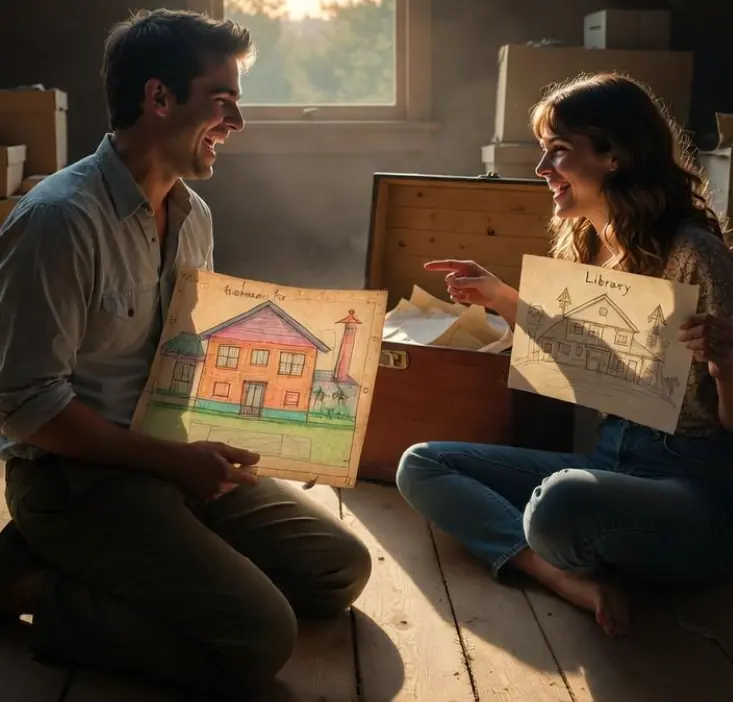
Inside weren't jewels or deeds. It was a collection of hand-drawn "blueprints" on oversized construction paper, dated fifteen years ago.
I leaned over his shoulder, and my breath hitched. They were the plans for the "Ultimate Treehouse Fort" we had tried to build the summer Chloe moved in. I remembered that summer; it had been a disaster of splinters and arguments. But looking at the drawings, I saw something I’d forgotten.
The drawings were a collaborative mess. Kevin had drawn the "engine room," I had designed the "library," and there, in the middle, was Chloe’s contribution: a detailed map of the "Secret Garden" that was supposed to surround the base. Beneath the drawings was a photo our grandmother had taken of the three of us that August. We were covered in mud, holding hammers that were far too heavy for us, and we were all laughing so hard that the image was a blur.
"I remember that," Chloe whispered, stepping closer. "I was so nervous to show you my garden drawings. I thought you’d think they were girly and ruin the 'fort' vibe."
Kevin chuckled, a genuine, warm sound that broke the tension. "I actually thought they were the only part that made sense. My 'engine room' was basically just a box with a steering wheel glued to it."
We spent the next three hours sitting on the dusty attic floor, going through the chest. We found letters, old holiday decorations, and—most importantly—our grandmother’s journals. In her neat, elegant script, she had written about the day our father remarried.
“Today, the house feels bigger,” she had written. “Not because we added rooms, but because we added hearts. Watching Chloe try to fit in is like watching a new flower try to take root in an old garden. It takes time, and it takes sunshine. I hope the children realize that this house doesn't belong to the past; it belongs to whoever is willing to love it today.”
I looked at Chloe, and then at Kevin. The "gold mine" and the "sentimental hoarding" suddenly felt like very small, very silly labels.
"I'm sorry, Chloe," I said, reaching out to take her hand. "I was wrong. This house belongs to you just as much as it belongs to us. You've been the one making sure the flowers in the garden didn't die for the last three years while Kevin and I were too busy to visit. You're the one who actually 'loves it today.'"
Chloe squeezed my hand back. "And I’m sorry for pushing to sell. I was just so worried about Mom. I felt like I had to choose between her and the house."
Kevin sat back against a trunk, looking at the tattered blueprints of our childhood fort. "Maybe we don't have to choose," he said, his "developer" brain finally working in a different direction. "What if we don't sell the whole property? The back lot is zoned for a small cottage. We could sell that portion to cover the bills, and keep the main house as a rental or a shared vacation spot. We could even fix up that old 'engine room' for the next generation."
The idea was a bridge. It wasn't about winning or losing; it was about compromise and the realization that the house was more than an asset—it was our anchor.
The rest of the summer was spent not in conflict, but in a collaborative effort to breathe life back into Sycamore Lane. We painted the porch together (choosing a color that Chloe liked), Kevin fixed the sagging fence, and I organized the family archives.
We are the Millers and the Reeds, and we’ve learned that an inheritance isn't just about what someone leaves you; it’s about what you’re willing to build with the people they left you with. The house didn't come with a manual on how to be a family, but it gave us the space to figure it out for ourselves.
On the last night of the summer, we sat on the back porch, watching the fireflies. The house felt quiet, but it was a peaceful quiet—the kind that comes after a long, necessary conversation.
"So," Kevin said, leaning back in his chair. "Who’s in charge of the Secret Garden next spring?"
"Me," Chloe and I said in unison, laughing.
Love isn't divided by biology or by the date you entered the family. It’s multiplied by the memories you’re willing to share and the grace you’re willing to give. And as the lights came on in the old Victorian, I realized that the "new beginning" wasn't just for the house. It was for us.
We aren't "originals" and "additions" anymore. We are just a family, standing on a foundation that is finally, truly solid.
The blended family vacation that almost ended in disaster
My mother thought my husband wasn’t good enough until he proved her wrong

The day my half-brother called me sister for the first time
My father chose happiness again and I had to learn what that meant
Two stepsisters, one bedroom, and a lesson about sharing more than space
Grandma moved in and brought more than just her suitcases
My stepmother wasn’t trying to replace my mom she was trying to love me
The stepfather i kept at a distance became the man who never left my side
He babysitter who almost broke our marriage helped us save it instead
My brother stopped speaking to me over money until we remembered who we were
Our blended family almost didn’t survive the first christmas
The day my son-in-law called me mom changed everything
My daughter blamed me for the divorce until she learned the whole story
Two stepbrothers, one inheritance, and the lesson we never expected
The half-sister i resented became the person who saved our family
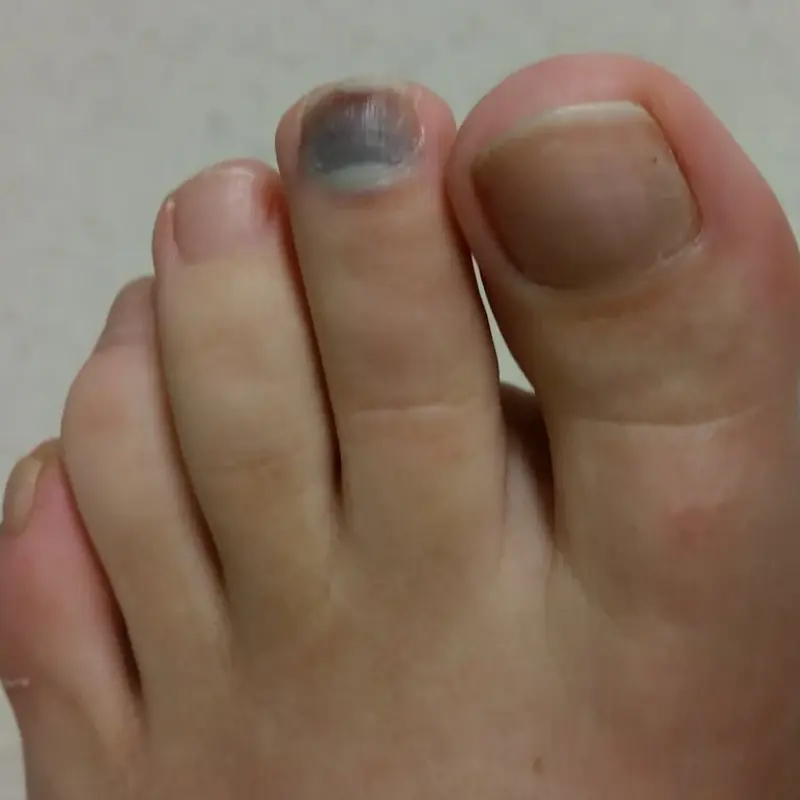
Black toenail? Causes, warning signs, and what to do next.

Scientists Sh.oc.ked — One Protein May Be the Root of Every Ca.nc.er
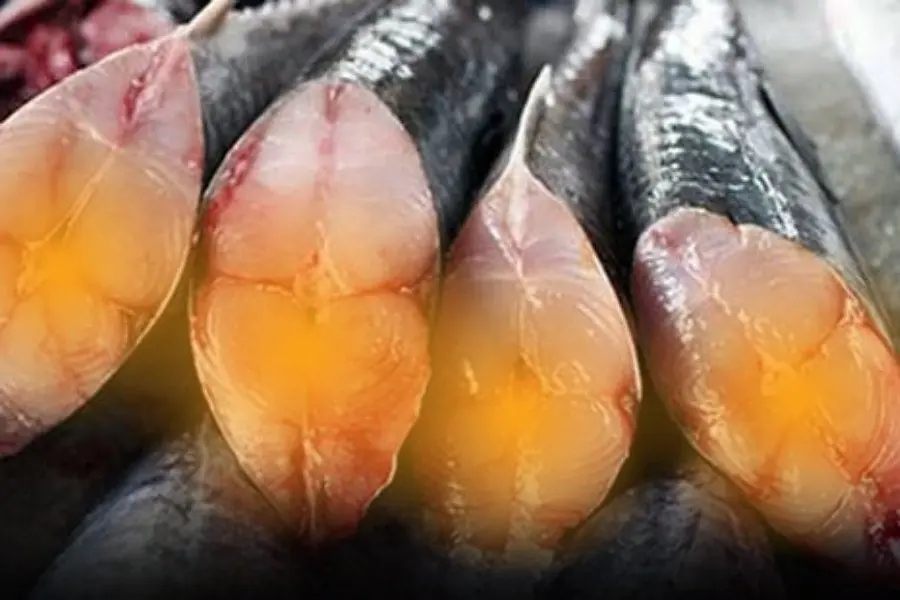
Thought salmon was the DHA king? The real champion is a fish you’ve probably ignored
If you often notice ringing in your ears, this might be a sign that you will suffer from ...
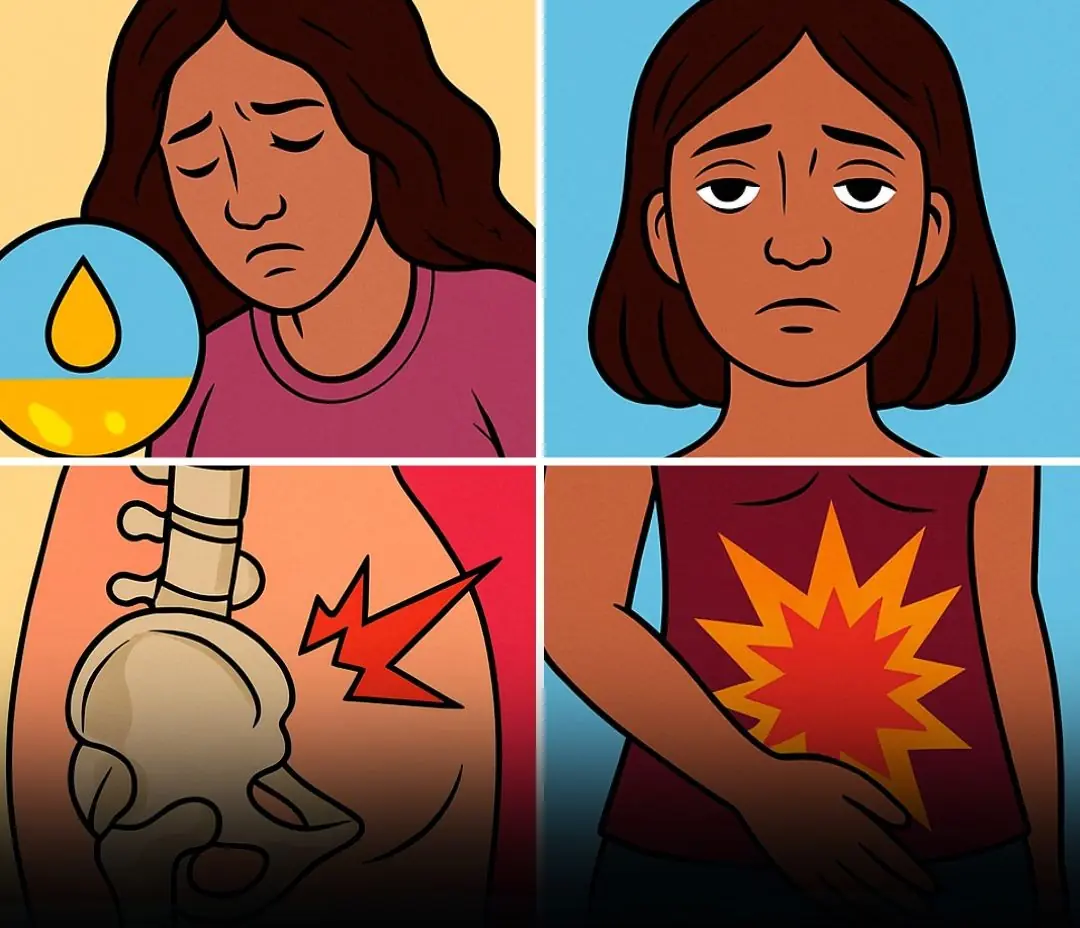
8 Unusual Signs That May Indicate Cervical Cancer – Women Should Know Early

Don’t Ignore These 20 Early Warning Signs That Your Body Could Be Fighting Can:cer
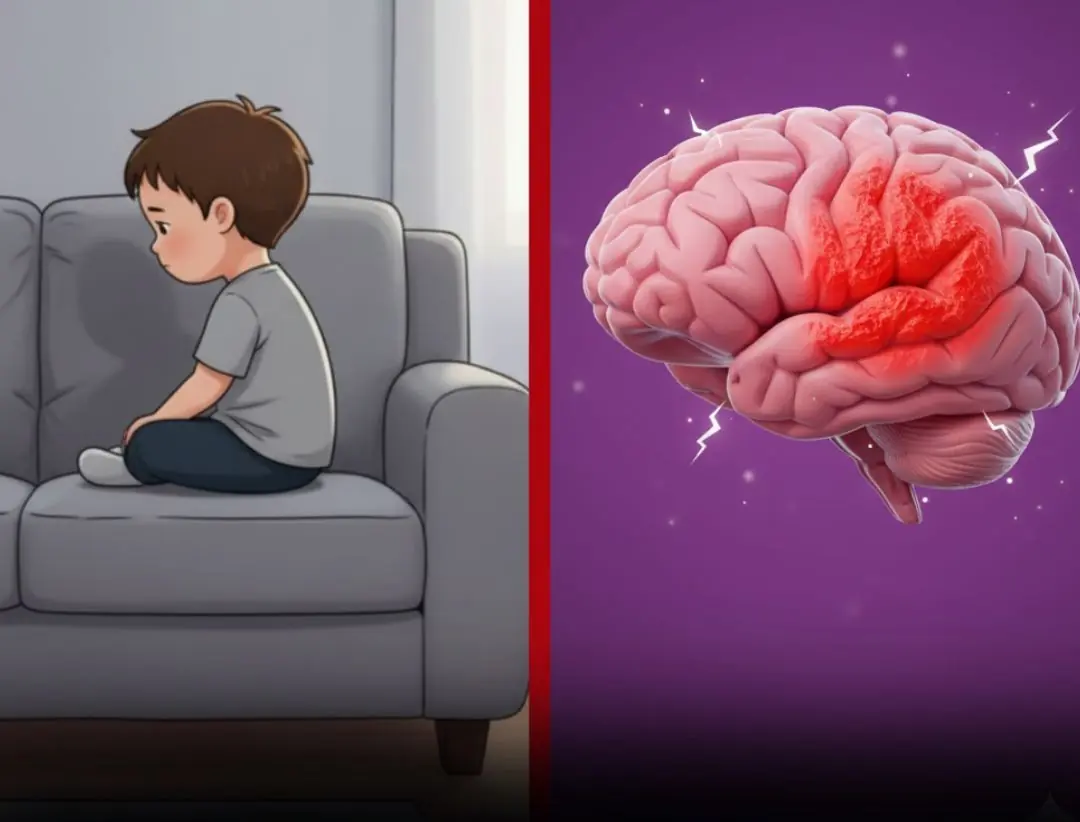
4 signs parents need to understand to save their children
Some fruits, though delicious and seemingly healthy, can become
The blended family vacation that almost ended in disaster
My mother thought my husband wasn’t good enough until he proved her wrong
The day my half-brother called me sister for the first time
My father chose happiness again and I had to learn what that meant
Two stepsisters, one bedroom, and a lesson about sharing more than space
Grandma moved in and brought more than just her suitcases
My stepmother wasn’t trying to replace my mom she was trying to love me