
I realized our family traditions were hiding something unspoken
I realized our family traditions were hiding something unspoken
Story 11/02/2026 10:30
The envelope sat on my kitchen counter for three days before I had the courage to open it. It was a formal request from a mediator, a cold and clinical piece of paper that represented the final fracturing of a thirty-year bond. My brother, Evan, and I were fighting over the remains of our father’s estate—specifically, a small lake cottage in Michigan that had been in our family for generations. To an outsider, it looked like a standard legal dispute over property value and buyout options. But as I stared at the letter, I knew that the house was just a placeholder. We weren't fighting over wood and water; we were fighting over the thirty years of shadows that had lived between us.
Evan was the "golden child" of our suburban childhood. He was the one who could turn a casual conversation into a celebration, the one who made our parents’ eyes light up just by walking into a room. I was the "reliable" one—the son who got the grades, kept the secrets, and made sure the lawn was mowed. Our parents loved us both, I knew that, but the way they loved us was different. Evan was loved for his potential, for the person they hoped he would become. I was loved for my utility, for the stability I provided.
The tension manifested in small, sharp bursts during family gatherings. It was in the passive remarks during Thanksgiving dinners.
"Oh, Mark is so organized," my mother would say, patting my hand while looking at Evan. "He’s the one we count on. But Evan—Evan has that spark, doesn't he? He’s going to do such big things."
Evan would give me a half-smile—a look that felt like a secret victory. He grew up believing the world owed him a stage, while I grew up believing I was the one who had to build it.
When our father passed away last year, the "spark" and the "utility" finally collided. The will left the cottage to both of us, but Evan immediately wanted to sell it to fund a new business venture. I wanted to keep it, to preserve the one place where I felt our family had actually been a team.
"It’s just a house, Mark," Evan had said during our first meeting about the estate. "It’s sitting on a fortune in equity. I need the capital to get this project off the ground. You’re being sentimental at the expense of my future."
"Your future has always been the family’s priority, Evan," I replied, my voice tight. "I’m just asking for one thing to stay the same."
The silence that followed lasted six months. We stopped speaking. We missed birthdays, ignored texts, and communicated only through the filtered, polite language of our respective lawyers. The emotional distance was a physical weight. I felt a profound sense of loss, not just for the brother I had played catch with in that backyard, but for the version of myself that didn't feel so bitter.
The quiet but meaningful confrontation happened on a humid Tuesday in July. We agreed to meet at the cottage one last time to clear out our father’s personal belongings before the mediation hearing.
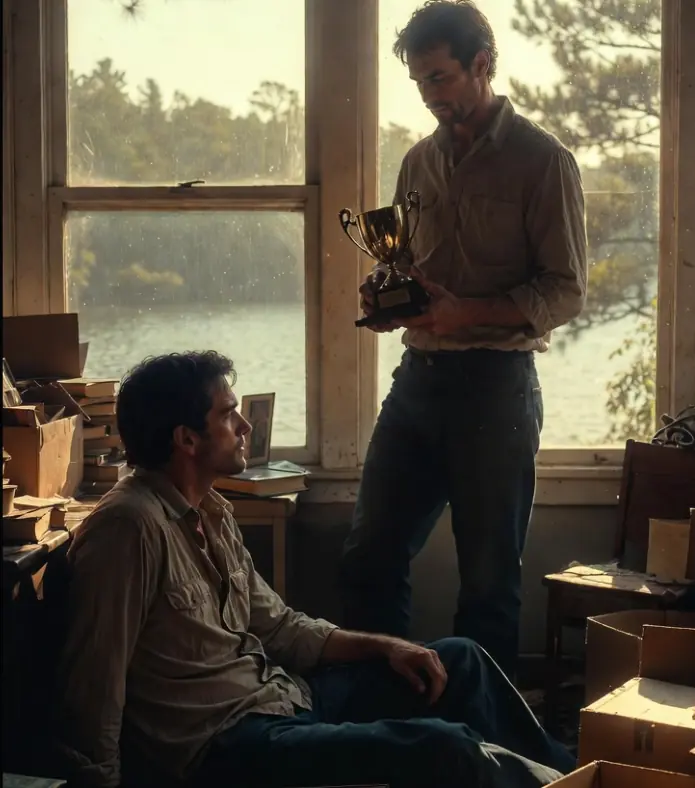
The house was stifling, the air thick with the smell of pine needles and dust. We worked in separate rooms for hours, the only sound the scraping of boxes across the floor. Finally, I walked into the small sunroom and found Evan standing by the window, holding a wooden trophy I had won in a middle school debate.
"I remember this," he said, not looking at me. "Mom put it on the mantle for two days, and then she moved it to the back of the bookshelf to make room for my soccer championship photo."
I froze. I remembered that day. I remembered the quiet sting of seeing my accomplishment tucked away to highlight his.
"I didn't think you noticed," I said.
"I noticed everything, Mark," Evan said, finally turning to face me. His eyes weren't angry; they were tired. "You think I enjoyed being the favorite? You think I didn't see the way Dad looked at you when you fixed the lawnmower or handled the taxes? He looked at you with trust. He looked at me like I was a glass vase that was always one second away from shattering."
"He gave you everything, Evan," I said, the words feeling like shards of glass. "He funded every 'venture' that failed. He excused every mistake. I had to be perfect just to be seen."
"And I had to be perfect just to keep them from being disappointed," Evan shot back. "I wanted to be the reliable one. I wanted to be the one who could fix things. But they decided I was the dreamer, so I had to keep dreaming even when I was exhausted. This business venture? It’s not about the money, Mark. It’s about finally proving I can build something that doesn't need a safety net from you or Dad."
The realization hit me with a profound, cooling clarity. We had both been trapped in the roles our parents had assigned us. I had spent my life resentful of his "spark" because it felt like it dimished my hard work. He had spent his life resentful of my "utility" because it made him feel incompetent. The fight over the cottage wasn't about the equity; it was about the equity of our parents' attention.
We sat on the dusty floor of the sunroom, surrounded by the ghosts of our childhood. For the first time in thirty years, we weren't the Golden Child and the Reliable Son. We were just two middle-aged men realized they had been fighting a war that wasn't theirs.
"I don't want to sell the house because I want to erase the past," Evan whispered. "I want to sell it because I don't want to be the guy who needs a handout anymore. I want to stand on my own feet."
"And I don't want to keep it because I’m sentimental," I admitted. "I want to keep it because it’s the only place where I felt like I was enough for them without having to do a chore."
The confrontation didn't lead to a hug or a grand reconciliation. There was no "I love you" or a promise that things would go back to the way they were. Some wounds are too old for a quick bandage. But the air between us changed. The bitterness was replaced by a heavy, somber understanding.
We reached a partial agreement that afternoon. I would buy out his half of the cottage over five years, at a price that gave him the capital he needed but allowed me to keep the keys. It was a compromise that felt fair, but more importantly, it felt like a boundary. We were finally separating our identities from the property and from the expectations of our parents.
As we walked out to our separate cars, Evan paused at the gate. The new latch I had installed a month ago clicked shut with a satisfying, solid sound.
"Thanks for meeting me, Mark," he said.
"Yeah," I replied. "Good luck with the project. Really."
We aren't "best friends" again. We still don't talk every week, and there is still a lingering awkwardness when we see each other at family events. But the "silent war" is over. I’ve stopped keeping score of who got more attention, and he’s stopped trying to perform for an audience that isn't there anymore.
I realized that sibling conflicts are often like those old boxes in the attic—filled with things that don't belong to us anymore, but we're too afraid to throw away. We stopped speaking over money, but we started healing over the truth. It’s a quiet, fragile kind of peace, but for now, it’s enough. The lake is still there, the house is still standing, and for the first time in a very long while, I am just Mark, and he is just Evan.
I realized our family traditions were hiding something unspoken
When my parents asked us to move in, i didn’t expect it to test my marriage
i found out i was the only one who didn’t know the truth
My husband’s success changed the way his family treated me
I thought therapy would fix our family, but it revealed more than i was ready for
We agreed to an open secret in our family and it slowly tore us apart

The inheritance came with conditions none of us expected
Marrying Kavita: The Choice Everyone Fought—And the Truth I Didn’t Expect

A Father’s Instinctive Dash to Protect His Daughter




“What do you mean ‘separate property’? The house will be joint!” my mother-in-law screeched while I was signing the papers at the notary’s
He registered the apartment in his mother’s name — and had no idea what would happen seven days later

When my mother-in-law asked whose name the apartment was in, I smiled—and said nothing. That decision ended up saving my life
“Yes, I’m throwing you out—on New Year’s Eve! Do you really think I’m supposed to put up with insults in my own home?” Alice pointed her mother-in-law toward the door
“No, I’m not giving your mother any more money! Enough! Let her deal with her debts herself—I’m done!”

These White Bumps on Your Lips or Private Areas Could Be a Sign of Something Serious

How Does Drinking Coconut Water Affect Your Kidneys?
I realized our family traditions were hiding something unspoken

8 Warning Signs of Digestive Problems You Should Never Ignore
When my parents asked us to move in, i didn’t expect it to test my marriage
i found out i was the only one who didn’t know the truth
My husband’s success changed the way his family treated me

7 Surprisingly Handy Ways to Use Cloves
I thought therapy would fix our family, but it revealed more than i was ready for
We agreed to an open secret in our family and it slowly tore us apart
My stepdaughter said something that changed how i saw my marriage
The inheritance came with conditions none of us expected

What condition causes frequent leg numbness, and what might be the reason behind it?

What You Should Know If You Enjoy Daytime Naps
Marrying Kavita: The Choice Everyone Fought—And the Truth I Didn’t Expect
A Father’s Instinctive Dash to Protect His Daughter

My Husband Took a Secret 15-Day Trip With His “Best Friend”—When He Came Back, I Asked One Question That Stopped Him Cold