Frankly speaking, there isn’t much difference in the taste between spring water and mineral water, but the difference lies in the components dissolved in the water. Mineral water contains dissolved minerals, while spring water contains natural components derived from the spring the water was sourced from. Depending on the source, these minerals affect taste and quality.
Additionally, natural spring water contains only the minerals that were naturally present in the spring as the water was extracted. These components are typically made up of calcium, magnesium, or trace amounts of sodium. Mineral water may have these components as well, but not necessarily naturally processed. These minerals may be added into mineral water.
In this article, we present to you the facts on the benefits and differences of spring and mineral — saving you from another head-scratching moment the next time you’re confronted with choosing between the two! Needless to say, spring water and mineral water are labeled differently for a reason.
What is Spring Water?
Spring water comes from underground sources that ‘spring’ up as freshwater bodies. Water sourced from springs no longer passes through a community water system, and instead goes through a reverse osmosis treatment process to remove the impurities in the water while retaining its ‘natural’ quality.
Its quality and purity is also ensured by a certain set of vulnerability perimeters, preventing any cases of pollution and contamination. As a result, spring water has a wholesome taste, with a bit of saltiness or smoothness depending on its natural components. Natural spring water is completely safe to drink, albeit processing the water removes impurities and microorganisms.
Apart from its main benefit of coming from a fresh source, spring water is considered to be one of the best water types to drink, providing the body with vital nutrients to get through the day. Spring water is also a terrific channel for delivering oxygen throughout the body, hydrating organs, and improving bodily functions.
When purchasing water from the store, it’s important to read the label carefully to check whether the water was bottled from the source. Only 55% of bottled water claiming to be this natural spring water is real and actually from natural springs. It pays to know whether it falls under that category or it’s just part of the 45% brands of treated tap water masquerading as spring water.
What is Mineral Water?
Similar to spring water, mineral water also originates underground from a protected water source, usually as runoff from mountains and rock formations. The stark difference? Mineral water flows over rocks, which allows it to pick up trace minerals unlike spring water. Mineral water is also known to have 250 minerals per million solids.
Mineral water is generally classified into two types: hard and soft. These descriptions only refer to how much calcium and magnesium ions have been dissolved in the water; the more dissolved ions, the more it can be considered as “harder water.” Fun fact: despite being in trace amounts, these minerals provide our body with essential nutrients the more we drink!
When it comes to taste, there’s also a striking difference between the two. It’s been said that soft water tends to taste a little saltier, while hard water has a more earthy taste due to more presence of mineral components in the liquid. However, there are also cases of mineral water that has a slightly sweeter taste. The differences in taste is attributed to the components.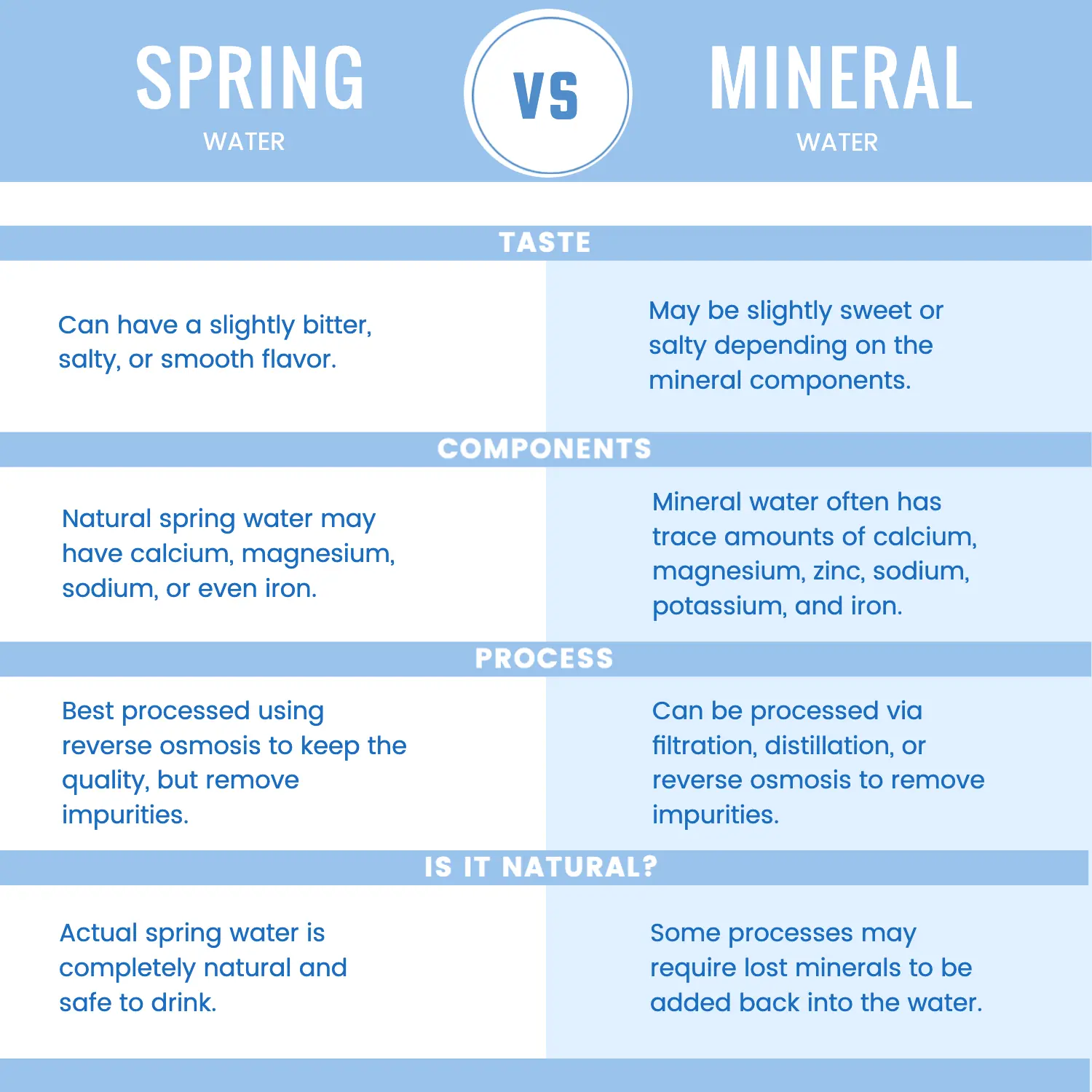
The Bottomline: Choosing the Best Water for You
Now that you know the difference between the two water type’s sources, nutrients and overall taste, you can better decide what’s the better option for your daily H2O intake. Spring water is as natural as you can go when it comes to pure drinking water, but mineral water contains trace amounts of nutrients our bodies need to function properly.
While neither type of water is considered better than the other - as both water types are generally good for your body, there’s one thing you can be sure of: staying hydrated is essential for our bodies, and we need to be sure that we’re getting the right intake of water daily. We should have proper access to clean, safe, and sterile drinking water for our daily needs!