He Knows It Isn’t Real… Or Does He? 🐒💭
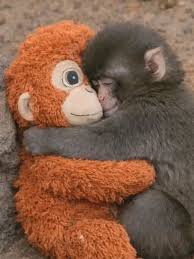
There are moments that stop us—not because they are loud or dramatic, but because they are quiet in a way that feels almost too real.
Punchy sits there, holding a small plush toy in his hands.
He doesn’t play with it the way you might expect. He doesn’t toss it aside or lose interest after a few seconds. Instead, he does something that feels… intentional. He brings the toy close. He looks at it. And then, slowly, carefully, he begins to feed it.
Again.
And again.
And again.
Each movement is gentle. Deliberate. Repeated with a kind of patience that doesn’t seem random.
And that’s when the question begins to form:
Does he know it isn’t real… or does he?
A Moment That Feels Too Familiar
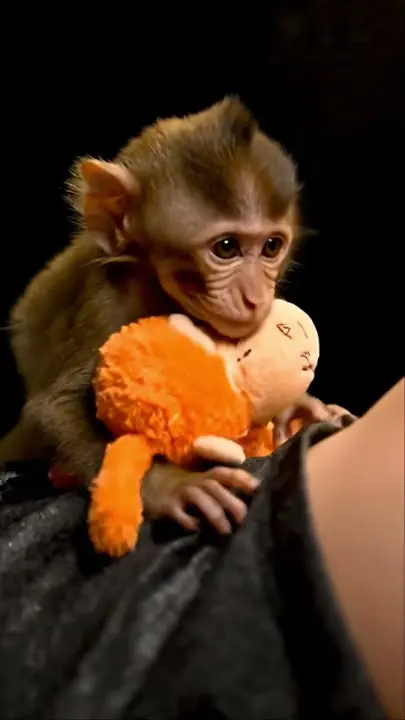
At first glance, it might seem simple—just an animal interacting with an object. But the longer you watch, the harder it becomes to dismiss.
There’s something familiar in the way Punchy behaves.
The careful handling.
The repeated action.
The quiet focus.
It doesn’t look like instinct alone. It doesn’t look like meaningless repetition.
It looks like… care.
And that’s what makes it unsettling in the most thought-provoking way.
Because care is something we recognize. It’s something deeply human—or at least, something we’ve always believed belongs mostly to us.
So when we see it reflected back in a moment like this, it challenges something fundamental:
Where does emotion begin—and who gets to have it?
Understanding vs. Feeling
We often separate the world into two categories: those who understand, and those who simply react.
Humans, we believe, understand. We assign meaning. We recognize reality. We know when something is alive—and when it is not.
Animals, on the other hand, are often seen as driven by instinct. They respond, they adapt, but they don’t “know” in the same way we do.
But Punchy complicates that narrative.
Because what he’s doing doesn’t fit neatly into either category.
If he understands the toy isn’t alive, then why treat it with such care?
And if he doesn’t understand, then why does his behavior feel so emotionally precise?
The Power of Repetition
One of the most striking aspects of Punchy’s behavior is not just what he does—but how often he does it.
Repetition is powerful. In humans, it can mean many things: habit, comfort, ritual, or even emotional need.
We repeat actions when they matter to us.
We repeat actions when they bring us peace.
We repeat actions when they help us cope.
So what does repetition mean for Punchy?
Is he practicing something he has learned?
Is he recreating a memory?
Or is he simply holding onto a feeling he doesn’t fully understand—but doesn’t want to let go of?
Objects as Emotional Anchors

Humans have a long history of forming attachments to objects.
A child clings to a favorite toy or blanket.
An adult keeps a photograph, a gift, or a personal item that holds emotional value.
We know these objects aren’t alive. We know they don’t respond. And yet, they carry meaning.
They represent comfort.
They represent memory.
They represent connection.
So when Punchy holds his plush toy and treats it with care, it forces us to ask:
Is this really so different?
Maybe the question isn’t whether the toy is real.
Maybe the question is whether the feeling is.
The Need for Connection
At the core of this moment is something universal: the need for connection.
For social animals—especially primates—connection is not optional. It’s essential.
They form bonds.
They seek companionship.
They rely on interaction for emotional stability.
When that connection is missing, something has to fill the space.
Sometimes, that “something” is an object.
Not because the object is alive—but because the need behind it is.
Are We Projecting… or Recognizing?
It’s easy to look at Punchy and assume we’re projecting our own emotions onto him.
We see care because we understand care.
We see tenderness because we’ve experienced tenderness.
But is it projection… or recognition?
Are we imagining something that isn’t there?
Or are we finally seeing something that has always been there—but often overlooked?
This is where the line between human and animal begins to blur.
Emotion Without Language
One of the biggest differences between humans and animals is language.
We explain what we feel.
We label emotions.
We analyze and describe our inner world.
Animals don’t do this—at least not in ways we fully understand.
But does the absence of language mean the absence of emotion?
Or does it simply mean emotion exists in a purer, less complicated form?
Punchy doesn’t explain what he’s doing.
He doesn’t justify it.
He doesn’t question it.
He just does it.
And in that simplicity, there is something incredibly powerful.
The Limits of Logic
We often rely on logic to define what is real and what is not.
The toy is not alive.
It doesn’t feel.
It doesn’t respond.
From a logical perspective, there is no reason for Punchy to treat it the way he does.
But emotion doesn’t always follow logic.
In fact, some of the most meaningful human experiences don’t.
We love things we can’t explain.
We miss people who are no longer there.
We hold onto memories that exist only in our minds.
So why should Punchy be any different?
A Reflection of Ourselves
What makes this moment so powerful isn’t just what Punchy is doing—it’s what it reveals about us.
We see ourselves in him.
In the way he holds on.
In the way he repeats.
In the way he gives meaning to something that, logically, has none.
It reminds us that emotion doesn’t always need a clear reason.
Sometimes, it just needs a place to exist.
The Beauty of Not Knowing
Perhaps the most honest answer to the question—“Does he know?”—is that we don’t know.
And maybe we don’t need to.
Not everything meaningful can be measured or explained.
Some things are meant to be observed.
Felt.
Reflected on.
Punchy’s actions don’t give us clear answers.
But they do give us something else:
A moment to pause.
A moment to question.
A moment to feel.
So… What Are We Really Seeing?
Are we witnessing real emotion?
Or are we projecting our own feelings onto something we don’t fully understand?
Maybe it’s both.
Maybe emotion is not as exclusive as we once believed.
Maybe it exists in more places—and in more forms—than we’re used to recognizing.
The Final Thought
Punchy feeding his plush toy may seem like a small moment.
But sometimes, the smallest moments carry the biggest questions.
About emotion.
About connection.
About what it truly means to feel.
And maybe, in the end, the question isn’t whether the toy is real.
Maybe the only thing that matters… is that the feeling might be.
💬 What do you think?
Are we seeing real emotion—or are we simply projecting our own?
Comment your thoughts below!