While stroking your cat and witnessing her contented expression, indicating her enjoyment, she abruptly seizes your hand in her mouth. What could have transpired?
Cats tend to have issues with proximity and can become overstimulated rather swiftly. If you have experienced a cat that swipes or bites during affectionate petting, you're familiar with this behavior. One moment, she's inviting attention, and the next, she's signaling for it to cease immediately. This sudden shift often arises from conflicting feelings. Many cats experience both affection and aversion to touch, and which sentiment prevails can fluctuate from one moment to the next.
To prevent being bitten during what should be a loving petting session, it's essential to understand what triggers your cat's sudden biting, interpret her body language, and learn how to pet her safely.
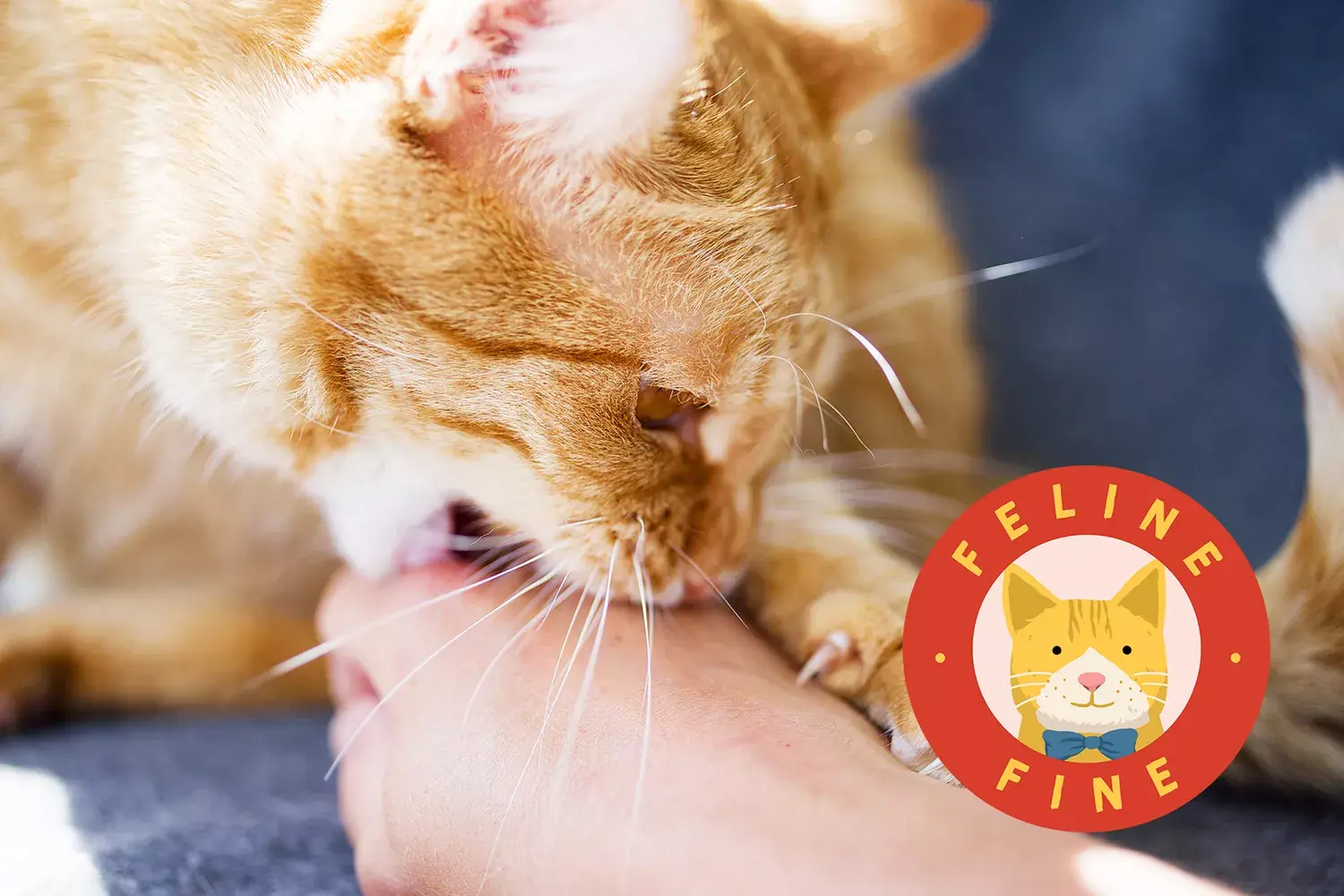
Why Do Cats Bite?
There are many reasons cats bite, from love and affection to fear and frustration. While cat bites may all hurt the same on the human end, you can pay attention to your cat's body language and other clues to let you know what caused the sudden bite—and prevent it from happening again.
Frustration
Cats, in contrast to humans, possess constrained impulse management and emotional regulation abilities, rendering them prone to becoming easily frustrated. Instances such as excessive petting can trigger frustration in cats. Nonetheless, lacking verbal communication, cats resort to expressing their emotions through body language, sometimes resorting to biting.
A cat experiencing frustration typically exhibits warning indicators such as holding its tail straight out, vocalizing, flicking its tail, or dilating its pupils. Recognizing any of these signals suggests it's advisable to allow the cat some distance.
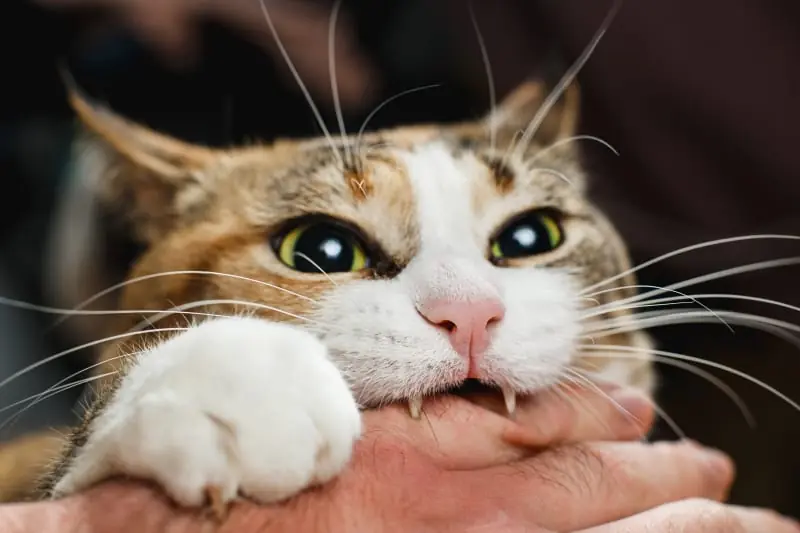
Attention
Cats might resort to biting not only to reduce attention but also to seek more attention! If your young cat bites you and then heads towards a toy or food bowl, she likely aims to engage you in play or ask for a treat. In such instances, it's advisable to deter the biting by withholding the desired response right after the biting occurs. Nonetheless, her intention is likely valid, so ensure she receives adequate playtime daily and offer enriching activities for her to engage in when you're occupied.
Playfulness
Playful kittens often engage in biting behavior as they interact, leading to occasional gentle love bites from a feline eager to enjoy some playtime. Although adorable during kittenhood, it's advisable to guide this behavior towards cat toys to prevent them from persisting in using fingers, wrists, and ankles as playthings as they mature.
Moreover, cats possess inherent hunting instincts and require outlets to channel their prey drive regularly. Inadequate playtime or insufficient enriching toys may prompt them to seek out prey-like targets within your home, often resulting in attacks directed at ankles and feet.
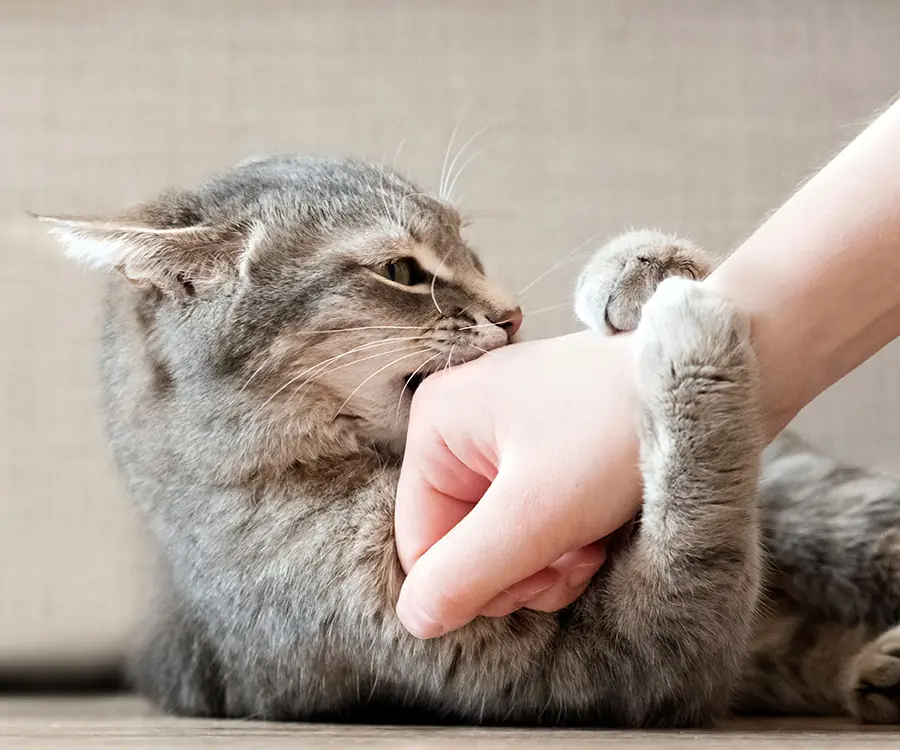
The Right Way to Pet Your Cat
We all aim to prevent getting bitten, and fortunately, there's a proper method for stroking a cat that can decrease the likelihood of being nipped. Undoubtedly, there are cats who thoroughly enjoy endless petting sessions, some who tolerate only a brief touch, and others who fall somewhere in between. It ultimately boils down to individual preferences. Interestingly enough, people exhibit similar variations. Some are highly tactile, while others prefer more distance, with countless others falling somewhere in the middle.
Before initiating contact with a cat for the first time, it's essential to proceed slowly and introduce yourself. Allow the cat to sniff your hands to assure her you pose no threat before initiating physical contact. Most cats favor gentle strokes on the head, neck, and chin, making these ideal starting points. While it's tempting to lavish cats with attention indefinitely, it's wise to limit petting, especially if you're unfamiliar with the cat, to prevent potential frustration.
Understanding your own cat's preferences entails closely observing their body language during petting sessions. Gradually experiment with longer durations of petting and different areas. While many cats prefer to avoid having their belly, legs, and tail touched, every cat is unique. You might even discover that your cat is an enthusiastic belly rub enthusiast!

How To Tell if Your Cat Is About To Bite
Because cats often suddenly bite out of frustration, it's important to learn their body language clues before a bite. Each cat has their own ways of saying, "I've had enough," or "Don't touch me there." Sometimes they just move away. Sometimes it's more subtle, like a whisper.
Some feline versions of "I've had enough" look or sound like this:
- She may vocalize (other than purring).
- Her ears may go back, sideways, or flat.
- She may start to flick or lash her tail.
- Her skin may twitch.
- Her pupils may dilate or look like slits.
- Her claws may come out.
- Her whiskers may come forward.
- Her legs or shoulders may become stiff.
- She may look at your hand.
- She may raise her paw.
If you don't heed these whispers, your cat has to shout—with a hiss, swat, or bite.
To learn your cat's signal for I've had enough, pet her gently only when you can look right at her—not when you're watching TV or talking on the phone. Watch for even the slightest change in your cat. As soon as you see it, stop petting. If you're not sure, stop petting anyway.
Remember to Respect Your Cat's Preferences
If you're unsure about interpreting your cat's body language regarding her boundaries, focus on building trust. Offer gentle pets twice, then withdraw your hands. If she chooses to remain nearby, wait a short while before petting her again twice. Leaving her wanting more demonstrates that you won't overwhelm her, leading to relaxation and the possibility of gradually increasing affection.
As you become familiar with your cat's preferences and honor them, a positive shift occurs: she becomes more receptive to affection. Recognizing that you'll cease when she indicates, she feels more secure and less conflicted about interaction. She learns that she can communicate subtly without resorting to biting and trusts you to understand.
It's vital to acknowledge that companion animals have autonomy over touch—when, where, and for how long. Respecting these boundaries is crucial for fostering trust and avoiding confrontations like biting.