Many cat owners have experienced it: no matter how many cozy beds or blankets you buy, your cat still chooses your bed. Sometimes they curl up near your feet. Other times they stretch confidently across your pillow as if they own the place.
It may seem like a simple preference for comfort. But in reality, a cat’s decision to sleep in your bed is influenced by instinct, psychology, biology, and social bonding. What looks like a small nightly habit can reveal a lot about how your cat feels — about you and about its environment.
Here are the surprising reasons behind this behavior.
1. Your Bed Is the Safest Place in the House
Cats are both predators and prey in the wild. Even though domestic cats live indoors, their instincts remain strong. When they sleep, they become vulnerable. Choosing a sleeping spot is therefore a strategic decision.
Your bed carries your scent — a familiar and reassuring signal. To your cat, that scent means:
-
Security
-
Stability
-
Territory belonging to someone trusted
Sleeping beside you reduces perceived risk. In a quiet bedroom with predictable routines, your cat feels protected.
From a behavioral standpoint, choosing your bed often indicates trust rather than dominance.

2. You Are a Source of Warmth
Cats naturally seek warmth. Their normal body temperature is higher than that of humans (around 38–39°C or 100–102°F). Warm environments help them conserve energy.
Your body emits consistent heat throughout the night. Compared to a standalone cat bed, sleeping next to you provides:
-
Stable warmth
-
Reduced energy expenditure
-
Physical comfort
This is especially appealing during colder months. Even in warmer climates, body heat combined with soft bedding creates an ideal sleeping environment.
3. Bonding and Social Attachment
Although often described as independent, cats are social animals in subtle ways. Research shows that many domestic cats form attachment bonds with their owners similar to the bonds dogs form.
Sleeping is a vulnerable state. By choosing to sleep near you, your cat demonstrates:
-
Emotional comfort
-
Social bonding
-
Positive association
Cats may not express affection in obvious ways, but proximity during sleep is one of the strongest trust signals they can give.
Some cats even synchronize sleep cycles with their humans, adjusting their patterns to align with household rhythms.
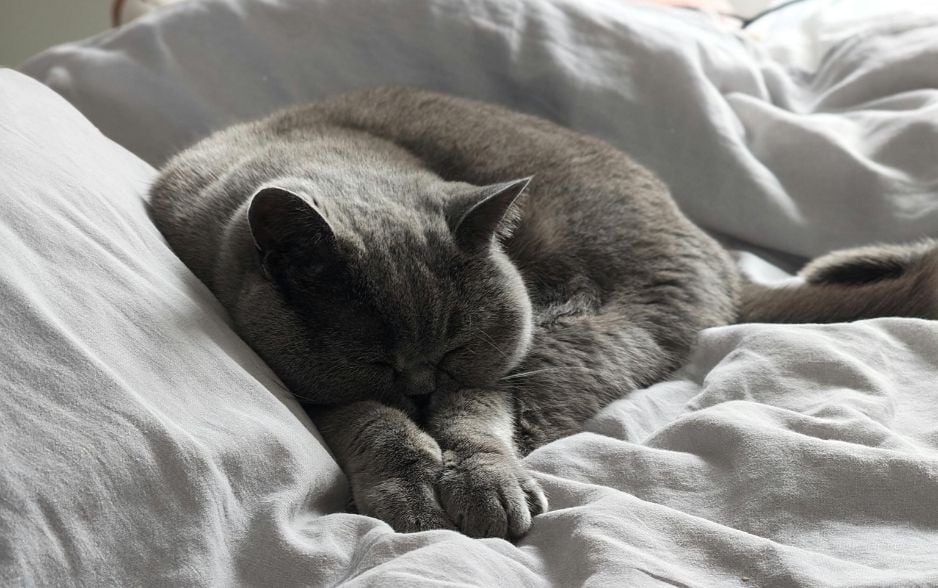
4. Scent Marking and Territory
Cats communicate heavily through scent. When your cat sleeps on your bed, it may rub its face, knead blankets, or curl tightly into your pillow. These behaviors are not random.
Cats have scent glands in their cheeks and paws. By resting on your bed, they:
-
Deposit their scent
-
Reinforce territory
-
Blend their scent with yours
This scent mixing creates a shared “colony scent,” strengthening social bonds within what the cat perceives as its group.
In simple terms: your cat is making the bed part of its safe zone.
5. Routine and Predictability
Cats thrive on routine. Your bedtime likely follows a consistent pattern — lights dim, movement slows, sounds decrease. This predictability signals that it is safe to rest.
Over time, your bed becomes associated with:
-
Calmness
-
Quiet
-
Stability
Cats are highly sensitive to environmental changes. A consistent bedtime environment becomes one of the most reliable places in the home.
6. Emotional Sensitivity
Cats are surprisingly perceptive to human emotional states. Studies suggest they can detect changes in tone, posture, and even subtle physiological cues.
If you are stressed, ill, or emotionally unsettled, some cats may choose to stay closer. While not all cats exhibit this behavior, many show increased proximity during times of change.
It is not mystical — it is pattern recognition. Your cat responds to shifts in behavior and routine.
7. Height and Visibility
Beds often provide a slightly elevated position compared to the floor. Cats prefer sleeping spots that allow them:
-
A clear view of entrances
-
Easy escape routes
-
Strategic observation
Your bed combines elevation, warmth, and security — a perfect combination from an instinctual perspective.
![Giải đáp] Tại sao mèo thích ngủ với người? Có nên ngủ với mèo?](https://bmpet.vn/wp-content/uploads/2023/03/4-khi-ngu-chung-voi-meo-se-giup-giai-toa-duoc-nhung-cam-xuc-tieu-cuc-trong-dau.jpg)
Should You Allow It?
From a health standpoint, sleeping with your cat is generally safe for most healthy adults, provided:
-
The cat is regularly groomed
-
Parasite prevention is maintained
-
Litter hygiene is consistent
However, individuals with allergies or compromised immune systems may prefer separate sleeping arrangements.
If boundaries are desired, consistency is key. Cats adapt to new sleeping spots if introduced gradually and reinforced positively.
When It Might Signal Something Else
In rare cases, increased clinginess at night may reflect:
-
Anxiety
-
Environmental changes
-
Health issues
-
Aging-related insecurity
If your cat suddenly changes sleeping habits dramatically, especially combined with other behavioral shifts, a veterinary check-up may be wise.
Final Thoughts
When your cat chooses to sleep in your bed, it is rarely random. It reflects warmth-seeking instincts, scent bonding, emotional attachment, and a desire for safety.
To your cat, your bed is not just a mattress. It is:
-
A warm surface
-
A familiar scent
-
A trusted presence
-
A predictable space
What feels like a small habit is actually a quiet expression of trust.
In a world where cats guard their vulnerability carefully, choosing to sleep beside you may be one of the clearest signs that you are part of their safe place.