This funerary practice has been used traditionally by Zoroastrians, though it has become less common in recent times. As a result, there are a number of disused towers of silence, which no doubt have an air of mystery around them.
Why Did Zoroastrians Choose this Funerary Practice?
The exposure of dead bodies to scavenging animals is recorded by the 5th century Greek writer Herodotus to have been practiced by the Persians. Therefore, it would be reasonable to date this Zoroastrian practice to this period, and quite possibly even further back in time. There is a rationale for this treatment of the dead.
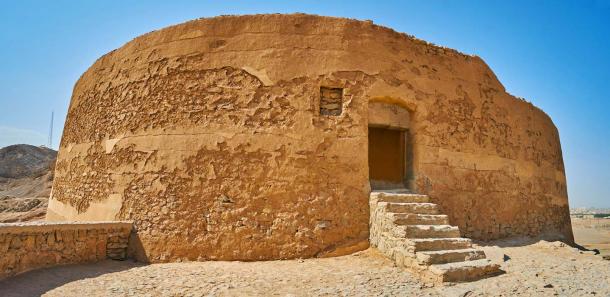
Ancient Tower of Silence (Dakhma), Yazd, Iran. (efesenko /Adobe Stock)
According to Zoroastrian belief, the four elements – fire, water, earth, and air, are sacred, and ought not to be polluted by the disposal of the dead. Cremation, for example, is believed to cause pollution to fire, air, and at times river water as well, while burial (without adequate lining of the grave) causes pollution to the earth and ground water.
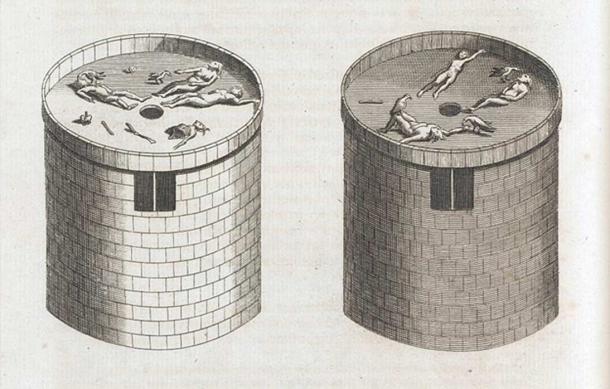
Printed drawing of 'Towers of Silence', two circular raised structures used by Zoroastrians (parsees) to dispose of the dead. (CC BY SA 4.0)
In order to avoid polluting these elements, Zoroastrians resorted to other means of disposing their dead. The most notable of these is the exposure of the dead to scavenging animals, which is the idea behind the construction of the towers of silence. Incidentally, the English term of this structure has been attributed to Robert Murphy, a translator in the service of the British colonial government in India during the early 19th century.
What Happens at the Towers of Silence?
At present, it is not entirely clear when the earliest of these structures were built. Nevertheless, the towers of silence that are in existence today may have the same or a similar construction to the ones used in the past. These towers were essentially raised platforms with three concentric circles within them. The bodies of men were arranged on the outer circle, those of women in the middle circle, and those of children in the inner circle.

Three-tiered tower of silence, in which men were placed on the outside, women in the middle, and children in the inner circle. (Public Domain)
The dead were left on the tower of silence, where their flesh would be eaten by vultures. Provided that the vultures are present in adequate numbers, the flesh may be completely stripped from the bones in less than half an hour.
After the body was stripped of its flesh, the remaining bones would be left to be dried and bleached by the sun. The stripping of the flesh and the drying of the bones are regarded as a purification process, after which the skeletal remains may be collected and deposited in an ossuary, which may be located within or nearby the tower. Alternatively, the bones may be placed in a central well, where, if the climate is dry, they would naturally disintegrate into powder.
Towers of Silence are Still Used Today
Towers of silence can be found in Iran and in India, where Parsi communities exist. In Iran, towers of silence were in use until this funerary practice was banned by the government during the 1970s. In a report from 2015, it was written that India has a Parsi population of around 61,000. Of these, 45,000 live in Mumbai. Hence, it is in this city that several towers of silence may be found.
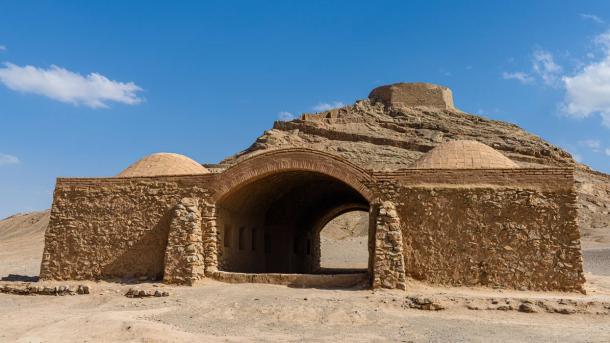
Zoroastrian Tower of Silence on a hill in Yazd, Iran. (frenk58 /Adobe Stock)
Unlike in Iran, the problem faced by the Parsi people of India is that of a depopulation of vultures. The decline in the vulture population was a result of the scavengers feeding on the carcasses of livestock that were given Diclofenac, a type of painkiller. This caused the vultures to suffer from irreversible kidney failure, causing their deaths. As a result, there were not enough vultures for the disposal of the dead.
While some in the Parsi community have decided to adopt other forms of funerary practices, such as burial or cremation, others are taking steps to maintain the tradition, for instance, by constructing aviaries, where vultures could live and breed near the towers of silence.
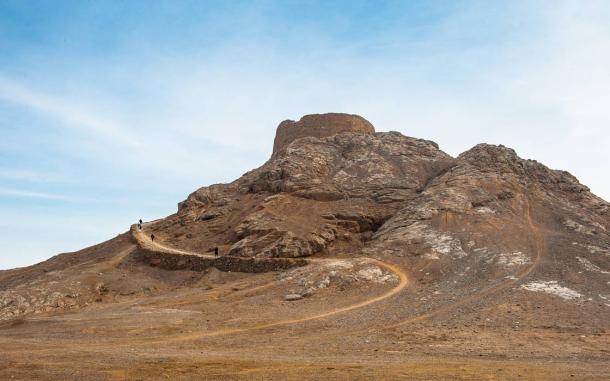
Beautiful landscape of the Zoroastrian Towers of Silence in Yazd, Iran. (siempreverde22 /Adobe Stock)
Top Image: Zoroastrians began using Towers of Silence in their funerary practices in the 5th century or perhaps even earlier. Source: efesenko /Adobe Stock