1. Why does stroke incidence increase during cold weather?
Statistics from hospitals in Vietnam show that stroke cases rise by about 15–20% during winter. Studies on circadian rhythms also indicate that strokes occur more frequently in the morning; many reports highlight that a significant proportion of stroke onset happens between 6 AM and noon. This is the period when blood pressure rises rapidly as the body shifts from rest to activity, increasing the risk of blood clot formation or vessel rupture.
In cold weather, the body releases more catecholamine hormones, causing vasoconstriction and elevated blood pressure — factors that increase stroke risk. Older adults, in particular, have difficulty adapting to temperature changes; when transitioning abruptly from a warm bed to a cold environment, blood vessels constrict and blood pressure spikes, potentially triggering a cerebrovascular accident.
Additionally, during cold weather, the number of red blood cells and platelets may increase, raising the risk of vascular blockage — especially in older individuals with atherosclerosis or high cholesterol. Cold temperatures also make people less physically active and more prone to unhealthy eating, leading to weight gain, increased fat levels, and elevated blood pressure — all of which contribute to higher stroke risk.
According to traditional medicine, stroke (trúng phong) in the elderly often arises from disharmony between the Liver and Kidney (Can – Thận) caused by improper eating, lifestyle habits, or emotional imbalance. When Liver–Kidney Yin becomes deficient, internal wind may arise; combined with winter cold obstructing meridians and blocking sensory orifices, stroke symptoms can develop.
2. Measures to prevent stroke during cold seasons
To prevent stroke in winter, individuals should adopt a healthy lifestyle:
-
Limit consumption of animal fats, salty foods, and sugary foods.
-
Avoid alcohol and reduce smoking to better control blood pressure.
-
Keep warm by wearing appropriate clothing, gloves, and socks.
-
Avoid opening doors suddenly or stepping outside abruptly when temperatures are low.
-
Reduce stress and maintain emotional balance.
-
Exercise regularly with moderate-intensity workouts.
In addition, several traditional medicine practices may be beneficial during cold weather:
2.1. Acupressure to enhance immunity
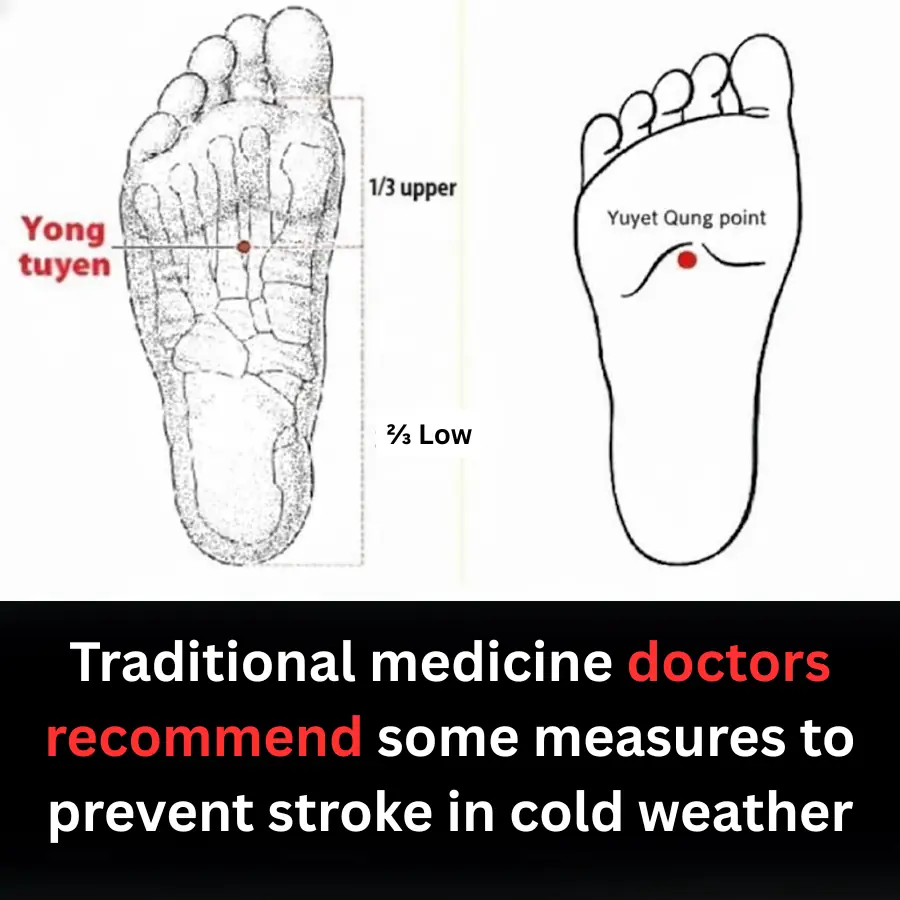
Stimulating certain acupoints helps improve blood circulation, balance internal and external energy, and strengthen resistance. Recommended acupoints include: Yongquan (Dũng Tuyền), Zusanli (Túc Tam Lý), Taixi (Thái Khê), Sanyinjiao (Tam Âm Giao), and Fengchi (Phong Trì). Massage each point clockwise about 30 times.
Locations of the acupoints:
-
Yongquan (Dũng Tuyền): Located at the junction of the anterior one-third and middle one-third of the sole of the foot.
-
Zusanli (Túc Tam Lý): Place the palm on the knee; the tip of the middle finger touches the shinbone. From that point, measure about 1 cun (approximately 2.5 cm).
-
Taixi (Thái Khê): Situated just behind the inner ankle, in the depression near the heel.
-
Sanyinjiao (Tam Âm Giao): On the inner shin, 3 cun above the inner ankle bone.
-
Fengchi (Phong Trì): Located in the depression between the sternocleidomastoid muscle and the trapezius muscle at the base of the skull.
2.2. Morning warm-up exercise
Sit on your heels with knees hip-width apart. Lean forward, extend your arms on the bed, and rest your forehead lightly on the floor. Breathe deeply and enjoy full-body relaxation for 30 seconds. Repeat 10 times.
2.3. Perilla ginger tea to warm the body
Ingredients:
-
Perilla leaves: 1 small handful
-
Fresh ginger: ½ piece
-
600 ml water
-
Rock sugar: to taste
How to prepare:
-
Wash the perilla leaves and crush or slice them.
-
Wash the ginger (skin can be kept) and crush it.
-
Add perilla and ginger to a pot and boil with water for 10–20 minutes (first 5 minutes on medium-high heat).
-
Drink the tea while it is still warm.