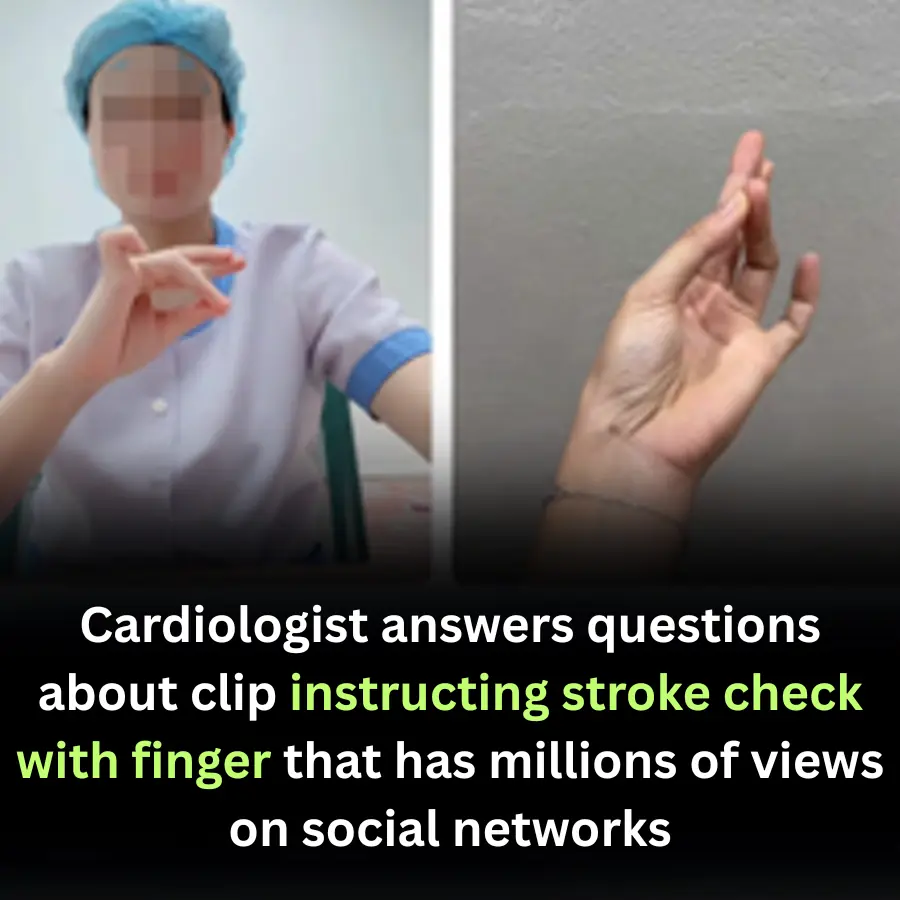
Recently, social media has circulated clips demonstrating a home test for brain health and stroke prevention by moving the little finger, attracting millions of views. Does this method have a scientific basis? A cardiologist answers questions about the accuracy of this trend.
Recently, social media has been filled with similar clips showing ways to check the brain at home to prevent stroke. These clips instruct viewers to:
-
Cross the index finger over the middle finger.
-
Touch the thumb to the ring finger.
-
Try moving the little finger up and down.
According to these clips, if the little finger can move up and down freely, the brain is functioning normally. Such videos have attracted millions of views and comments.
Regarding these at-home stroke test clips, Dr. Nguyễn Thu Huyền (Department of Internal Cardiology, 19-8 Hospital) explains that if someone already has a risk of stroke, they do not need to perform the test in the clip; observable signs such as weakness in the limbs, numbness, cramps, or reduced ability to lift a limb compared with the opposite side already indicate abnormality. You should compare the two hands or two feet to assess your own stroke risk. Comprehensive stroke screening at medical facilities includes many methods and steps — it is not as simple as a single maneuver like those shown in the clips.
At-home screening maneuvers for stroke risk
Dr. Nguyễn Thu Huyền notes that stroke cases increase in winter because blood pressure tends to fluctuate and blood vessels constrict in the cold. Besides keeping warm and managing underlying conditions, everyone can self-check a number of early warning signs at home. However, these home tests are only initial screening tools; for accurate evaluation, people should see a doctor and undergo in-depth screening with professional diagnostics.
-
Single-leg stand: a balance test related to brain health
How to perform:
Stand upright and lift one leg so that the knee is bent at a right angle to the body.
Open your eyes and try to maintain balance for 20 seconds.
If you feel dizzy, your leg trembles, or you lose balance, you should have your health checked, as this may indicate a neurological abnormality.
A study from Kyoto University (Japan) on nearly 1,400 67-year-old participants showed that people who could not stand on one leg for 20 seconds had a higher risk of cerebral small vessel disease (microbleeds): 30% of this group had two or more lesions; 15.3% had at least one lesion.
-
Testing arm strength: early detection of weakness or paralysis
Weakness or numbness in one arm is a common sign of stroke. A simple test you can do:
Raise both arms to shoulder height with palms facing up.
Close your eyes and hold the position for 2–3 minutes.
Open your eyes: if one or both arms rotate inward or drop, seek medical evaluation promptly.
-
Walking a straight line: detecting balance disorders
Dizziness, headache, and unsteady gait may signal stroke but are often overlooked. How to perform:
Create a straight line on the floor.
Walk so that the heel of the front foot touches the toes of the back foot.
Walk the length of the line and repeat if needed.
If you feel faint, have difficulty maintaining balance, or deviate significantly from the line, you should seek medical assessment.
-
Finger-touch test: assessing hand–eye coordination
Impaired coordination is a neurological red flag. How to perform (requires an assistant):
Sit facing the assistant.
Use your index finger to touch the assistant’s finger, then touch your own nose.
The assistant moves their finger while you repeat the sequence several times.
If you miss the target or cannot keep up, get a medical evaluation for accurate diagnosis.
How to detect stroke early
Stroke occurs very rapidly and can be fatal without timely emergency care. Delayed presentation to hospital increases the likelihood of severe residual deficits and places heavy burdens on patients, families, and society — including hemiplegia, speech disorders, memory loss, visual impairment, persistent vegetative state, or death. Many warning signs appear before a stroke but are often underestimated. Self-checks and observing family members can help identify abnormalities early and increase the chance of timely treatment during the “golden period” — a decisive factor for patient prognosis. Below is the BE FAST rule recommended by the American Heart Association for quick recognition of stroke signs:
B – Balance: sudden loss of balance, dizziness.
E – Eyes: blurred vision, reduced or lost vision in one or both eyes.
F – Face: facial droop or asymmetry — ask the person to smile.
A – Arm: weakness or paralysis of one arm or one side of the body.
S – Speech: slurred speech, difficulty speaking, unclear words.
T – Time: call emergency number 115 immediately.
Preventing stroke in winter
To prevent stroke during winter, Dr. Nguyễn Thu Huyền recommends six habits:
-
Keep warm appropriately by wearing hats, scarves, socks, and gloves outdoors; avoid sudden temperature changes.
-
Control underlying conditions by monitoring blood pressure daily and taking medications as prescribed for hypertension, heart disease, or diabetes.
-
Maintain a healthy lifestyle: quit smoking, limit alcohol, eat healthily with less salt and fat, and stay hydrated even in cold weather.
-
Exercise regularly: aim for 30 minutes a day, at least 5 days a week; warm up thoroughly before exercising outdoors in cold weather. Avoid bathing too late after 10 PM and do not exercise too early in the morning during winter.
-
Get enough sleep and reduce stress to help stabilize blood pressure and lower stroke risk.
-
Memorize the BE FAST signs to detect stroke quickly — call emergency services immediately and do not wait.
When should you undergo stroke screening?
Even if you are healthy, it is advisable to screen once or twice a year. High-risk groups should be checked more frequently:
-
People over 50 years old.
-
Those with hypertension, diabetes, cardiovascular disease, or overweight/obesity.
-
Individuals with a history of transient ischemic attack (TIA), carotid artery stenosis, or migraine with aura.
-
People who are physically inactive, smoke, consume alcohol, or use stimulants.