If you have ever tracked a flight on a map, you may have noticed something strange: instead of flying straight from departure to destination, airplanes often follow curved or arched paths. This raises a natural question - if the shortest distance between two points is a straight line, wouldn’t flying straight save fuel, time, and money?
The answer is more complex than it appears. In reality, airplanes already fly the most efficient routes possible. The curved paths you see are not wasteful detours but carefully calculated routes based on Earth’s shape, atmospheric conditions, safety considerations, and air traffic management. Understanding how aviation works helps explain why “straight” is not always the shortest - or smartest - way to fly.
The Myth of the Straight Line on a Flat Map
Most flight tracking maps use a flat, two-dimensional projection of Earth. On these maps, straight lines appear shorter, while curved lines seem longer. However, Earth is not flat - it is a sphere. When distances are calculated on a spherical surface, the shortest path between two points is not a straight line on a flat map.
This misunderstanding is one of the main reasons flight routes look inefficient when, in fact, they are highly optimized.
The Great Circle Route: The True Shortest Distance
What Is a Great Circle Route?
A Great Circle Route is the shortest distance between two points on the surface of a sphere. Airlines rely on these routes to minimize travel distance, fuel consumption, and flight time.
When a great circle route is projected onto a flat map, it often appears curved, especially on long-haul flights crossing continents or oceans.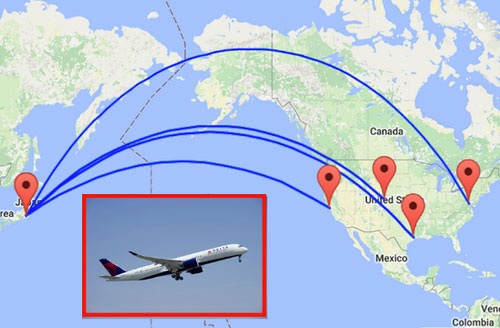
Why Flights Go Near the Poles
Earth slightly bulges at the equator due to rotation, making polar routes shorter for long-distance travel. That is why flights between North America and Asia often pass over:
-
Alaska
-
Northern Canada
-
Greenland
-
Siberia
Although this looks like a detour on a flat map, it is actually the shortest and most fuel-efficient path.
Example:
A flight from New York to Tokyo looks curved but saves hundreds of kilometers compared to an equatorial route.
Jet Streams: Nature’s High-Speed Highways
What Are Jet Streams?
Jet streams are narrow bands of extremely fast-moving air located at high altitudes. They can reach speeds of 300–400 km/h (190–250 mph) and play a crucial role in flight planning.
How Jet Streams Save Fuel
-
Flying with a jet stream reduces travel time and fuel consumption
-
Flying against a jet stream increases drag and fuel use
Airlines carefully plan routes to take advantage of tailwinds while avoiding strong headwinds. This means planes may deliberately fly a longer distance if it results in less resistance and lower fuel burn overall.
Real-World Impact
Eastbound flights across the Atlantic are often much faster than westbound flights because they ride powerful jet streams. In some cases, flights arrive over an hour earlier than scheduled.
Weather and Turbulence Avoidance
Why Weather Matters
Weather is a major factor in determining flight paths. Pilots and dispatchers constantly monitor:
-
Storm systems
-
Thunderclouds
-
Turbulence zones
-
Icing conditions
Flying straight through severe weather can be dangerous and uncomfortable, even if it appears shorter.
Why Flights Prefer Ocean Routes
Air over oceans tends to be more stable than air over land because water retains heat better. Land heats unevenly, causing rising warm air that leads to turbulence.
As a result, flight routes are often designed to:
-
Reduce turbulence
-
Improve passenger comfort
-
Minimize structural stress on the aircraft
Safety always takes priority over distance.
Airspace Restrictions and Global Traffic Control
Controlled and Restricted Airspace
Airplanes cannot fly freely anywhere in the sky. Certain airspaces are restricted due to:
-
Military activity
-
Political conflicts
-
Sensitive national borders
-
High traffic congestion
Flights must navigate around these zones, sometimes creating curved paths that appear indirect but are legally and operationally necessary.
Air Traffic Management
Busy air corridors require precise coordination to prevent collisions. Air traffic controllers assign routes and altitudes to maintain safe separation between aircraft.
This means that even if a straight path exists, it may not be available at that time.
The World’s Longest Non-Stop Flight
The current longest commercial non-stop flight operates between Singapore and Newark, New Jersey, covering more than 16,700 kilometers (10,400 miles) in approximately 18 hours and 45 minutes.
This route relies heavily on:
-
Great circle navigation
-
Jet stream optimization
-
Advanced fuel management
Without curved routing and wind optimization, such long-distance flights would be far less efficient - or impossible.
Why Do Planes Sometimes Climb Just Before Landing?
Passengers often feel anxious when a plane suddenly ascends after beginning its descent. According to aviation expert and pilot Patrick Smith, this maneuver is called a go-around and is a normal safety procedure - not an emergency.
Common Reasons for a Go-Around
-
Runway Obstruction
Another aircraft or vehicle may still be on the runway. -
Sudden Weather Changes
Poor visibility, wind shear, or unstable conditions may make landing unsafe. -
Unstable Approach
If the aircraft is not properly aligned or configured, pilots will abort the landing.
Go-arounds are trained procedures designed to ensure maximum safety.
What Happens If an Airplane Loses Cabin Pressure?
Movies often exaggerate cabin pressure loss as explosive and catastrophic. In reality, such events are extremely rare.
What Actually Happens
-
Cabin pressure loss usually occurs gradually, not explosively
-
Oxygen masks deploy automatically
-
Pilots descend to a safe altitude where oxygen is not required
Possible Passenger Effects
-
Ear discomfort
-
Mild dizziness
-
Occasional nosebleeds
Pilots and crew are extensively trained to handle these situations calmly and efficiently.
Final Thoughts: Curved Routes Are Smarter, Not Longer
Airplanes do not fly straight lines because straight lines on flat maps are misleading. Instead, they fly:
-
The shortest distance on a spherical Earth
-
Routes optimized for wind and fuel efficiency
-
Paths designed to avoid danger and turbulence
-
Courses that comply with international airspace rules
What looks curved to passengers is actually the most efficient, safest, and fastest route available.
The next time you watch a flight path arc across the globe, remember - you are already traveling the smartest way possible.